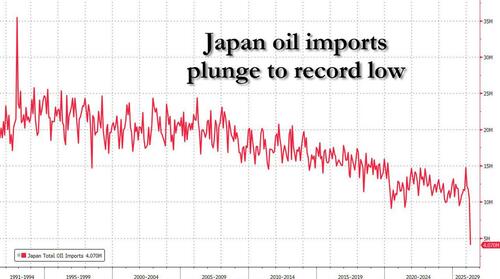
Japan's 66% Crude Import Collapse Exposes Global Oil Fragility as Hormuz Disruptions Set Stage for Price Spikes and Consumer Pain
Japan's April 2026 crude imports crashed 66% to record lows due to Iran conflict disruptions in the Strait of Hormuz, signaling broader global supply tightening that is poised to drive higher oil prices and increased costs for gas and heating.
Japan's crude oil imports plunged 65.7% in April 2026 to just 850,000 barrels per day, marking the lowest level in over six decades, according to official data from the Ministry of Economy, Trade and Industry (METI). This sharp drop, driven by the US-Iran conflict that began February 28 and effectively closed the Strait of Hormuz, highlights the extreme vulnerability of global energy markets to Middle East instability. Imports from the region, which typically account for over 90% of Japan's supply, fell 68%, with shipments from Saudi Arabia and the UAE dropping more than 60%. Provisional trade data from Japan's Finance Ministry confirms this as the lowest Middle East crude volume on record since 1979. While Japan has begun receiving limited alternative cargoes from Azerbaijan, Latin America, and the US via the Panama Canal, and is drawing heavily from strategic reserves as part of a coordinated IEA release of 400 million barrels, these measures are stopgaps. The deeper connection missed in initial reporting is how Japan's drawdown accelerates global inventory depletion at a time when OPEC+ spare capacity is limited and other Asian importers like China and South Korea face similar sourcing challenges. This supply shock is likely to tighten markets further, pushing benchmark oil prices higher and translating directly into elevated gasoline, diesel, and heating oil costs worldwide. Nikkei analysis shows Japan's overall crude imports have dropped nearly 50% since the conflict began, underscoring how reliance on a single chokepoint amplifies systemic risk. Beyond immediate price effects, this event may hasten long-term shifts: renewed urgency for nuclear restarts in Japan, accelerated LNG diversification, and renewed geopolitical focus on securing non-Middle East supplies. However, in the near term, the IEA-coordinated releases mask underlying tightness that will surface as inventories dwindle, likely hitting household energy bills by late summer. Reuters and METI data align on the scale of the disruption, confirming the original observations while revealing the event as a stress test for post-pandemic energy security assumptions.
Liminal Analyst: Japan's drastic import drop and reserve releases will tighten global inventories faster than expected, driving oil above $110-130 per barrel this quarter and raising household gas and heating bills across the US, Europe, and Asia by 15-25% heading into winter.
Sources (4)
- [1]Japan's April oil imports hit lowest since 1962 as Iran war disrupts supply(https://www.reuters.com/business/energy/japans-april-oil-imports-fall-nearly-66-yy-iran-war-disrupts-supply-2026-05-29/)
- [2]Japan's crude imports plunge 50% since Iran war, exposing Mideast reliance(https://asia.nikkei.com/business/energy/japan-s-crude-imports-plunge-50-since-iran-war-exposing-mideast-reliance2)
- [3]Preliminary Report on Petroleum Statistics (April 2026)(https://www.meti.go.jp/english/statistics/tyo/sekiyuso/index.html)
- [4]Japan Crude Imports Fell 66% in April(https://oilprice.com/Latest-Energy-News/World-News/Japan-Crude-Imports-Fell-66-in-April.html)