US Defense R&D Outpaces OECD Peers by Wide Margin Amid Record Budget Push
OECD data confirms US defense R&D spending dwarfs other OECD nations at $3.64 per $1,000 GDP; record $1.5T FY27 request and South Korea’s arms export surge add context on innovation, fiscal trade-offs, and sector impacts.
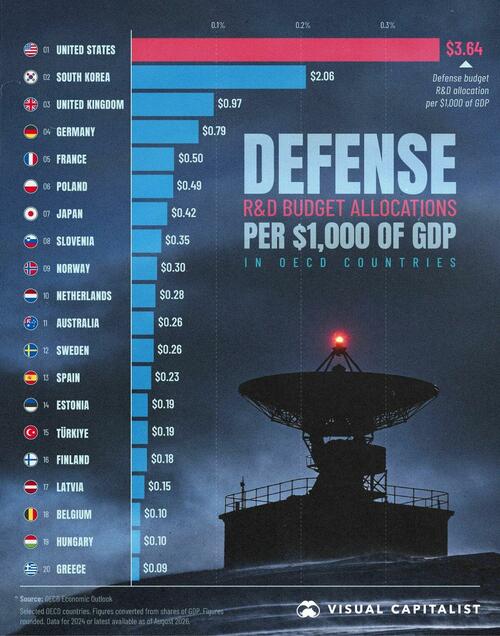
New data from the OECD Economic Outlook, Volume 2026 Issue 1, shows the United States allocating $3.64 in defense research and development per $1,000 of GDP—nearly 1.8 times South Korea’s $2.06 and more than triple the United Kingdom’s $0.97, the next highest spenders. No other OECD country exceeds $1 per $1,000 of GDP, with the group average at $0.58 and median at $0.27. Germany follows at $0.79, France at $0.50, and Greece at the bottom with $0.09.[1][2]
The figures, covering 2024 or the latest available as of August 2026, underscore America’s dominant position in funding future military capabilities, from advanced weapons to emerging technologies. In absolute terms, US military spending reached $954 billion in 2025, accounting for one-third of global totals. South Korea’s sustained investment has propelled four of its firms into the SIPRI Top 100 arms producers, with combined 2024 revenues rising 31% to $14.1 billion.[3]
The gap is poised to widen further. The Trump administration requested a record $1.5 trillion for FY2027 defense—42% above prior levels—including an increase in defense R&D from $16.6 billion to $18.7 billion. This comes as OECD analysis highlights how defense R&D can stimulate private innovation and productivity, though secrecy and resource competition may limit spillovers.[4][5]
For defense sector stakeholders, the US lead reinforces technological edges but fuels debate on resource allocation, fiscal pressures, and opportunity costs versus civilian priorities. European and Asian peers face steeper relative burdens to close gaps, while historical spin-offs in computing, aerospace, and materials illustrate potential dual-use benefits when diffusion occurs effectively.
[Defense Analyst]: Sustained US dominance in defense R&D could accelerate tech edges and contractor opportunities but intensify congressional scrutiny over priorities and long-term fiscal sustainability.
Sources (5)
- [1]Ranked: Defense R&D Spending by Country(https://www.visualcapitalist.com/defense-rd-spending-per-thousand-dollars-of-gdp-by-oecd-country/)
- [2]Defence spending – no free lunch(https://cepr.org/voxeu/columns/defence-spending-no-free-lunch)
- [3]SIPRI Top 100 arms-producing and military services companies, 2024(https://www.sipri.org/publications/2025/sipri-fact-sheets/sipri-top-100-arms-producing-and-military-services-companies-2024)
- [4]Pentagon details record $1.5 trillion budget request(https://www.washingtonpost.com/national-security/2026/04/21/pentagon-15-trillion-budget-details/)
- [5]The fiscal and economic impacts of higher defence spending(https://www.oecd.org/en/topics/sub-issues/economic-outlook/higher-defence-spending-fiscal-pressures-and-uncertain-economic-payoffs.html)