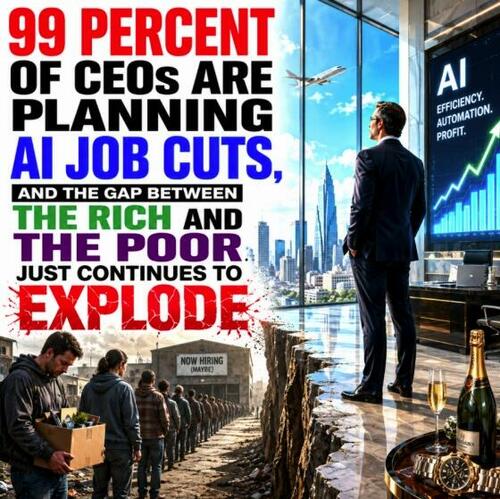
99% of CEOs Planning AI Job Cuts: Mercer's Report Exposes Corporate Strategy Fueling Inequality and White-Collar Displacement
Mercer's 2026 Global Talent Trends report shows near-universal CEO plans for AI headcount reductions amid low confidence in human-AI integration, exemplified by Meta's large-scale cuts. This signals accelerating white-collar displacement, rising worker anxiety, and unaddressed risks of widening economic inequality as automation prioritizes efficiency over equitable transitions.
A sweeping new survey from Mercer reveals that 99% of C-suite executives expect AI initiatives to drive headcount reductions within the next two years, with 98% simultaneously planning major organizational redesigns. Only 32% of these leaders believe their organizations can optimally integrate human workers with AI systems, despite 63% viewing work redesign around automation as the highest-ROI opportunity. This gap between ambition and readiness signals not just efficiency gains but a fundamental devaluation of human labor across industries.[1][2]
The findings, drawn from over 12,000 respondents including 825 C-suite leaders, align with real-world actions. Meta is eliminating approximately 8,000 roles globally—including nearly 1,400 positions in Washington state—explicitly to redirect resources toward AI infrastructure, with engineering and product teams hit hardest. CEO Mark Zuckerberg has framed this as running a 'leaner' company amid massive GPU and data center investments. Similar patterns appear at other firms, contributing to what some describe as an emerging white-collar purge.[3][4]
While Mercer emphasizes redeployment and reskilling—with 65% of executives anticipating 11-30% of their workforce shifting roles due to AI—employee anxiety is rising sharply. Concern over AI-driven job loss jumped from 28% in 2024 to 40% in 2026, alongside fears of skill obsolescence. Workforce 'thriving' metrics have plummeted to 44%, lower than pandemic levels. This disconnect highlights a critical failure: corporations are optimizing for machine efficiency while underinvesting in the human transition.[1]
Deeper analysis reveals connections to accelerating inequality ignored in mainstream coverage. As AI reduces the economic value of routine cognitive work—particularly entry-level and mid-tier white-collar roles—returns accrue disproportionately to capital owners, shareholders, and tech executives. Historical automation waves primarily impacted manufacturing; this one targets knowledge workers with student debt and fewer transferable skills. Complementary surveys, such as those from CFOs, project meaningful AI-related cuts, though aggregate numbers remain debated. Reports from BCG and PwC suggest AI will reshape more jobs than it eliminates outright, yet the Mercer data shows executives prioritizing cuts over thoughtful hybridization.[5][6]
The implications extend beyond individual layoffs. Younger workers face a labor market where entry barriers rise as AI handles baseline tasks, potentially entrenching wealth gaps. Without aggressive, employer-led reskilling at scale—and with leaders underestimating the emotional toll—societal strain could manifest as reduced consumer spending, political instability, or backlash against data centers and AI infrastructure. Mercer's investors appear more optimistic, with 72% believing human-AI integration creates competitive advantage, yet execution lags.
This isn't speculative futurism; it's a coordinated corporate roadmap already in motion. The 'human-machine equation' remains unsolved, and current trajectories favor elite capture of productivity gains over broad-based prosperity. Addressing it requires more than incremental training programs—it demands rethinking whether endless labor displacement serves society or merely concentrates power.
LIMINAL: Near-universal CEO plans for AI cuts, paired with poor readiness for human integration, will rapidly concentrate wealth among capital holders while displacing younger white-collar workers, risking deeper societal divides and anti-tech backlash unless reskilling matches the pace of automation.
Sources (5)
- [1]Mercer’s Global Talent Trends 2026 Report(https://www.mercer.com/about/newsroom/mercer-s-global-talent-trends-2026-report/)
- [2]99% of CEOs Expect AI-Driven Layoffs in the Next Two Years(https://gizmodo.com/99-of-ceos-expect-ai-driven-layoffs-in-the-next-two-years-2000762994)
- [3]Meta cuts nearly 1,400 jobs in Seattle area in sweeping AI revamp(https://www.geekwire.com/2026/meta-cuts-nearly-1400-jobs-in-washington-state-20-of-local-workforce-in-sweeping-ai-revamp/)
- [4]CFOs admit privately that AI layoffs will be 9x higher this year(https://fortune.com/2026/03/24/cfo-survey-ai-job-cuts-productivity-paradox-2026/)
- [5]99% of CEOs are planning AI layoffs in the next 2 years(https://finance.yahoo.com/sectors/technology/articles/99-ceos-planning-ai-layoffs-110000014.html)