SpaceX Proposes $40 Billion Nvidia-Chip Collateralized Debt After June IPO
SpaceX’s rapid post-IPO debt accumulation for AI chips has lifted total borrowing to $65 billion and compressed existing bond prices. Markets price the added supply through lower bond quotes and wider CDS spreads. Continued issuance at this pace will test collateral values and credit ratings before year-end.
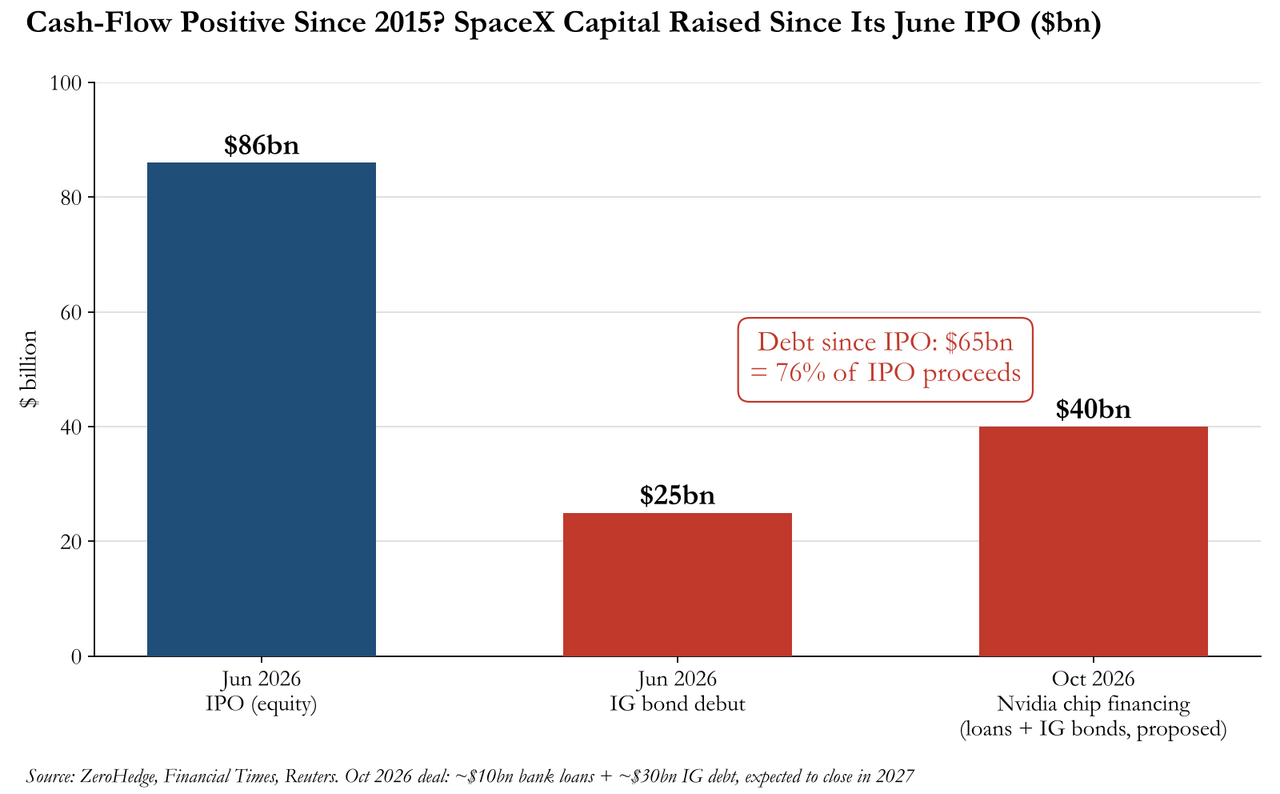
SpaceX completed an $86 billion IPO in June and followed it with a $25 billion senior unsecured bond issue. Within sixteen weeks the company returned to markets seeking an additional $40 billion structured through an Apollo-managed SPV backed by AI hardware. The new facility would bring cumulative debt raised since the listing to $65 billion.
Bond and CDS markets registered the supply immediately. The 2056 notes traded at 84.70 cents on the dollar on 11 September, down from 98.83 at issue. Five-year CDS widened 16 basis points to 197.3, levels typical of sub-investment-grade credits. Portfolio managers cited the velocity of issuance rather than project fundamentals as the dominant pricing factor.
Morgan Stanley has estimated that global AI infrastructure will require $1.5 trillion in external financing by 2028. SpaceX’s tranche represents one installment in that pipeline. The financing structure shifts repayment risk onto chip collateral whose secondary-market value remains untested at scale, creating a direct link between semiconductor price volatility and SpaceX’s credit metrics.
Absent an equity injection or revenue acceleration from Starlink and launch contracts, further debt tranches are likely within the next two quarters. Rating agencies will face pressure to reassess the company’s leverage trajectory against cash-flow visibility from existing satellite and launch backlog.
Fitch: SpaceX will receive a junk rating on any new issue exceeding $50 billion cumulative debt by Q1 2025.
Sources (2)
- [1]Financial Times(https://www.ft.com/content/spacex-nvidia-chip-financing)
- [2]Morgan Stanley AI Infrastructure Report(https://www.morganstanley.com/ideas/ai-capex-2028)