Russian diesel exports doubled after Trump’s sanctions waiver, but no cargo has reached the United States
After a Trump-Putin diesel arrangement and a Treasury license, Russian diesel exports roughly doubled in October 2026 but stayed far below normal, went mainly to Brazil and Turkey, and never reached a U.S. port amid statutory and political opposition.
Documented: On 9 October 2026, after a call with Vladimir Putin, President Donald Trump said Russia would supply diesel “to the American and Global Marketplace.” The Treasury then issued a general license authorizing sale, delivery, and importation of Russian diesel, including into the United States, through 7 April 2027. Russia partially lifted its own diesel export ban the same period. Trump’s stated volumes were about 300,000 metric tons immediately, 500,000 tons in November, and 1 million tons thereafter.
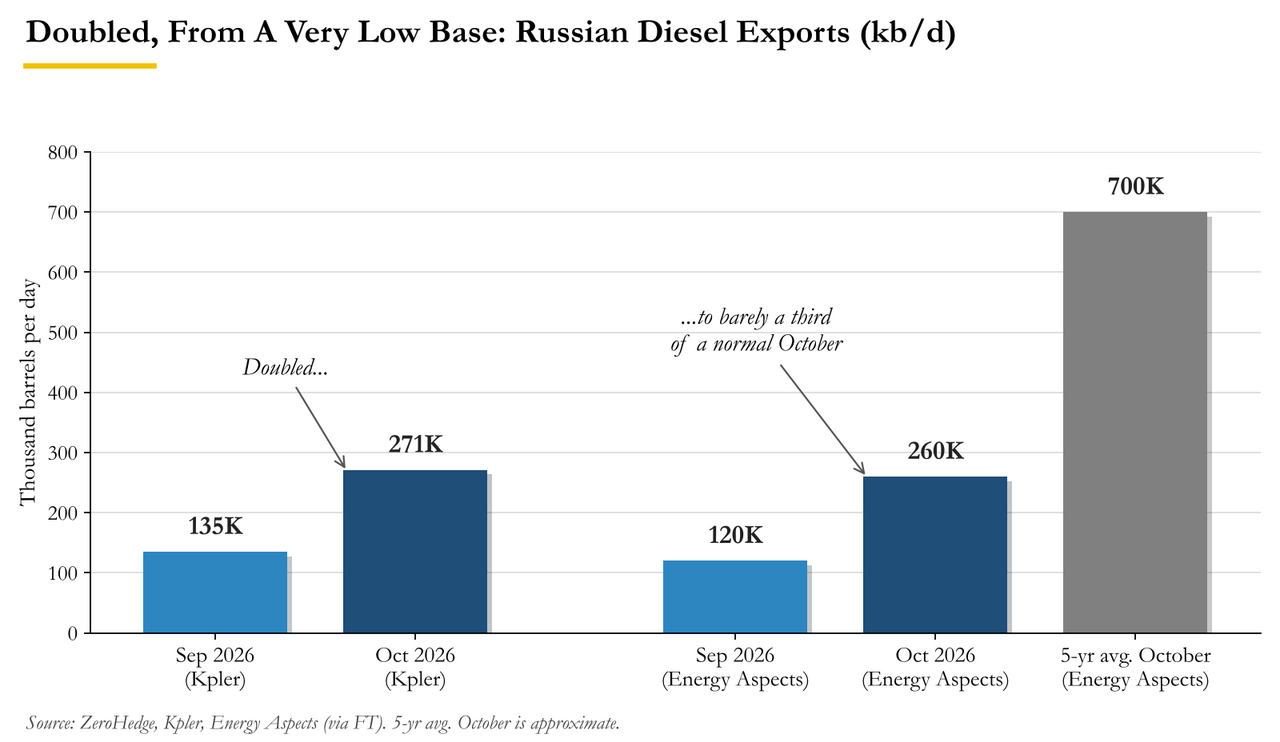
Documented, not a U.S. delivery: Commodity trackers and the International Energy Agency show Russian diesel and gasoil loadings rebounded in October. The Financial Times, citing Kpler, reported average diesel exports of about 271,000 barrels a day in October, roughly double September’s 135,000. Energy Aspects’ Richard Bronze told the FT his firm’s figures were similar—about 120,000 b/d in September to 260,000 in October—against a five-year October average near 700,000 b/d. Reuters, citing the IEA and Kpler, reported gasoil shipments roughly doubling to about 270,000 b/d, with October diesel and gasoil loadings of about 1.13 million metric tons, including cargoes for Turkey and Brazil, and stated that no diesel cargo from Russia had reached the United States. Early Reuters shipping data already showed tankers such as Leruo and Dolunay signaling Brazil and Turkey after the ban was lifted.
Documented friction on the U.S. leg: Vessel tracking and congressional pressure explain the gap between the license and American ports. Maritime Executive reported that the Malta-flagged Agioi Fanendes loaded about 40,000 tonnes of ultra-low sulfur diesel at Primorsk and had been signaling New York, then held off the East Coast “for orders.” Senator Richard Blumenthal warned the Greek owner that discharging the cargo could violate the 2022 statutory ban on Russian energy imports, arguing a Treasury license cannot override a statute passed by Congress. New Jersey Governor Mikie Sherrill told port and terminal operators she would try to keep such tankers from berthing. Other tankers linked to the trade, including Leruo and Talisman, diverted away from U.S. ports. Energy Secretary Chris Wright has said the stranded cargo would likely go to a buyer abroad. A White House official told the FT the arrangement was “a deal for the world,” meant to add diesel to the global market and thereby lower prices for Americans—an indirect-substitution argument, not a claim that Russian barrels had landed in U.S. tanks.
Claimed versus measured: The administration’s claim is that extra Russian barrels anywhere ease the U.S. diesel market because diesel is globally traded. What is documented is a partial recovery of Russian exports from a depressed base, redirected mainly to Brazil, Turkey, and other non-U.S. buyers, while U.S. buyers and port authorities treated the cargo as legally radioactive. Analysts at Energy Aspects, the OSW Centre for Eastern Studies, the Atlantic Council, and EPRINC have separately argued that the announced volumes are small relative to U.S. diesel demand (on the order of four million barrels a day) and to the global distillate shortfall, and that Russian export capacity remains constrained by refinery damage. EPRINC, using Kpler, estimated exportable Russian diesel near 240,000 b/d in October 2026 after domestic demand, with a large share of refining capacity idle.
The arbitrage the numbers actually show is narrower than a sanctions windfall narrative. Moscow regained a legal channel and a month of higher seaborne diesel sales—revenue that AP and European analysts have described as politically useful even if commercially modest—without having to place a barrel in a U.S. harbor. Washington obtained a talking point about global supply and a license that domestic lawmakers and state officials have so far blocked at the waterline. Whether U.S. pump prices moved because of that channel is not established by the export data; the volumes that did move went elsewhere, and even the doubled October rate remained well below a normal Russian October.
U.S. diesel buyers and refiners did not receive the Russian barrels the White House said would ease American fuel costs, while Russian exporters regained a legal outlet to other markets under a sanctions waiver that Congress and some state officials are treating as unenforceable at U.S. ports.
Sources (7)
- [1]Trump lifts sanctions on Russian diesel, suggests US may buy amid surging fuel prices(https://www.politico.com/news/2026/10/09/trump-diesel-sanctions-lifted-russia-01114977)
- [2]Russian fuel exports, oil output rebounded in October after deal with Trump, IEA says(https://www.reuters.com/business/energy/russian-fuel-exports-oil-output-rebounded-october-after-deal-with-trump-iea-says-2026-11-13/)
- [3]Russian diesel returns to Turkey, Brazil after export ban lifted, shipping data shows(https://www.reuters.com/business/energy/russian-diesel-returns-familiar-destinations-following-export-ban-lift-shipping-2026-10-20/)
- [4]Tanker Linked to Trump's Russian Diesel Waiver Pauses off U.S. East Coast(https://maritime-executive.com/article/tanker-linked-to-trump-s-russian-diesel-waiver-pauses-off-u-s-east-coast)
- [5]Trump–Putin agreement on diesel supplies(https://www.osw.waw.pl/en/publikacje/analyses/2026-10-12/trump-putin-agreement-diesel-supplies)
- [6]Russia Diesel for America: A Deal on Paper(https://eprinc.org/russia-diesel-for-america-a-deal-on-paper/)
- [7]The US-Russia diesel deal and Trump's attacks on Zelenskyy give the Kremlin a boost(https://apnews.com/article/russia-putin-trump-diesel-zelenskyy-ukraine-war-d99a9aed32baeef7b7a0fcaec084509c)