Iran’s Security Chief Rules Out Sending Any Enriched Uranium Abroad as Hormuz Incidents Steady Oil
Iran’s security chief publicly refused to let any enriched uranium leave the country, denied U.S. talks, and tied Hormuz’s reopening to seven unmet conditions, while fresh shipping incidents lifted oil off a two-month low. The 60 percent stockpile’s fate remains unverified.
Documented: On November 11, 2026, Mohsen Rezaei, secretary of Iran’s Supreme National Security Council, told Lebanon’s Al Mayadeen that Tehran would not allow even a single particle of enriched nuclear material to leave the country. Reuters, Radio Free Europe/Radio Liberty, and Iran’s IRNA all carried the remarks. Rezaei said Russia had been told the material would stay in Iran and be used domestically, including, he claimed, for nuclear-powered ships and submarines. He also said there were no talks underway with Washington and dismissed reports of a recent meeting in Qatar as false and aimed at pushing oil prices down. He warned that any new U.S. strikes would be met by attacks on American bases farther away.
The refusal is not a one-day improvisation. Documented: Rezaei said the same thing in Moscow on November 5 after meeting Vladimir Putin, and again on October 20 while hosting Pakistan’s army chief. Reuters reported in May, citing two senior Iranian sources, that Iran’s supreme leader had issued a directive barring near-weapons-grade uranium from being sent abroad. That directive has not been published. Russia has previously offered to take Iranian uranium as part of a possible deal; Tehran is publicly declining the offer.
What is at stake is a stockpile the inspectors cannot currently see. Documented: The International Atomic Energy Agency estimated that Iran held 440.9 kilograms of uranium enriched to 60 percent when Israel and the United States struck Iranian nuclear facilities in June 2025. That level is far above civilian power-reactor needs and is treated by the agency as a short technical step from roughly 90 percent. How much of that material survived the June 2025 strikes, and later strikes after a new war began on February 28, 2026, is unverified. The IAEA has said it lacks access to confirm location or quantity. Western governments accuse Iran of seeking a weapons capability; Iran says the program is peaceful. Neither claim is settled by the November 11 interview.
The sequencing is the harder fact. Documented: Iranian officials say the Strait of Hormuz stays restricted, and nuclear talks do not start, until the United States meets seven conditions tied to a June interim understanding. Convergent public descriptions include an end to hostilities on regional fronts, including Lebanon; lifting a U.S. naval blockade; sanctions relief; release of frozen assets; and war reparations. Lists differ at the edges, and Tehran has not published a single canonical text in the reporting reviewed here. Washington’s stated position is the reverse order: nuclear issues, including the highly enriched stockpile, belong in any initial negotiation. A senior Iranian official told Reuters on November 5 that Tehran had already sent a nuclear proposal via Qatar, to be discussed only after the seven demands are met. The contents of that proposal were not disclosed. Claimed by some outlets, and not confirmed: that Iran has left open the option of diluting the uranium inside the country under supervision. An Iranian lawmaker called dilution talk media speculation. Treat dilution as unresolved, not as policy.
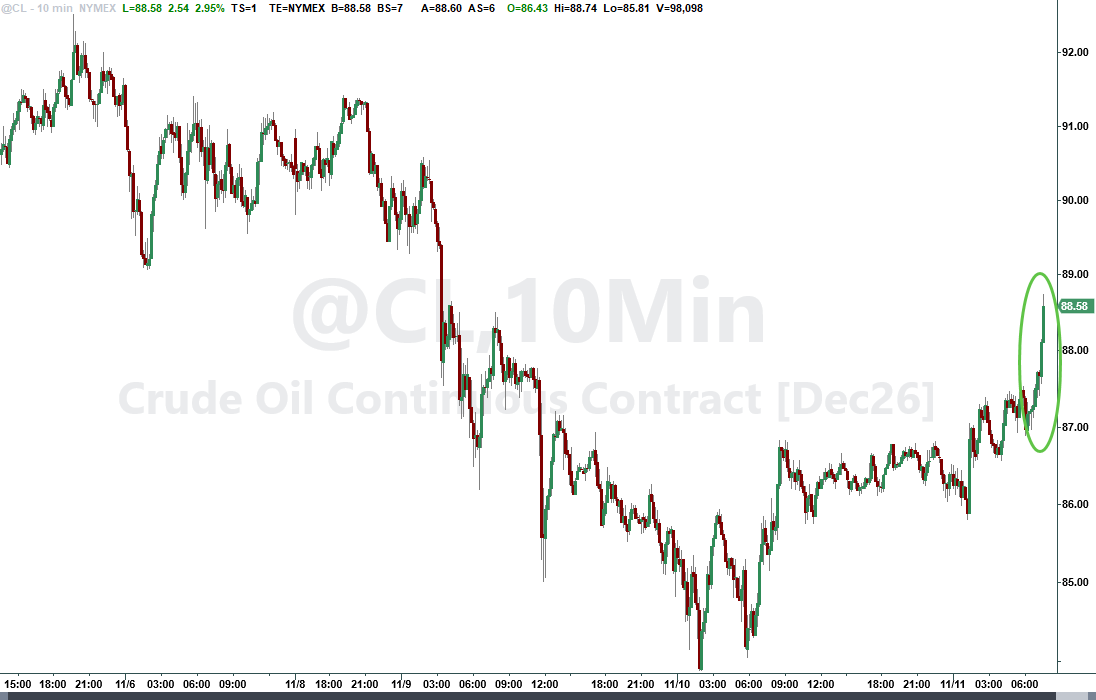
The oil market priced the public line, not the unpublished proposal. Documented: Brent had fallen to about a two-month low after U.S. officials, following Republican losses in the November 3 midterms, played down further strikes. On November 11 prices recovered as shipping incidents continued and Iranian officials denied talks. Reuters reported Brent up about 1.4 percent to $92.77 a barrel by mid-morning London time in one dispatch; later prints varied as the session moved. The mechanism is straightforward. Hormuz normally carried about a fifth of global oil and LNG trade. Since late February, Iran has treated some corridors as unauthorized and traffic has collapsed relative to the pre-war norm. The Washington Institute for Near East Policy counted 37 ships attacked in October, the highest monthly total since the war began, with further incidents logged in November.
Claimed, not independently established: that specific tankers caught fire because they struck Iranian naval mines on an “unauthorized” route. Iran’s Revolutionary Guard and army have said this repeatedly. The UK Maritime Trade Operations agency reported a tanker struck northeast of Lima, Oman, without naming an attacker or confirming a mine. U.S. Central Command has previously called Iranian mine-strike claims false and said main lanes had been cleared. Damage and disruption are documented; the precise cause of each fire is not.
The connection that matters is structural, not conspiratorial. Removal of the 60 percent material would shrink a breakout option if the stockpile still exists. Keeping it on Iranian soil preserves that option and also avoids a verification exercise Tehran has not accepted. Either way, the public red line makes a quick nuclear bargain harder. Hormuz restrictions make the delay expensive for every importer, not only for negotiators. Gulf-sourced optimism about talks has been walked back within hours by Iranian officials more than once this month; oil has moved with those walk-backs. That pattern is documented. What remains speculation is whether the refusal is a final position or a price for the seven conditions, and whether enough of the 440.9 kilograms remains intact for the argument to be about material rather than leverage.
Sources (7)
- [1]Iran will not allow enriched nuclear material to leave the country, security chief says(https://www.reuters.com/world/middle-east/iran-will-not-allow-enriched-nuclear-material-leave-country-security-chief-says-2026-11-11/)
- [2]Iranian Security Chief Insists Enriched Uranium Won't Leave Country(https://www.rferl.org/a/iran-enriched-uranium-transfer-russia-us-war/33895253.html)
- [3]Oil rises from two-month low as Hormuz shipping attacks offset Iran truce hopes(https://www.reuters.com/business/energy/oil-rises-two-month-low-hormuz-shipping-attacks-offset-iran-truce-hopes-2026-11-11/)
- [4]Iran sent nuclear proposal to the US via Qatar, senior Iranian official tells Reuters(https://www.reuters.com/world/middle-east/iran-sent-nuclear-proposal-us-via-qatar-senior-iranian-official-tells-reuters-2026-11-05/)
- [5]Putin met Iranian security council chief Rezaei in Moscow(https://www.reuters.com/world/middle-east/putin-met-iranian-security-council-chief-rezaei-moscow-2026-11-05/)
- [6]SNSC rules out transfer of enriched nuclear material abroad(https://en.irna.ir/news/86319050/SNSC-rules-out-transfer-of-enriched-nuclear-material-abroad)
- [7]Iran war live: Iran’s Rezaei rejects moving nuclear material out of country(https://www.aljazeera.com/news/liveblog/2026/11/11/iran-war-live-hegseth-survives-impeachment-bid-iran-denies-us-talks)