HSBC and Wall Street Banks Flag Rising Risks of Global Food Price Shocks in 2026-27 Amid Weather, Wars, and Supply Squeezes
Multiple credible financial and agricultural institutions corroborate warnings of tightening global grain supplies and rising food prices driven by El Niño, geopolitical conflicts, and fertilizer disruptions, with forecasts indicating potential shortfalls in 2026/27 that could impact consumers within the next 12 months.
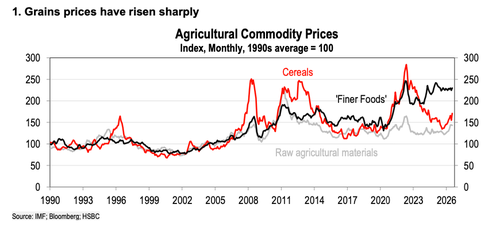
Analysts at HSBC and peer institutions are highlighting converging pressures on global agricultural markets that could drive higher food prices and volatility through 2027, with potential effects on grocery costs and availability. HSBC economist Jamie Culling's recent note, 'Food Prices Rising Due to the Weather and Wars,' points to tightening grain supplies, El Niño intensification, Black Sea disruptions from Russia-Ukraine escalation, and Middle East conflicts constraining fertilizer and energy flows via the Strait of Hormuz. Global grains production is forecast to fall below consumption in 2026/27—the first such shortfall since 2020/21 and the largest since 2006/07—leading to tighter stock-to-use ratios and lower crop yields, according to USDA projections cited in the analysis. Cereal prices (wheat, corn, barley, rice) have already risen 22% year-over-year through July, with spikes in cocoa and coffee linked to weather extremes.[1]
Broader corroboration comes from multiple institutions. The World Bank has warned that El Niño conditions, combined with Middle East disruptions, risk pushing food prices higher, particularly affecting vulnerable economies in sub-Saharan Africa.[2] JPMorgan analysts similarly project a prolonged food crisis, with potential global food inflation rising from 2.8% to 5% in the first half of 2027.[1] The International Grains Council and FAO note production declines or risks from El Niño, alongside fertilizer trade drops of 20-25% early in 2026, while the Economist highlights renewed threats to Black Sea grain exports supplying nearly a third of global wheat trade.[3][4]
These factors extend beyond immediate headlines: repeated weather shocks are shifting from transitory events to persistent inflationary pressures, as noted in Financial Times reporting on climate-linked 'food-flation,' while energy and input cost spikes from conflicts amplify farmer expenses.[5] UK harvests are already projected down significantly due to drought, illustrating localized ripple effects.[6] Stock buffers built from prior strong supplies are eroding quickly, increasing price volatility and food insecurity risks in import-dependent regions.
HSBC Commodities Team: Supply-side pressures from weather and conflict are likely to sustain elevated grain and food prices with heightened volatility through mid-2027, directly raising grocery costs in developed markets and exacerbating insecurity elsewhere.
Sources (6)
- [1]World Bank warns El Niño risks driving up global food prices(https://www.ft.com/content/ec6fc161-a202-4393-b8a2-5a84dcac7d2d)
- [2]Food crisis fears rise as speculation stokes market jitters(https://tribune.com.pk/story/2625144/food-crisis-fears-rise-as-speculation-stokes-market-jitters)
- [3]The renewed threat to global grain supplies(https://www.economist.com/europe/2026/08/24/the-renewed-threat-to-global-grain-supplies)
- [4]Global Food Supplies Ample, but Risks Growing: FAO(https://www.syngenta.ca/market-news/global-food-supplies-ample--but-risks-growing--fao)
- [5]Brace yourself for food prices to surge(https://www.telegraph.co.uk/business/2026/08/13/brace-yourself-for-another-surge-in-food-price-inflation/)
- [6]Climate change is pushing up food prices — and worrying central banks(https://www.ft.com/content/125e89c0-308a-492f-ae8e-6834847d1186)