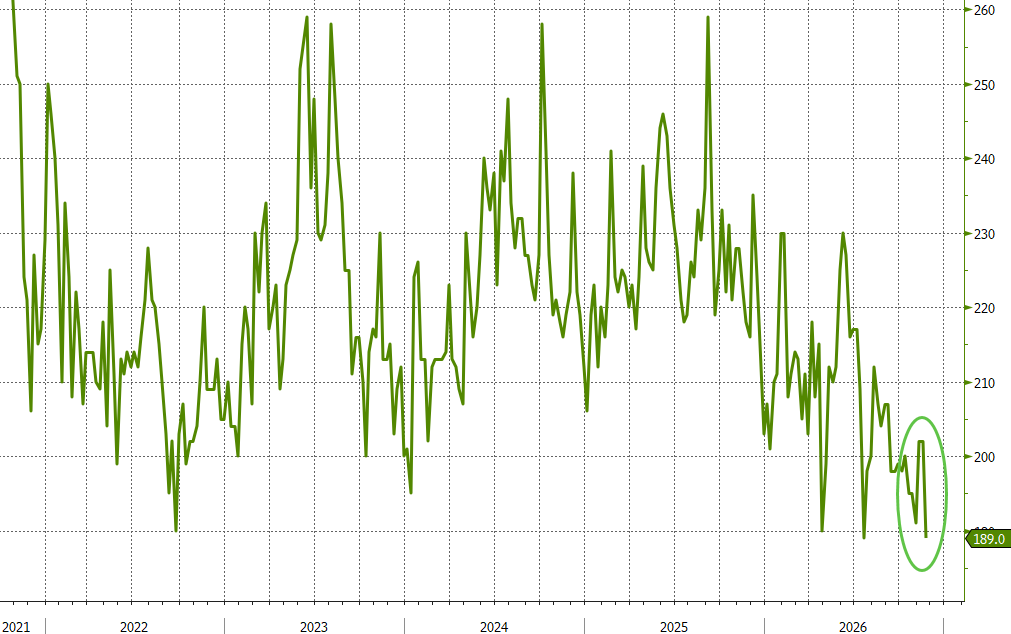
Initial jobless claims fell to 189,000, tying the year's low and a level last matched in the late 1960s
Seasonally adjusted initial jobless claims fell to 189,000 in the week ending November 21, tying the 2026 low and a level associated with the late 1960s, while continuing claims dropped and Conference Board job perceptions improved. The print documents low layoffs, not a full recovery in hiring.
Documented: The U.S. Department of Labor reported that seasonally adjusted initial claims for unemployment insurance fell by 13,000 to 189,000 in the week ending November 21, 2026. The prior week was revised down by 1,000 to 202,000. The four-week moving average declined by 1,500 to 196,000. Economists surveyed by outlets including the Wall Street Journal and FXStreet had expected about 200,000. The same 189,000 level was recorded for the week ended July 18, 2026, and again for the week ended October 31. FRED lists the November 21 figure at 189,000, sourced to the Employment and Training Administration. Trading Economics described the November reading as tying the lowest initial-claim count in nearly six decades; Reuters reporting earlier in November had already treated the July and late-October prints of 189,000 as the lowest since 1969.
Documented, continuing claims: Insured unemployment fell by 95,000 to 1,697,000 in the week ending November 14, and the insured unemployment rate fell to 1.1% from 1.2%. That series lags initial claims by one week and was revised higher for the prior week. The drop is large relative to recent weeks, but the four-week average of continuing claims was still near 1.72 million.
Documented, sentiment: The Conference Board's Consumer Confidence Index rose 11.4 points to 103.3 in November, the highest in nearly two years, according to the Board and Reuters. The labor-market differential—the share saying jobs are “plentiful” minus the share saying jobs are “hard to get”—widened by 7.6 points to +12.4. “Plentiful” rose to 30.8% from 26.2%; “hard to get” fell to 18.4% from 21.4%. Reuters noted that this differential tracks the unemployment rate and that the unemployment rate had fallen from 4.5% a year earlier to 4.1% in October, with part of that decline attributed to a smaller labor force.
Claimed, not established by these releases: That a single weekly claims print is evidence the labor market has turned from “low hire, low fire” into a healthier regime, or that young workers are no longer reluctant to quit. Initial claims measure new filings after a separation. They do not measure hiring, quits, job openings, or underemployment. The Labor Department and secondary reports also note that weekly claims are hard to seasonally adjust and remain volatile, especially around holidays; this report was released a day early because of Thanksgiving.
What the numbers do and do not show: Low initial claims are consistent with few new layoffs. They are not, by themselves, evidence that jobs are easy to find or that a recession narrative has been disproved. The same week’s data still sit inside the pattern economists have been describing as low firing with constrained hiring. Consumer perceptions of the job market improved sharply in November, which is a separate fact from payroll growth. A claims figure near a multi-decade low is real; reading it as proof that employment risk has disappeared is an interpretation the official series does not make.
People watching for layoffs get a concrete official number: new unemployment filings fell to 189,000, a very low level, while fewer people were on continuing benefits the prior week. That reduces near-term evidence of a firing wave, without showing whether hiring has actually improved.
Sources (6)
- [1]U.S. Department of Labor, Unemployment Insurance Weekly Claims Report, week ending November 21, 2026(https://www.dol.gov/newsroom/releases/eta)
- [2]Initial Claims (ICSA), FRED, Federal Reserve Bank of St. Louis(https://fred.stlouisfed.org/series/ICSA)
- [3]US Initial Jobless Claims Ties 57-Year Low, Trading Economics(https://tradingeconomics.com/united-states/jobless-claims/news/604322)
- [4]US consumer confidence jumps to highest level in nearly two years, Reuters(https://www.reuters.com/world/us/us-consumer-confidence-surges-highest-level-nearly-two-years-2026-11-24/)
- [5]U.S. Jobless Claims Sink More than Expected, Dow Jones via Morningstar(https://www.morningstar.com/news/dow-jones/202611254075/us-jobless-claims-sink-more-than-expected)
- [6]US Consumer Confidence Surged in November, The Conference Board via PR Newswire(https://www.morningstar.com/news/pr-newswire/20261124ny05512/us-consumer-confidence-surged-in-november)