U.S. Push to Ban Chinese Cars Reveals Deeper Trade Tensions and Supply Chain Risks
The U.S. push to ban Chinese cars, already present near borders via Mexico, reveals deeper trade tensions, supply chain vulnerabilities, and risks to regional alliances. Beyond market access, national security fears and consumer demand for affordability clash with protectionist policies, echoing past trade disputes and exposing gaps in domestic EV strategies.
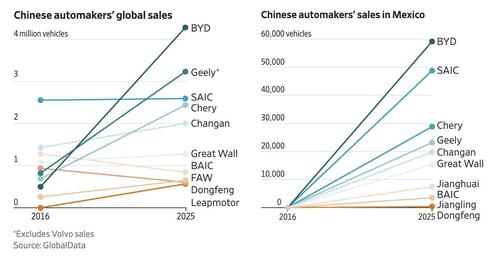
The U.S. government’s intensifying efforts to restrict Chinese-made vehicles, as reported by ZeroHedge, are not just a reaction to a potential future influx but a response to an already unfolding reality. Chinese automakers like BYD and Geely are gaining ground just across the border in Mexico, offering low-cost, feature-rich vehicles that appeal to American consumers near the border. This proximity, combined with indirect entry through partnerships and personal imports, undermines the narrative that a ban can fully shield the U.S. market. Beyond the immediate issue of market access, this situation exposes deeper geopolitical and economic fault lines: escalating trade tensions, vulnerabilities in global supply chains, and the risk of alienating key trading partners like Mexico.
ZeroHedge’s coverage, while highlighting the presence of Chinese cars near U.S. borders, misses critical context about the broader implications of these restrictions. First, it underplays the role of Mexico as a strategic hub in the North American auto industry. Under the USMCA trade agreement, Mexico is a vital partner in automotive manufacturing, with integrated supply chains that support U.S. jobs. A heavy-handed U.S. policy against Chinese vehicles risks straining this relationship, especially as Mexico balances its own economic interests by hosting Chinese firms. Second, the focus on consumer access overlooks the national security dimension driving U.S. policy—specifically, fears that Chinese electric vehicles (EVs) could embed surveillance technology or disrupt critical infrastructure, as outlined in a 2023 U.S. Department of Commerce report on connected vehicle risks.
Drawing on historical patterns, this standoff echoes past U.S.-China trade disputes, such as the solar panel tariffs of the 2010s, where protectionist measures slowed Chinese market entry but failed to fully bolster domestic industries due to global supply chain dependencies. Today, the auto sector faces similar challenges: U.S. automakers rely on Chinese-sourced components for EVs, particularly batteries, even as they lobby for bans on finished vehicles. This contradiction highlights a structural weakness—protectionism may shield domestic manufacturers temporarily but does little to address the underlying lack of self-sufficiency in critical technologies.
Moreover, the affordability of Chinese vehicles taps into a growing frustration among American consumers priced out of the domestic market, where new car prices have soared past $48,000 on average, according to Kelley Blue Book data from 2023. If Chinese EVs, often priced below $20,000, were to gain wider access, they could force U.S. manufacturers to innovate or lower costs—potentially benefiting consumers but threatening legacy automakers already struggling with EV transitions.
From the Chinese perspective, firms like BYD are not merely seeking market share but are executing a state-backed strategy to dominate global EV production, as evidenced by China’s 'Made in China 2025' industrial policy. Their expansion into Mexico and Latin America is a deliberate move to circumvent U.S. barriers, leveraging proximity and trade agreements to inch closer to the American market. This mirrors China’s broader approach in other sectors, where indirect routes—via third countries or partnerships—have often outmaneuvered direct restrictions.
U.S. policymakers, meanwhile, frame the issue through a dual lens of economic competitiveness and national security. The Biden administration’s proposed tariffs and reviews, as detailed in a February 2024 White House statement, aim to prevent data collection by Chinese firms and protect domestic jobs. Yet, this stance risks escalating into a broader trade war, potentially disrupting not just autos but semiconductors, rare earths, and other interconnected industries where China holds leverage.
What’s missing from the original coverage is the potential ripple effect on global alliances. A U.S. ban could push Mexico and other Latin American countries closer to China, reshaping regional trade dynamics at a time when the U.S. seeks to counter Beijing’s influence through initiatives like the Americas Partnership for Economic Prosperity. Additionally, the focus on cars obscures a larger question: how will the U.S. secure its supply chains for EV batteries and critical minerals, given China’s dominance in these areas? Without a coherent strategy, bans may amount to little more than symbolic gestures.
In synthesizing these perspectives, it’s clear that the U.S.-China auto dispute is a microcosm of a larger struggle over technological and economic supremacy. While ZeroHedge frames this as a market access issue, the real stakes involve supply chain resilience, consumer impacts, and the delicate balance of regional alliances. The path forward will require more than tariffs—it demands investment in domestic innovation, strategic partnerships, and a realistic assessment of global interdependencies.
MERIDIAN: The U.S. ban on Chinese cars may slow their entry but won’t halt indirect penetration via Mexico or partnerships, potentially escalating trade tensions and straining alliances like USMCA if supply chain dependencies aren’t addressed.
Sources (3)
- [1]U.S. Wants To Ban Chinese Cars, But They're Already At The Gate(https://www.zerohedge.com/markets/us-wants-ban-chinese-cars-theyre-already-here)
- [2]White House Statement on Connected Vehicle Security Risks(https://www.whitehouse.gov/briefing-room/statements-releases/2024/02/29/fact-sheet-president-biden-announces-actions-to-protect-american-workers-and-businesses-from-chinas-unfair-trade-practices/)
- [3]U.S. Department of Commerce Report on Connected Vehicle Risks(https://www.commerce.gov/news/press-releases/2023/03/commerce-department-issues-report-identifying-risks-connected-vehicles)