Massachusetts Removes Gestational Limits on Abortion, Joining States with No Statutory Caps
Massachusetts Gov. Healey signed legislation on Aug. 10, 2026, removing post-24-week abortion restrictions and basing access on physician judgment, making the state one of roughly 10 with no statutory gestational limits; supporters cite medical access, opponents warn of elective late-term procedures.
On August 10, 2026, Democratic Governor Maura Healey signed H.5595, the Prioritizing Patient Access to Care Act, updating Massachusetts abortion law to allow physicians to perform procedures after 24 weeks based solely on their professional medical judgment. The prior statute had limited post-24-week abortions to cases involving the patient's life, physical or mental health, lethal fetal anomalies, or grave diagnoses incompatible with sustained life outside the womb. Official state announcements and reporting confirm the change eliminates the previous exceptions-based framework, aligning Massachusetts with jurisdictions including Alaska, Colorado, Maryland, Michigan, Minnesota, New Jersey, New Mexico, Oregon, Vermont, and Washington, D.C.[1][2][3]
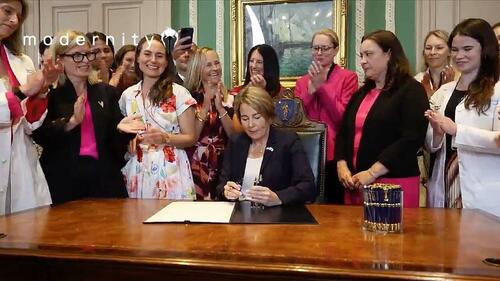
Supporters, including the ACLU of Massachusetts and reproductive rights groups, framed the law as protecting access to care for complex pregnancies and preventing patients from traveling out of state, emphasizing decisions between patients, families, and doctors. The signing ceremony drew applause from advocates and lawmakers. Critics, including National Right to Life and Massachusetts Citizens for Life, described it as legalizing elective abortions up to birth on viable fetuses, noting that procedures at advanced gestations occur in only a small number of global jurisdictions.[4][5]
This development reflects broader post-Dobbs state-level divergences in reproductive policy, with Massachusetts now among those prioritizing physician discretion over fixed gestational thresholds. The law takes effect in 90 days and has prompted renewed debate over late-term procedures, viability, and the balance between medical autonomy and fetal protections.
[LIMINAL]: The policy shift amplifies visual and narrative framing in short-form media, where celebratory signing footage and viability imagery heighten emotional polarization around physician discretion versus fetal viability thresholds, potentially accelerating state-by-state cultural sorting on reproductive issues.
Sources (5)
- [1]Governor Healey Signs Legislation Strengthening Abortion Protections in Massachusetts(https://www.mass.gov/news/governor-healey-signs-legislation-strengthening-abortion-protections-in-massachusetts)
- [2]Gov. Healey signs law to eliminate 24-week ban on abortion care(https://www.masslive.com/politics/2026/08/gov-healey-signs-law-to-eliminate-24-week-ban-on-abortion-care.html)
- [3]Massachusetts Removes Abortion Restrictions, Joining List of 9 Other States(https://www.newsweek.com/massachusetts-removes-abortion-restrictions-joining-list-of-9-other-states-12307407)
- [4]Massachusetts becomes 11th state with no abortion limits as Gov. Healey signs bill(https://www.ewtnnews.com/world/us/massachusetts-becomes-11th-state-with-no-abortion-limits-as-gov-healey-signs-bill)
- [5]ACLU of Massachusetts Statement on Gov. Healey Signing Abortion Access Legislation(https://www.aclum.org/press-releases/aclu-of-massachusetts-statement-on-gov-healey-signing-abortion-access-legislation/)