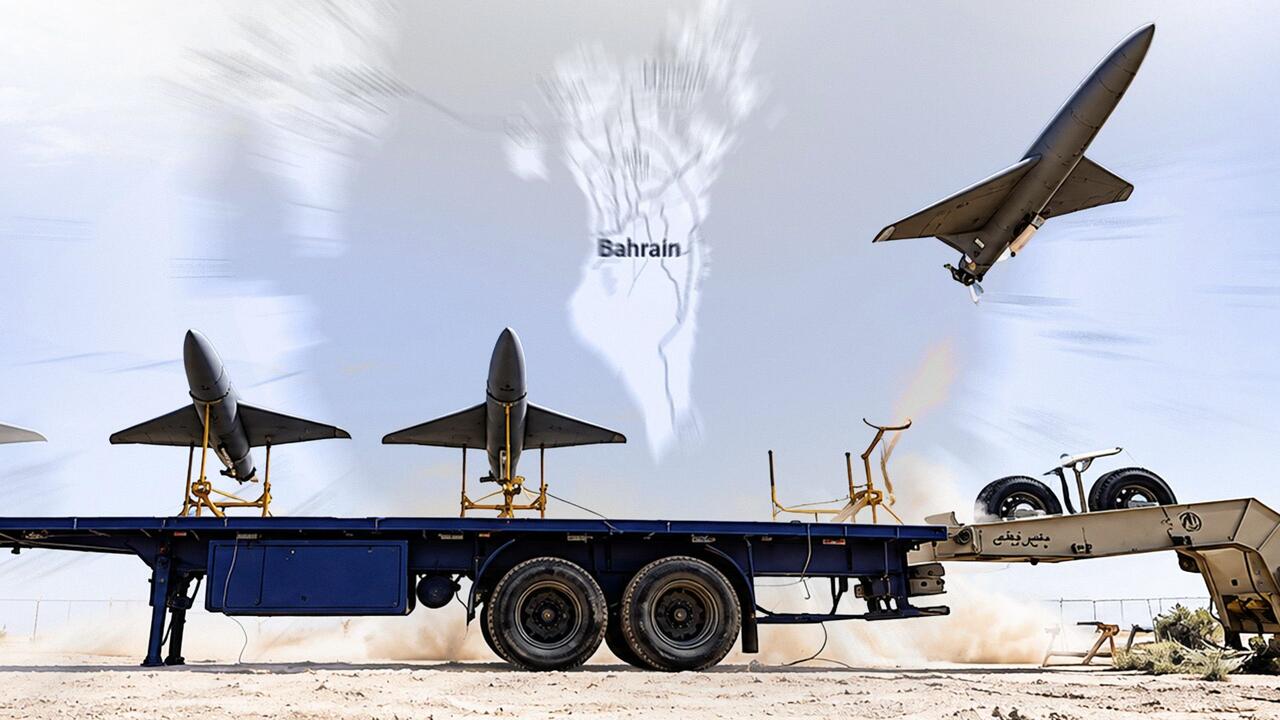
Iran claims second drone strike on US radar site in Bahrain; IRGC again declares Hormuz closed
Iran’s IRGC claimed six drones hit a US radar at Bahrain’s Riffa base and again declared Hormuz closed. Bahrain said it intercepted the drones. The strait has been severely restricted since February, not newly sealed on Sunday.
Documented: On 15 November 2026, Iran’s Islamic Revolutionary Guard Corps said its Aerospace Force launched six drones at a US air-defence radar at the Al-Riffa (also spelled Al-Rifaa) helicopter base in Bahrain, calling the strike the second phase of a response to what it described as hostile US actions. Iranian state outlets, including IRNA and Mehr, carried the statement and said the IRGC again declared that the Strait of Hormuz “is closed,” framing US escort efforts as failed oil smuggling. Bahrain’s defence force said air defences intercepted and destroyed several Iranian aerial attacks before they reached their targets, and accused Tehran of a continuing “systematic hostile approach.” The interior ministry issued two nationwide alerts—the first since September—telling residents to remain calm and move to the nearest safe location. AFP, cited by RFE/RL, reported explosions over the island around 4 a.m. local time and again around 6:30 a.m. Reuters, The Guardian, Al Jazeera, Bloomberg, and dpa all reported the competing accounts. Neither Bahrain nor the United States immediately confirmed that the radar was hit.
Documented context, not a new closure: The Sunday claim followed a Friday IRGC assertion that it had destroyed a US early-warning radar in Bahrain. US Central Command said both drones launched that day were shot down, with no injuries or damage. The wider war dates to late February 2026, when the United States and Israel struck Iran and Tehran responded against Gulf states that host US forces, Bahrain among them. Those Gulf strikes had largely paused until this week. Bahrain hosts the US Navy’s Fifth Fleet. Bahrain’s foreign ministry said it rejects being used as an arena for settling scores and holds Iran responsible for the Friday and Sunday attacks.
Claimed, not independently verified: The IRGC’s assertion of a “successful impact” on the Riffa radar. Separate IRGC Navy claims that oil tankers struck naval mines south of or in the strait in recent days. Maritime authorities have not confirmed those mine reports in the coverage reviewed here. Iranian media have also said commercial ships still transit under IRGC coordination and permits, which sits awkwardly beside a flat declaration that the waterway is closed.
What the traffic record actually shows: Trackers that use AIS and official advisories describe a strait that is neither normally open nor physically sealed. hormuz.now, drawing on AIS and citing IMF PortWatch and UKMTO material, put mid-November commercial crossings at roughly 8 percent of the pre-crisis rate and labelled the status severely restricted, on day 262 of the crisis counting from 28 February. Other tallies differ by vessel definition and by whether ships sail with transponders off, but they agree on a large, months-long drop from the pre-war baseline of well over 100 commercial transits a day. The US has said it has escorted thousands of ships through a southern corridor; Iran says the strait stays closed to hostile traffic until Washington accepts Tehran’s terms.
The wallet link is real, but it is not a sudden Sunday switch. Roughly a fifth of the world’s seaborne oil and a large share of LNG normally move through Hormuz in peacetime. That flow has already been constrained for most of 2026. A fresh exchange of strikes on a Fifth Fleet host, paired with another IRGC closure slogan, is a signal that the restricted regime is being defended, not that a new blockade began this morning. Speculated: that these drones will force a price spike within weeks, or that the strait will reopen if one more radar claim is disproved. Neither follows from what officials have documented. What is documented is a stalled diplomatic track, renewed attacks on Bahrain after a September lull, and a chokepoint that both sides still treat as a bargaining chip rather than a settled fact.
Fuel buyers and anyone whose goods depend on Gulf shipping are already living with a Hormuz that carries only a fraction of its normal traffic. A new claimed strike on the US fleet headquarters in Bahrain, and another Iranian declaration that the strait is closed, keeps that restriction in place while talks stay stuck.
Sources (6)
- [1]Bahrain intercepts Iranian aerial attacks as Tehran says it attacked US base(https://www.reuters.com/world/middle-east/bahrains-interior-ministry-issues-alerts-potential-threats-2026-11-15/)
- [2]Iran launches drone attacks against US military base in Bahrain(https://www.theguardian.com/world/2026/nov/15/iran-launches-drone-attacks-against-us-military-base-in-bahrain)
- [3]Iran says it targets US radar in Bahrain. What do we know?(https://www.aljazeera.com/news/2026/11/15/iran-says-it-targets-us-radar-in-bahrain-what-do-we-know)
- [4]Bahrain Says It Intercepted Iranian Attacks As Tehran Claims Strike On US Base(https://www.rferl.org/a/bahrain-said-its-air-defenses-intercepted-and-destroyed-several-iranian-aerial-attacks/33898951.html)
- [5]Six drones targeted US air defense radar at Bahrain helicopter base: IRGC(https://en.irna.ir/news/86321974/Six-drones-targeted-US-air-defense-radar-at-Bahrain-helicopter)
- [6]Is the Strait of Hormuz Open? Live Status(https://hormuz.now/)