America's 250-Year Transformation: Demographic Shifts, Immigration Waves, and Enduring Constants Amid Structural Change
Synthesizing Census, MPI, and Pew data confirms major shifts in urbanization, immigration (especially post-1986 Mexican inflows), and fertility alongside surname stability, linking to identity, economic, and governance debates.
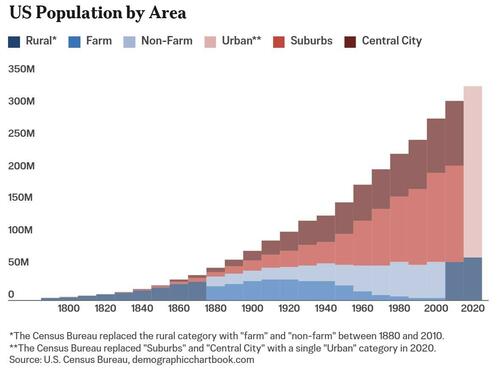
The United States has undergone profound geographic, demographic, and social transformations since its founding as 13 colonies, expanding into a nation of 50 states through purchases, treaties, and conflicts. Official data underscores a dramatic rural-to-urban transition: while roughly 95% of the population lived in rural areas in 1790, by 2020 this had fallen to around 14-20% depending on definitional metrics from the Census Bureau, with suburban growth dominating post-1950 urbanization.
Population growth has been explosive, rising over 84-fold, yet core elements persist. The Census Bureau's April 2026 analysis of surnames reveals remarkable stability, with Smith, Johnson, Williams, Brown, Jones, Miller, Davis, and Wilson ranking among the top 15 in both 1790 and 2020 censuses, even as Asian-origin names like Zhang, Liu, and Wang surged recently.
Immigration patterns have reshaped identity and composition. The foreign-born population grew from approximately 2.2 million (around 9-10% share) in 1850 to over 45-51 million (13.7-15.6%) by 2020-2024, per Migration Policy Institute tabulations of Census data. Early waves were overwhelmingly European; by recent decades, Latin America (led by Mexico) and Asia predominated. The Mexican-born population alone expanded from under 800,000 in 1970 to nearly 11.7 million by 2010, influenced by the 1986 Immigration Reform and Control Act, which studies link to shifting from seasonal to more permanent settlement.
Household and fertility dynamics evolved alongside. In 1800, the average woman bore about seven children, supported by abundant land as noted by Benjamin Franklin; total fertility rates have since plummeted to below replacement levels amid urbanization, economic shifts, and cultural changes, per historical analyses from Statista and academic reviews.
These long-term trends connect to contemporary debates: rapid demographic diversification raises questions of cultural cohesion and identity; fertility declines and aging populations strain economic growth and entitlement systems; and concentrated immigration patterns influence labor markets, housing, and governance at federal and state levels. Suburbanization has altered urban cores, while persistent surname continuity highlights underlying cultural anchors amid flux. Such structural evolutions, often overlooked in short-term news cycles, frame ongoing policy discussions on borders, family incentives, and national character.
Analyst: Persistent demographic momentum from immigration and sub-replacement fertility will intensify pressures on identity politics, fiscal sustainability of entitlements, and regional governance structures over the next decade.
Sources (5)
- [1]U.S. Census Bureau: Eight of the Nation’s Top 15 Last Names Stayed the Same Since 1790(https://www.census.gov/library/stories/2026/04/2020-census-names-data.html)
- [2]Migration Policy Institute: U.S. Immigrant Population and Share over Time, 1850-Present(https://www.migrationpolicy.org/programs/data-hub/charts/immigrant-population-over-time)
- [3]Migration Policy Institute: Mexican-Born Population in United States Over Time(https://www.migrationpolicy.org/programs/data-hub/charts/mexican-born-population-over-time)
- [4]Statista: Fertility rate in the U.S. 1800-2020(https://www.statista.com/statistics/1033027/fertility-rate-us-1800-2020/)
- [5]Carsey School of Public Policy / UNH: Growing Racial Diversity in Rural America (2020 Census)(https://carsey.unh.edu/publication/growing-racial-diversity-rural-america-results-2020-census)