Rice Price Surge Exposes Intersecting Energy, Climate, and Trade Vulnerabilities Across Asia
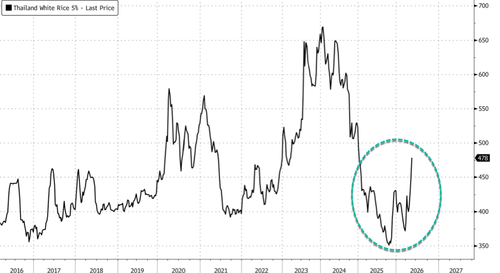
Rice price spike of 20% in May reflects simultaneous energy cost pressures from Hormuz and anticipated El Niño yield reductions, with FAO and IRRI data indicating direct transmission to consumer food costs within months via fertilizer and fuel channels.
Thailand white rice benchmark prices rose 20% in May, the sharpest monthly gain since 2008, coinciding with elevated diesel and fertilizer costs linked to Strait of Hormuz disruptions and forecasts of El Niño-driven dryness. Primary FAO Food Price Index data for May 2024 shows the cereals sub-index climbing 6.3 points month-over-month, driven by rice while wheat and maize remained relatively stable. International Rice Research Institute field reports from Thailand, Cambodia, and the Philippines document fertilizer prices up nearly 50% since late February, directly raising per-hectare input costs for smallholders who rely on diesel pumps for irrigation. NOAA ENSO outlooks issued in April 2024 assign a 70% probability of El Niño persistence through Northern Hemisphere summer, projecting reduced rainfall across the Mekong and Chao Phraya basins. Carnegie Russia Eurasia Center analysis from March 2024 notes that Hormuz-related energy shortfalls translate into higher food prices with a six-to-nine-month lag, consistent with observed fertilizer-to-harvest cycles. Philippine Department of Agriculture projections estimate potential 700,000-ton losses under strong El Niño scenarios, equating to 3.5% of targeted output. Perspectives differ on transmission speed: import-dependent nations face rapid pass-through to retail prices within one to two crop cycles, whereas subsidized producers may absorb costs longer through fiscal buffers. Primary documents from FAO and national agricultural ministries provide the underlying price and production figures rather than secondary interpretations.
MERIDIAN: Import-reliant Asian economies will register measurable retail rice price increases by late 2024, with the magnitude varying according to existing subsidy regimes and domestic stock levels rather than global benchmarks alone.
Sources (3)
- [1]FAO Food Price Index May 2024(https://www.fao.org/worldfoodsituation/foodpricesindex)
- [2]NOAA ENSO Diagnostic Discussion April 2024(https://www.cpc.ncep.noaa.gov/products/analysis_monitoring/enso_advisory)
- [3]IRRI Fertilizer Price Monitoring Report 2024(https://www.irri.org)