GRACE Satellites Show Human Irrigation Outweighs Climate in Driving Water Storage Declines Across Four Continents
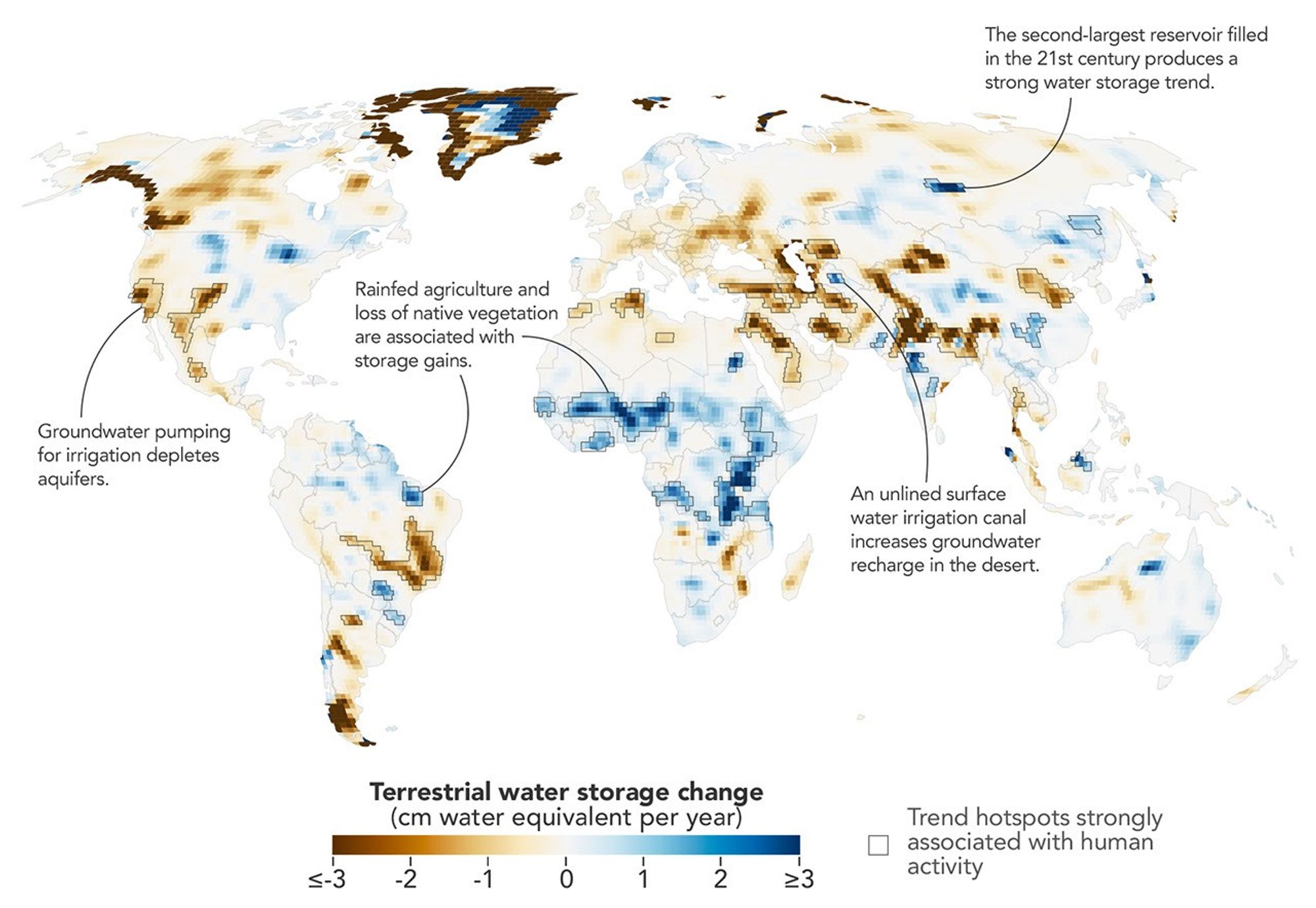
GRACE gravity data attribute stronger-than-previously-estimated water storage losses to human irrigation in four key regions. The work shows land-use conversion can also increase storage in some rainfed systems. Refined spatial resolution highlights the need for targeted management to protect aquifers under continued agricultural demand.
The NASA analysis processed monthly GRACE gravity anomalies into high-resolution trend maps at five-to-ten times previous spatial detail, isolating 40 regions where anthropogenic factors aligned with storage changes after removing climate signals. Statistical attribution showed irrigation-driven depletion strongest in northern India, where the refined trend steepened beyond earlier estimates, while rainfed cropland expansion in sub-Saharan Africa and northern Brazil correlated with unexpected storage gains despite drier conditions.
These patterns connect directly to daily human decisions: aquifer mining for wheat and rice in India and almonds in California accelerates subsidence and reduces baseflow, while savanna-to-millet conversion in Africa raises water tables through altered evapotranspiration. The findings extend prior GRACE studies by demonstrating that human water management now overrides natural variability on every nonpolar continent except Australia, amplifying risks to food production and regional water security already stressed by population growth.
Future missions with improved temporal sampling will be required to separate seasonal pumping cycles from long-term trends and to test whether policy interventions such as groundwater metering can reverse observed declines before critical thresholds are crossed.
O’Neill: GRACE-FO successor data will show northern India aquifer loss exceeding an additional 30 km³ by 2030 under current extraction rates.
Sources (2)
- [1]Primary Source(https://science.nasa.gov/earth/earth-observatory/the-human-fingerprint-on-earths-water-cycle/)
- [2]Supporting Source(https://agupubs.onlinelibrary.wiley.com/doi/10.1029/2023EF003852)