From Shadows to Statues: North Korea's Memorial Museum Normalizes Nuclear-Armed Troop Deployments in Russia's War, Signaling Enduring Anti-Western Axis
North Korea publicly opened a museum honoring troops killed aiding Russia in Ukraine/Kursk, with Kim and top Russian officials in attendance. This cements a nuclear-armed military partnership involving ~11k deployed DPRK soldiers and thousands of casualties, representing escalation in proxy conflict and mutual tech/manpower exchange under their defense pact—underappreciated as a shift toward formalized authoritarian military blocs.
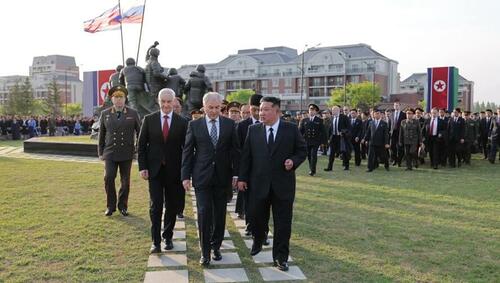
In a striking public ceremony on April 26, 2026, North Korean leader Kim Jong Un inaugurated the Memorial Museum of Combat Feats at the Overseas Military Operations in Pyongyang, attended by senior Russian officials including Defense Minister Andrei Belousov and State Duma Chairman Vyacheslav Volodin. The event, timed to the anniversary of Russian forces reclaiming territory in the Kursk border region, featured statues, balloons, military jets, and tributes to North Korean soldiers killed fighting alongside Russian troops against Ukrainian forces. Kim declared the fallen as eternal symbols of heroism binding the Korean and Russian peoples, while condemning U.S. 'hegemonic ambitions and military adventurism.' This goes beyond propaganda: it represents the overt normalization of direct combat participation by one nuclear state in another's war, a threshold crossed with surprisingly little Western outrage or strategic recalibration.
Corroborated across mainstream reporting, South Korea's National Intelligence Service estimates North Korea deployed around 10,000-11,000 troops, primarily to the Kursk offensive, suffering approximately 6,000 killed or wounded by early 2026. Earlier Western intelligence put initial casualties near 4,700-5,000, with Pyongyang rotating forces and gaining valuable modern warfare experience, including drone tactics and combined arms operations, in exchange for Russian technical upgrades. This exchange is the fruit of the 2024 mutual defense pact, which obligates mutual military assistance and has already seen North Korea supply massive quantities of artillery shells and ballistic missiles.
Mainstream outlets have covered the museum opening but often frame it as isolated pageantry rather than a fundamental geopolitical rupture. What others miss is the deeper normalization effect: two nuclear powers (Russia and North Korea) now openly operate integrated combat units on the battlefield, eroding post-WWII norms against direct foreign troop commitments in peer conflicts. This isn't mere proxy warfare; it is state-on-state military fusion between sanctioned 'pariah' regimes, testing the West's red lines while exposing limits of sanctions and isolation strategies. Putin previously vowed Russia would 'never forget' the Korean soldiers' sacrifice, and reciprocity is inevitable—potentially including Russian technical or even troop support in any future Korean Peninsula flare-up, complicating U.S. bases in the South.
The museum, complete with coffins repatriated under Kim's watch since last summer, transforms battlefield deaths into national mythology, sustaining domestic support for the deployment despite heavy losses. This alliance foreshadows a more militarized anti-hegemonic bloc, where manpower-scarce Russia leverages North Korean 'cannon fodder' and battle-hardened veterans return home with skills that could destabilize Northeast Asia. As proxy lines blur into direct multilateral engagements, the Kursk-North Korea connection reveals how nuclear deterrence increasingly enables rather than prevents conventional escalations between aligned authoritarian powers. Sources confirm the event's details, casualty trends, and strategic pact as documented facts, not speculation.
LIMINAL: This museum cements a durable Russia-North Korea combat brotherhood that will likely draw Russian support to any future Korean conflict, expanding nuclear-backed proxy fighting from Europe to Asia and forcing the West to confront integrated authoritarian warfighting it has long dismissed as impossible.
Sources (5)
- [1]Ukraine war: North Korea's Kim Jong Un reaffirms support for Russia as memorial museum opens(https://www.bbc.com/news/articles/cql7l707244o)
- [2]North Korea opens memorial for troops killed in Russia-Ukraine war(https://apnews.com/article/north-korea-russia-ukraine-memorial-museum-7c010fe1ded78fc45167c4fbab17ec92)
- [3]Kim Jong Un vows to continue support for Russia as North Korea opens memorial museum for troops killed in Ukraine war(https://www.nbcnews.com/world/north-korea/kim-jong-un-vows-continue-support-russia-north-korea-opens-memorial-mu-rcna342244)
- [4]Nearly 11,000 North Korean troops stationed in Russia's Kursk Oblast at start of 2026(https://kyivindependent.com/nearly-11-000-north-korean-troops-stationed-in-russias-kursk-oblast-at-start-of-2026-media-reports/)
- [5]North Korea opens museum for troops killed fighting for Russia(https://www.aljazeera.com/gallery/2026/4/27/north-korea-opens-museum-for-troops-killed-fighting-for-russia)