Unitree's Humanoid Sprint: Accelerating AI Embodiment and Reshaping US-China Competition, Labor Markets
Unitree's 10m/s humanoid sprint highlights China's strategic push in embodied AI, with implications for manufacturing scale, labor displacement in aging societies, and intensified US-China tech rivalry that prior coverage largely framed as spectacle rather than systemic shift.
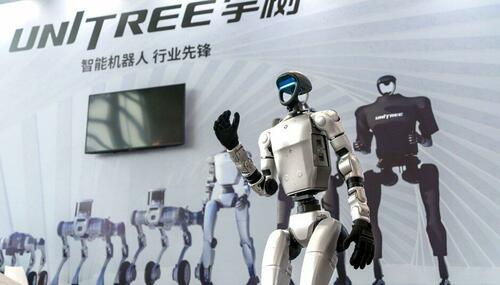
Unitree's April 2026 demonstration of its upgraded H1 humanoid achieving a sustained 10 m/s (22.4 mph) sprint with a 62 kg frame and 0.8 m leg length represents more than a viral engineering milestone. While the ZeroHedge coverage centers on the spectacle—comparing it to Usain Bolt's 27.8 mph peak and speculating about battlefield or pursuit applications—it understates the systematic convergence of hardware dexterity, sensor fusion, and large-scale AI models that Chinese developers have pursued under successive national plans. Primary documents, including China's 14th Five-Year Plan for Economic and Social Development (2021) and the Ministry of Industry and Information Technology's 2023 Robotics Industry Development Guidelines, explicitly identify high-performance bipedal systems as strategic assets for both manufacturing resilience and dual-use technologies. These texts prioritize 'embodied intelligence' far more than Western secondary commentary typically acknowledges.
What the original reporting missed is the linkage to labor economics and supply-chain reconfiguration. UBS Evidence Lab's 2025 analysis of Asian factory automation projected that cost-effective humanoids below $30,000 per unit could raise robot density in Chinese electronics and automotive plants from 400 to over 1,000 units per 10,000 workers by 2030—levels that would exceed current South Korean peaks. This acceleration builds on patterns seen in solar PV and EV battery sectors, where state-guided scaling enabled China to capture 70-80% of global production capacity within a decade. A parallel dynamic is now visible in robotics: Unitree's rapid iteration cycle, supported by domestic servo motors and vision-language models from firms like Baidu and SenseTime, compresses what once took Western labs years into months.
Synthesizing the primary Unitree technical release, the International Federation of Robotics' 2025 World Robotics Report, and an IMF staff discussion note on AI and labor markets (2024), several underreported tensions emerge. The IMF paper, drawing on occupational task data, estimates that 25-30% of manufacturing tasks in middle-income economies are highly exposed to humanoid automation—higher than prior studies focusing only on fixed-arm robots. Chinese analysts counter that an aging population (median age projected to reach 50 by 2035 per UN World Population Prospects) makes these systems a necessary offset rather than a net displacer. Western perspectives, reflected in recent U.S. House Select Committee on the Strategic Competition Between the United States and the Chinese Communist Party briefings, frame the same capabilities as a security vulnerability, citing dual-use potential and recommending tighter controls on high-end compute exports that train the underlying models.
The coverage also overstated novelty on pure speed: wheeled and quadruped platforms have long exceeded 10 m/s; the significance lies in combining sprint performance with stable bipedal locomotion, dynamic balance recovery, and forthcoming integration of multimodal AI for unstructured environments. Boston Dynamics' Atlas platform has demonstrated acrobatics but remains power-hungry and costly; Tesla's Optimus Gen 2 emphasizes manipulation over velocity. Unitree's approach—lightweight carbon-fiber composites and proprietary actuators—suggests a focus on manufacturability at scale, a pattern consistent with Beijing's 'civil-military fusion' doctrine outlined in State Council documents.
Geopolitically, this narrows the window for policy response. U.S. efforts under the CHIPS and Science Act have emphasized semiconductor sovereignty, yet lag in translating silicon advances into embodied systems at volume. European Union AI Act discussions on high-risk robotics appear reactive rather than competitive. Labor organizations in both developed and emerging markets warn of rapid displacement without commensurate retraining; yet historical data from previous automation waves (e.g., CNC machine tools in the 1980s) shows productivity gains can expand total employment if new tasks emerge quickly enough. The missing variable remains cost curves: if Unitree or its successors reach sub-$20,000 price points with >8-hour endurance, the substitution effect on global assembly lines could outpace adaptation capacity.
Multiple perspectives coexist without resolution. Chinese state media present the breakthrough as evidence of indigenous innovation overcoming export restrictions. U.S. defense analyses highlight risks of autonomous systems in contested environments. Economists diverge on net welfare: optimists forecast cheaper goods and freed human labor for care and creative sectors; skeptics cite unequal capture of gains and transitional unemployment spikes. Primary evidence—from patent filings at the China National Intellectual Property Administration showing a 340% rise in humanoid-related grants since 2020—suggests the underlying trajectory is structural, not cyclical. The Unitree sprint is therefore best understood not as an isolated record but as a visible marker of accelerating AI-automation capabilities that will test labor institutions, alliance structures, and technological containment strategies simultaneously.
MERIDIAN: Unitree's sprint signals hardware catching up to software advances in China; expect accelerated factory adoption by 2028 but also new US export controls on actuators and sensors as embodied AI becomes a defined strategic domain.
Sources (3)
- [1]China's Unitree Unveils Humanoid Robot With "Human-Like Physique" That Can Outrun Most People(https://www.zerohedge.com/technology/chinas-unitree-unveils-humanoid-robot-human-physique-can-outrun-most-people)
- [2]14th Five-Year Plan for Economic and Social Development of the People's Republic of China(http://www.gov.cn/xinwen/2021-03/13/content_5592681.htm)
- [3]IMF Staff Discussion Note: AI and Labor Markets - Friend or Foe?(https://www.imf.org/en/Publications/Staff-Discussion-Notes/Issues/2024/07/15/Gen-AI-and-Labor-Markets)