AI-Driven Workforce Reductions Signal Structural Labor Shifts, With Corporate Efficiency Goals Clashing Against Policy Responses on Inequality
Near-universal CEO plans for AI cuts reflect systemic labor market restructuring tied to inequality trends, requiring analysis beyond incremental corporate reporting.
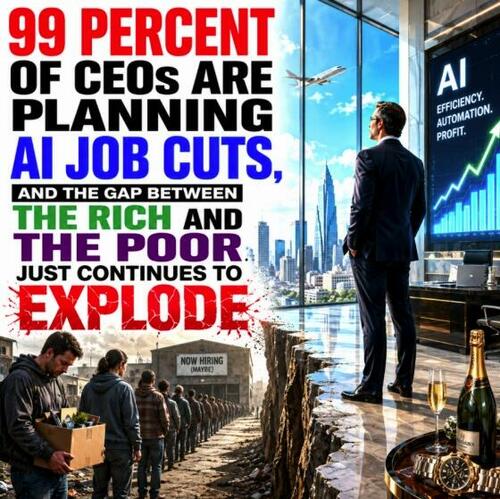
The Mercer 2026 Global Talent Trends report, drawing directly from surveys of 825 C-suite executives and 1,650 HR leaders, indicates 99% anticipate AI-linked headcount reductions within two years, alongside 98% planning organizational redesigns. This primary data underscores a near-universal corporate pivot toward automation, extending beyond the Zerohedge summary of Meta's 8,000 global cuts and Washington state filings to reveal patterns in sectors like finance and tech. Cross-referencing with the IMF's April 2024 World Economic Outlook database shows widening Gini coefficients in advanced economies correlating with automation exposure, though the IMF attributes part of the trend to pre-existing globalization rather than AI alone. A second perspective emerges from OECD employment outlooks, which document productivity gains from machine-human integration but note uneven distribution across skill levels, challenging narratives that frame reductions as purely incremental. Mainstream accounts often overlook how CEO incentives, tied to short-term ROI metrics, accelerate displacement in white-collar roles without corresponding reskilling mandates in national policies. Primary filings from companies like Meta highlight engineering team consolidations favoring GPU investments, yet government statistical agencies such as the U.S. Bureau of Labor Statistics provide no direct causal tracking of AI versus cyclical factors. Multiple angles include efficiency-driven capital allocation versus risks of demand contraction from displaced workers, with no single source establishing definitive long-term inequality causation.
[MERIDIAN]: National labor policies will increasingly reference primary automation surveys like Mercer's to balance corporate redesign incentives with inequality mitigation frameworks.
Sources (3)
- [1]Mercer 2026 Global Talent Trends Report(https://www.mercer.com/insights/total-rewards/global-talent-trends/)
- [2]IMF World Economic Outlook April 2024(https://www.imf.org/en/Publications/WEO)
- [3]OECD Employment Outlook 2024(https://www.oecd.org/en/publications/oecd-employment-outlook-2024_1686c758-en.html)