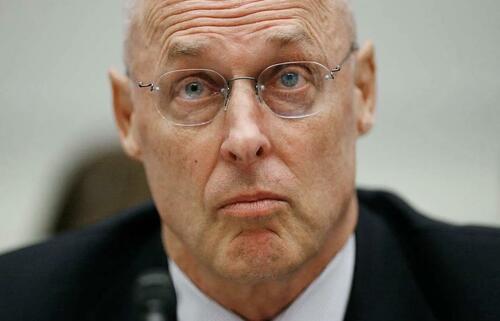
Paulson's 'Vicious' Warning: Systemic Cracks in the $39 Trillion Treasury Market Signal Liquidity Crisis Risks
Henry Paulson's recent Bloomberg warnings about a potential 'vicious' collapse in Treasury demand amid $39T U.S. debt expose underappreciated systemic risks. Mainstream views downplay acute liquidity threats, basis trade vulnerabilities, foreign demand shifts, and global collateral impacts that could force Fed intervention and trigger cascading crises.
Former Treasury Secretary Henry Paulson, who navigated the 2008 financial crisis, has issued a stark alert: the U.S. sovereign debt burden, now approaching $39 trillion, is testing the foundational assumptions of the Treasury market as the world's ultimate safe asset. In a Bloomberg interview, Paulson explicitly warned that declining demand—particularly from foreign investors—could trigger falling Treasury prices and rising yields, creating a dangerous feedback loop. 'When you hit the wall and you're trying to issue Treasuries and the Fed is the only buyer and the prices of the Treasuries are going down and interest rates are up, that's a dangerous thing,' he stated. He called for policymakers to prepare an 'emergency break-the-glass plan' on the shelf, emphasizing that the moment of crisis 'will be vicious.'[1][2]
This is not hypothetical posturing. Recent Treasury auctions have shown weaker demand amid a massive $10 trillion rollover need this year, coinciding with geopolitical strains from the U.S.-Iran conflict that have contributed to volatility. Foreign official holdings have dipped to 16-year lows in custody data, with central banks diversifying into gold as the dollar's share of global reserves continues a gradual decline. While private foreign investors have partially offset this, they prove more price-sensitive than official buyers, raising risks if yields spike or currency hedging costs rise.[3][4]
Mainstream coverage often frames U.S. debt as a slow-moving fiscal headache tied to deficits and political polarization. Paulson's intervention exposes deeper systemic vulnerabilities that receive less attention: the Treasury market's central role in global collateral, repo financing, and benchmark rates. A disorderly loss of confidence would not resemble a standard recession. Leveraged basis trades—estimated near $1 trillion in notional size—could unwind rapidly, amplifying selling pressure across Treasuries and the repo market. The New York Fed has tracked liquidity fluctuations, noting brief deteriorations amid 2025 tariff volatility that later stabilized, but ongoing geopolitical and fiscal uncertainty keeps the market on edge. DTCC's 2026 Systemic Risk Barometer similarly ranks U.S. economic slowdown, market dislocation, and fiscal policy uncertainty among top threats.[5][6]
The cascading implications extend globally. If the Fed must act as buyer of last resort—effectively restarting large-scale QE targeted at Treasuries—it risks further eroding confidence in U.S. debt sustainability, compressing real yields, and accelerating capital flight into hard assets. This would challenge the dollar's reserve status more profoundly than prior cycles, as foreign official sectors already show reserve diversification trends. Unlike 2008, when authorities had fiscal space to respond, today's debt trajectory leaves fewer conventional tools, potentially forcing monetization that transmits inflation and volatility to emerging markets dependent on dollar funding.
Paulson's timing appears deliberate, coming as debt held by the public exceeds $30 trillion and net interest payments surpass $1 trillion annually. His call for a preemptive, targeted emergency framework acknowledges that once the 'wall' is hit, the self-reinforcing dynamics of liquidity evaporation, higher borrowing costs, and collateral repricing could outpace policymakers. While not predicting immediate collapse, these signals highlight heterodox risks: the very foundation of the global financial architecture may be more fragile than consensus acknowledges, with second-order effects including accelerated de-dollarization and reallocation toward non-fiat stores of value.
LIMINAL: Paulson's alert flags that sovereign debt stress could originate the next major crisis at the core of global finance, compelling direct Fed Treasury purchases that accelerate collateral shocks, foreign divestment, and a structural shift away from dollar dominance toward hard assets and alternative systems.
Sources (5)
- [1]Henry Paulson Suggests US Make a Break-Glass Treasuries Plan(https://www.bloomberg.com/news/articles/2026-04-16/henry-paulson-suggests-us-make-a-break-glass-treasuries-plan)
- [2]America's $39 trillion debt could break the Treasury market, Henry Paulson warns(https://fortune.com/2026/04/17/us-national-debt-threatens-treasury-market-henry-paulson/)
- [3]Former Treasury Secretary Henry Paulson warns U.S. needs an emergency ‘break-the-glass’ plan if Treasury demand collapses(https://www.marketwatch.com/story/former-treasury-secretary-henry-paulson-warns-u-s-needs-an-emergency-break-the-glass-plan-if-treasury-demand-collapses-051e2a2c)
- [4]Treasury Market Liquidity Since April 2025(https://libertystreeteconomics.newyorkfed.org/2026/04/treasury-market-liquidity-since-april-2025/)
- [5]U.S. debt suddenly draws weaker demand as $10 trillion must be rolled over this year amid Iran war(https://fortune.com/2026/03/28/us-debt-auctions-weak-demand-treasury-yields-10-trillion-refinance-iran-war-bond-market/)