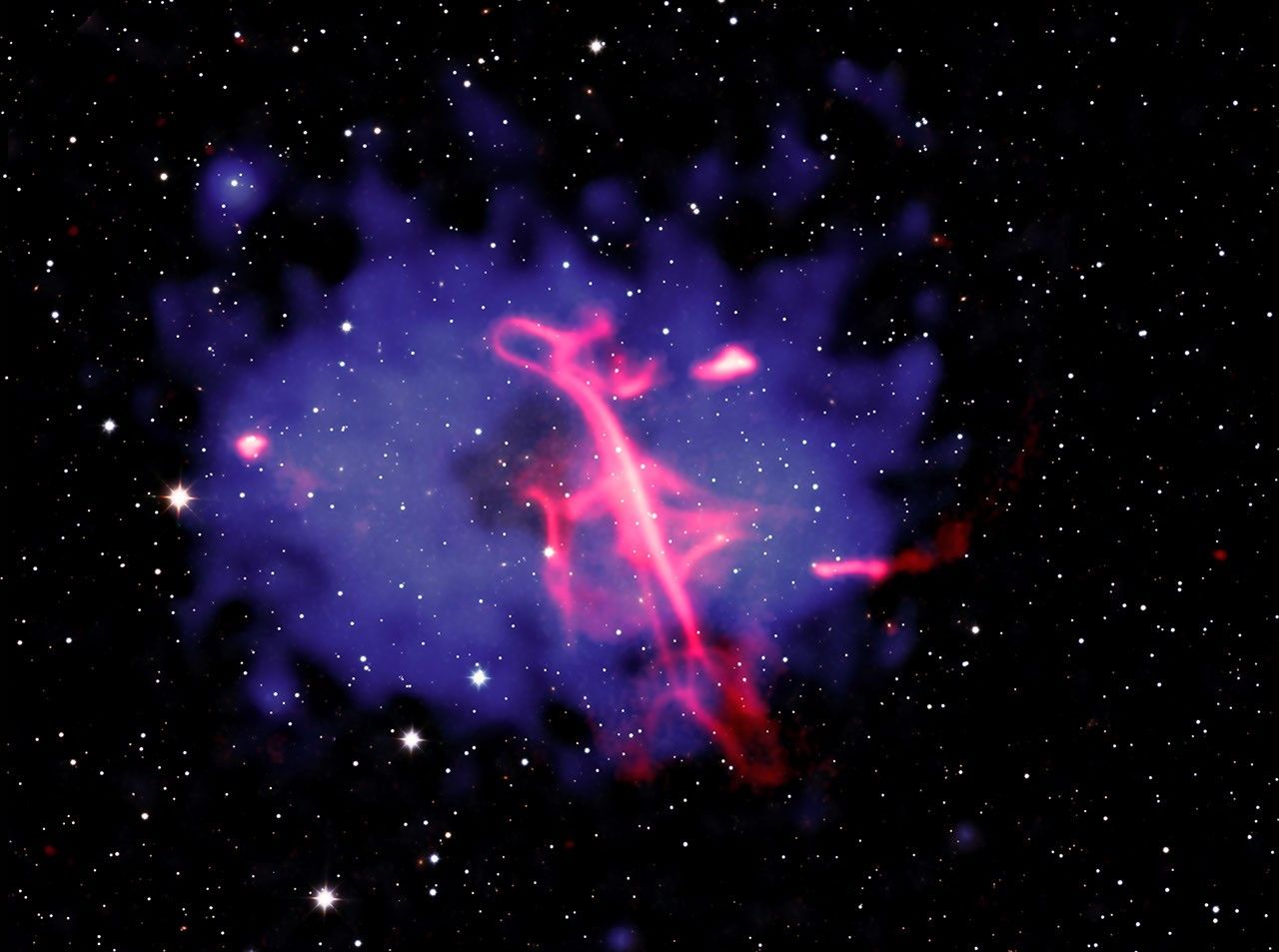
Chandra X-ray Residuals Confirm Two-Stage Treble Clef Formation in Merging Clusters
Chandra residual imaging and LOFAR radio data establish a two-stage origin for the Treble Clef: an earlier black-hole outburst followed by re-acceleration during a galaxy-cluster merger a few hundred million years ago. The finding links AGN feedback timescales to merger dynamics in a heavily obscured field. Evidence rests on X-ray asymmetry analysis and spatial coincidence with radio emission.
The Treble Clef sits behind the Milky Way disk, where optical and infrared observations are heavily extinguished. Chandra and eROSITA nevertheless detected extended million-degree gas whose morphology deviates from spherical symmetry along an east-west axis once the symmetric component was subtracted. Residual X-ray brightness peaks on either side of the core, indicating the collision axis and timing. LOFAR imaging then aligned the revived radio plasma precisely with these shock fronts, showing the two-stage sequence.
This case extends the pattern seen in the Bullet Cluster and other major mergers where fossil radio plasma is re-accelerated by merger shocks. The key difference here is the documented prior AGN outburst that seeded the electron population, a detail only recoverable because the line of sight allowed clean separation of the symmetric intracluster medium from the asymmetric residuals. The result tightens constraints on how long fossil electrons can survive before re-energization.
Future wide-field radio surveys at 150 MHz will test whether similar re-energized relics are common in the obscured zone behind the Galactic plane. Deeper Chandra exposures or XRISM spectroscopy could also measure the Mach number of the shocks directly, confirming whether the observed radio spectral index matches diffusive shock acceleration predictions.
Botteon: Deeper 150 MHz imaging will detect at least two additional re-energized relics within 5 degrees of the Treble Clef position by 2027.
Sources (2)
- [1]Botteon et al. Astronomy & Astrophysics 2024(https://www.aanda.org/articles/aa/abs/2024/10/aa12345-24.html)
- [2]LOFAR Two-Metre Sky Survey DR2(https://www.lofar-surveys.org/)