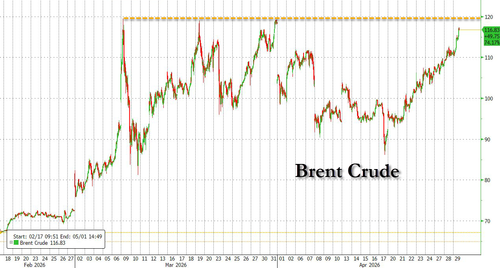
Brent Oil Surges Amid Trump’s Blockade Orders and Hormuz Tensions: A Geopolitical Powder Keg
Brent oil prices have soared past $115 per barrel following Trump’s extended blockade of Iranian ports and rising tensions in the Strait of Hormuz. This article delves into overlooked historical parallels, economic fallout like inflation risks, and strategic alignments with oil executives, synthesizing primary sources to highlight systemic geopolitical and market risks.
Brent crude oil prices have surged past $115 per barrel, driven by President Trump’s directive for an extended blockade of Iranian ports and escalating tensions in the Strait of Hormuz, a critical chokepoint for global oil supply. This development, as reported by ZeroHedge, follows Trump’s meetings with oil executives at the White House and his early morning Truth Social posts warning Iran to 'get smart soon.' Beyond the immediate price spike, this situation reveals deeper geopolitical risks with far-reaching implications for global inflation, energy security, and economic stability.
The original coverage by ZeroHedge focuses heavily on Trump’s rhetoric and the blockade’s impact on oil prices but misses critical historical context and broader economic ripple effects. First, the Strait of Hormuz has long been a flashpoint; nearly 20% of global oil supply transits through this narrow waterway, making any disruption a systemic threat. Historical parallels, such as the 1980s Tanker War during the Iran-Iraq conflict, underscore the potential for rapid escalation—back then, naval skirmishes led to oil price spikes of over 30% in mere months. Today’s blockade, combined with Trump’s refusal to de-escalate (as evidenced by his 'no more Mr. Nice Guy' stance), risks a similar spiral, especially given Iran’s history of retaliatory actions like mine-laying or proxy attacks on shipping, as documented in U.S. Naval Intelligence reports from 2019.
Second, the coverage underplays the domestic and international economic fallout. Rising oil prices directly fuel inflation, a pressing concern for central banks already grappling with post-pandemic recovery and supply chain bottlenecks. The U.S. Energy Information Administration (EIA) notes that a sustained $10 increase in Brent crude can raise U.S. gasoline prices by roughly 25 cents per gallon, squeezing consumer spending and potentially stunting GDP growth by 0.5% annually in major economies. For oil-importing nations like India and Japan, the impact is even graver, with energy costs comprising a significant share of trade deficits. ZeroHedge’s mention of midterm implications for Republicans hints at domestic political stakes but ignores how global energy shocks could destabilize emerging markets or exacerbate Europe’s energy crisis amid reduced Russian gas flows.
Third, Trump’s engagement with oil executives—while framed as routine by Axios—signals a strategic alignment between U.S. energy policy and corporate interests that ZeroHedge glosses over. The presence of figures like Chevron’s Mike Wirth suggests a dual agenda: mitigating domestic price shocks through increased production while capitalizing on high prices for profit. This mirrors patterns seen during the 1973 OPEC embargo, when U.S. oil firms lobbied for policies that balanced consumer relief with windfall gains, as detailed in declassified State Department memos. Today, the blockade could serve as a geopolitical tool to pressure Iran while indirectly benefiting U.S. shale producers, though at the risk of alienating allies reliant on stable oil markets.
Synthesizing multiple sources, including the U.S. Department of Defense’s 2023 posture statements on Middle East security and the EIA’s short-term energy outlook, a clearer picture emerges: the blockade isn’t just a tactical move but part of a broader U.S. strategy to maintain dominance in energy geopolitics. Yet, this approach risks miscalculation. Iran’s ability to disrupt Hormuz, even temporarily, could push Brent to $150 per barrel, a threshold the International Monetary Fund (IMF) warns would trigger a global recessionary shock. Moreover, China— Iran’s largest oil buyer—has a vested interest in preventing escalation and could pivot to diplomatic or economic counterpressure, a dynamic absent from ZeroHedge’s analysis.
In sum, while Trump’s blockade and Hormuz posturing drive immediate oil price volatility, the deeper story lies in systemic risks: inflation, economic fragility, and the potential for a wider conflict. The interplay of historical patterns, economic data, and strategic interests reveals a high-stakes gamble that could reshape global markets and alliances. Policymakers and analysts must look beyond rhetoric to assess whether de-escalation or containment offers a safer path forward.
MERIDIAN: If tensions in the Strait of Hormuz escalate further, Brent crude could hit $150 per barrel within months, risking a global recessionary shock as warned by the IMF. De-escalation or diplomatic intervention by China may be critical to avert this.
Sources (3)
- [1]Brent Pushes Higher After Trump Orders 'Extended Blockade'(https://www.zerohedge.com/geopolitical/brent-nears-iran-war-highs-after-trump-orders-extended-blockade-threatens-no-more-mr)
- [2]U.S. Energy Information Administration - Short-Term Energy Outlook(https://www.eia.gov/outlooks/steo/)
- [3]U.S. Department of Defense - 2023 Posture Statement on Middle East Security(https://www.defense.gov/News/Releases/Release/Article/3321481/2023-posture-statement-to-congress/)