Iran War's Ethane Shock: How Strait of Hormuz Closure Triggers Global Plastics Crisis and Renewed Inflation
The 2026 Iran war and Hormuz closure have cut off Middle East naphtha/LPG supplies to China, causing severe ethane shortages, record US imports, plastics price spikes up to 20% in key goods, and the end of disinflationary cheap Chinese exports—setting the stage for renewed global inflation above 3% in 2026 with underreported long-term supply chain shifts.
The ongoing US-Israel-Iran conflict, which escalated in late February 2026 with strikes on Iran and subsequent closure of the Strait of Hormuz, is delivering underappreciated economic aftershocks far beyond headline oil prices. While gasoline cost increases dominate news cycles, the disruption has severed critical flows of naphtha and liquefied petroleum gas (LPG) from the Persian Gulf—accounting for over 50% of China's naphtha imports and 40% of its LPG prior to the war—triggering an acute ethane and ethylene shortage that is now rippling through the global plastics and consumer goods supply chain.[1][2]
The International Energy Agency has warned that petrochemical feedstocks are experiencing 'the most immediate effects of the war by far,' with Asian supply chains thrown into disarray. Naphtha-fed crackers still comprise 57% of China's ethylene capacity. With virtually no strategic stockpiles of these specialized feedstocks (unlike its 1.5 billion barrels of crude reserves), Chinese petrochemical producers have declared force majeure and are scrambling for alternatives. Shipments of US ethane to China are projected to hit a record 800,000 tons in April—60% above monthly averages—deepening Beijing's reliance on American suppliers amid existing trade frictions.[3][4]
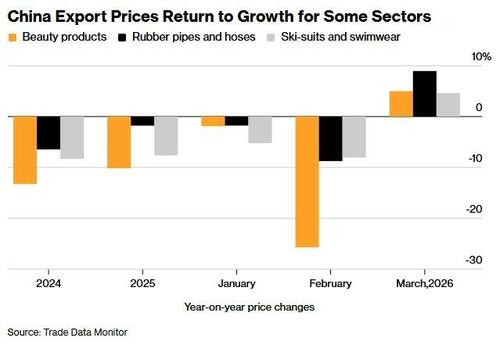
This feedstock shock is ending the multi-year era of declining Chinese export prices that had suppressed inflation in the US, Europe, and UK by an estimated 0.3-0.5 percentage points. Bloomberg analysis of customs data via Trade Data Monitor shows sharp March year-on-year price increases across more than a dozen household goods categories. Medical syringes have seen prices surge up to 20%, while synthetic fiber products like swimsuits, trousers, and ski suits rose in the low-to-mid single digits. Manufacturers of catheters, air conditioners, and apparel report daily plastic cost climbs, forcing price hikes after years of absorbing overcapacity pressures. Goldman Sachs and Bloomberg Economics now see Chinese export prices turning positive, with above-3% inflation back in play for major economies in 2026. A 10% oil cost rise typically lifts Chinese export prices by 50 basis points over the following year, with peak effects still ahead.[5][6]
The connections run deeper than acknowledged in most coverage. This is not merely a temporary energy spike but a structural exposure: global plastics production—foundational to packaging, medical devices, textiles, automotive parts, and consumer durables—relies on tightly integrated Middle Eastern feedstocks processed in Asia. The resulting crunch threatens compounded effects: higher costs for everyday items, potential shortages in healthcare supplies, and accelerated deglobalization as nations seek to onshore or diversify petrochemical dependencies. Reuters reports factories and wholesalers grappling with plastic shortages as the conflict's energy shock weakens activity even in services. The Atlantic notes force majeure declarations across industrial Asia, warning of rising consumer costs for toys, clothing, car parts, and more.[2][7]
What others miss is the geopolitical blowback pattern: a regional conflict is forging new trans-Pacific dependencies (US ethane to China) while exposing how concentrated supply nodes amplify inflation transmission. Unlike visible gasoline prices, these industrial input shocks embed persistently into core goods inflation with a 4-5 month lag. As strategic reserves of crude prove insufficient for specialized chemical chains, the war is quietly resetting cost structures worldwide, potentially sustaining higher inflation longer than forecasts anticipated before Hormuz was blocked.
Liminal: The ethane-plastics shock from the Iran conflict will embed 0.5-1% higher core inflation through 2026 by exposing Asia's feedstock vulnerabilities, forcing costly supplier shifts and accelerating onshoring that makes future supply chains more resilient but permanently more expensive.
Sources (5)
- [1]Inflation Looms as China’s Exporters Boost Prices on Iran Costs(https://www.bloomberg.com/news/articles/2026-04-23/inflation-looms-as-china-s-exporters-boost-prices-on-iran-costs)
- [2]Iran war deepens China's dependence on the U.S. for niche gas(https://www.bloomberg.com/news/articles/2026-04-20/iran-war-deepens-china-s-dependence-on-the-us-for-niche-gas)
- [3]Iran war impact seeps ever deeper into global economy(https://www.reuters.com/world/europe/iran-war-impact-seeps-ever-deeper-into-global-economy-2026-04-23/)
- [4]Brace for the Plastic-Price Hikes(https://www.theatlantic.com/science/2026/04/brace-plastic-price-hikes/686891/)
- [5]Iran fully closes Strait of Hormuz over US blockade(https://apnews.com/article/us-iran-war-israel-hormuz-18-april-2026-ab475cb979825b956a10d60103026b37)