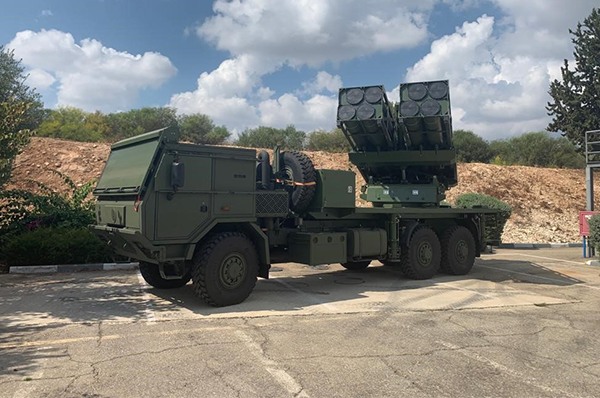
Eastern Mediterranean Realignment: Israel's $750M PULS Deal with Greece Forges Anti-Turkish Deterrence Axis
The $750M Israeli PULS sale to Greece cements a strategic anti-Turkish axis in the Eastern Mediterranean, linking battle-proven Israeli artillery with Athens’ Achilles Shield program. Beyond the contract, the deal reveals deepening energy-security ties, industrial offsets, and a pattern of smaller powers building parallel deterrence architectures that sidestep Turkish obstruction within NATO.
The Israeli Defense Ministry’s announcement of a $750 million sale of PULS rocket artillery systems to Greece marks far more than another defense export. It represents a deliberate strategic deepening of informal alliance architecture in the Eastern Mediterranean aimed squarely at containing Turkish revisionism, securing contested energy resources, and demonstrating the maturation of Israel’s battle-tested precision fires technology into a European export staple. While the Defense News report accurately captures contract value, timelines, and Elbit Systems’ industrial participation role, it underplays the geopolitical scaffolding and misses critical linkages to Athens’ broader Achilles Shield multi-domain modernization program and the longer trajectory of Greco-Israeli convergence since the 2010s.
PULS, with its modular ability to fire unguided rockets, precision-guided munitions, and 300 km-range missiles from both wheeled and tracked chassis, gives Greece a responsive deep-strike capability it has historically lacked against Turkish coastal and island threats. Delivery stretched over four years with a decade of sustainment reflects operational urgency: Greek planners watched Israel’s rocket artillery employment in Gaza and Lebanon with intense interest. The two-and-a-half-year negotiation delay, attributed in the source to the Middle East war, likely stemmed as much from Israeli prioritization of domestic stocks and Greek budgetary cycles as from any operational pause. In fact, combat validation has only increased PULS marketability.
This transaction must be read alongside Greece’s March 2026 approval of the full Achilles Shield package, including IAI Barak MX air defense batteries and Rafael’s David’s Sling and SPYDER systems. Together they form a layered shield protecting Greek islands and exclusive economic zones from Turkish drones, missiles, and amphibious feints. Original coverage largely treated these as separate procurements; the pattern is integrated Greek procurement of Israeli multi-domain kill chains calibrated against Ankara’s hybrid gray-zone tactics around Cyprus, Kastellorizo, and Libya.
The deal further illustrates Israel’s post-October 7 export surge. Despite domestic mobilization, Israeli defense sales hit record levels in 2024-2025 as customers sought systems with real-world counter-drone and precision-fire pedigrees. Elbit’s new joint venture with Germany’s KNDS to market EuroPULS, plus the Netherlands/German order referenced, shows Jerusalem threading between European strategic autonomy rhetoric and pragmatic technology partnerships. Local Greek production and know-how transfer, while limited, serve Athens’ goal of reducing total dependence on American, French, or German primes.
What mainstream reporting missed is the energy-security dimension. Since the 2010 Leviathan and Aphrodite gas discoveries, Israel, Greece, and Cyprus have built an informal entente explicitly designed to exclude Turkey from Eastern Mediterranean hydrocarbons. The EastMed Gas Forum, joint naval drills like “Mediterranean Shield,” and now integrated long-range fires form a coherent deterrent web. Turkish officials have already denounced the PULS sale as destabilizing, continuing a pattern seen after previous Heron UAV and Spike missile transfers.
Synthesizing the primary Defense News dispatch with a January 2026 IISS Strategic Survey chapter on Mediterranean maritime contestation and a Haaretz investigation into Elbit’s European expansion reveals a larger trend: smaller U.S. allies are constructing parallel security structures that bypass traditional NATO chains of command when Turkey is the implicit adversary. This carries risks. Ankara may accelerate its own indigenous rocket programs or deepen ties with Russia and China for equivalent systems. Yet for Greece, facing a Turkish navy twice its size, Israeli systems offer rapid, affordable, and politically reliable capability.
The broader pattern is clear. Israel is transitioning from U.S.-centric defense diplomacy to a diversified export model that doubles as coalition-building. Greece, traditionally reliant on French and German platforms, is hedging with Israeli technology that arrives faster, integrates with NATO standards, and comes without lectures on rule-of-law conditionality. The PULS deal, embedded in a government-to-government framework with mutual guarantees, effectively makes Israel a security guarantor for Greek interests in the Aegean and Levant.
Four years from now, when Greek PULS batteries achieve full operational capability alongside Barak MX interceptors, the Eastern Mediterranean will feature a denser, more resilient Israeli-Greek defensive lattice. This development was latent in a decade of quiet cooperation but has been accelerated by simultaneous threats from Iranian axis aggression and Turkish neo-Ottoman posturing. The original coverage told the transaction story; the strategic story is the quiet emergence of a new balancing coalition on NATO’s vulnerable southern flank.
SENTINEL: This arms transfer accelerates the formation of a de-facto Israel-Greece-Cyprus security bloc that will increasingly coordinate targeting data and maritime patrols, raising the threshold for Turkish adventurism around contested gas fields while complicating NATO consensus on southern flank threats.
Sources (3)
- [1]Israel to sell PULS systems to Greece for $750 million(https://www.defensenews.com/global/mideast-africa/2026/04/06/israel-to-sell-puls-systems-to-greece-for-750-million/)
- [2]Mediterranean Security: Contested Maritime Spaces and Emerging Alignments(https://www.iiss.org/publications/strategic-survey/2026/mediterranean-contestation)
- [3]Elbit’s European Push: From Israeli Artillery to EuroPULS Joint Venture(https://www.haaretz.com/israel-news/2026-02-12/ty-article/elbit-european-expansion-puls-greece-germany/0000018d-4a1f-d3f2-a5ff-4a1f00000000)