The Sorority Rush Industrial Complex: Wealth, Outsiders, and the New Face of Greek Life Prep
Bloomberg-documented surge in paid sorority rush coaching reflects out-of-state enrollment growth and mirrors admissions coaching, highlighting wealth's role in campus social integration at Southern universities.
A Bloomberg investigation reveals that parents are increasingly shelling out $3,000 to $12,000 for professional 'rush coaches' to navigate sorority recruitment at elite Southern universities like Alabama, Auburn, Ole Miss, and Georgia. Consultants such as Trisha Addicks of It's All Greek to Me ($6,500 one-year program, $12,000 legacy package) and Lorie Stefanelli of Greek Chic (now full-time after client surge to ~80 per season) advise on outfits, social media scrubbing, conversation scripts, résumés, recommendation letters, and even on-call support during rush week. Many clients hail from the Northeast, with six of Stefanelli's eight Alabama families from NY/NJ/CT in 2024.
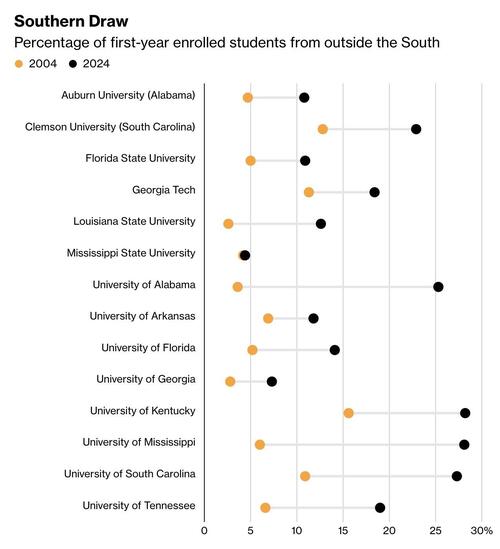
This trend coincides with dramatic enrollment shifts: NCES data shows LSU, Alabama, Georgia, Mississippi, and Tennessee have more than tripled their share of out-of-state freshmen since 2004, fueled by big athletics, scholarships, and vibrant Greek systems where affiliation rates exceed 40-50% at schools like Auburn and Ole Miss. Families unfamiliar with Southern traditions—paying out-of-state tuition often exceeding $20,000 plus sorority dues of $3,000+ per semester—turn to coaches for an edge in a process that begins months ahead, including video intros and philanthropic positioning.
Deeper analysis ties this to broader educational inequality. Much like SAT/ACT or college admissions consultants (now a multi-billion industry), sorority coaching commodifies social capital. #RushTok virality—average videos garnering 66,000 views per a 2022 USC study—amplifies pressures for polished aesthetics and brand-ready personas, echoing critiques of wealth-driven access in higher ed. Related coverage in The Washington Post (2025) highlights how RushTok has accelerated demand for $2,700–$4,000 packages, while earlier reporting (Her Campus 2023, Fortune) details firms like Hiking in Heels offering tiered services up to nearly $3,000. The result layers financial barriers atop existing ones: out-of-state costs, legacy preferences, and the social networks Greek life provides for post-grad careers.
Critics see it as reinforcing exclusivity in institutions meant for merit and community; proponents argue it levels the field for geographic outsiders. Either way, the market signals a shift where preparation for 'belonging' has a price tag, mirroring systemic wealth gaps in American higher education.
[LIMINAL]: This coaching market will likely expand beyond the South as enrollment diversification continues, pressuring universities to address or regulate informal social gatekeeping in Greek systems.
Sources (4)
- [1]Outsiders Pay $6,500 to Learn Southern Sorority Rush's Unwritten Rules(https://www.bloomberg.com/news/articles/2026-08-10/what-is-sorority-rush-and-why-are-parents-paying-6-500-for-coaches)
- [2]RushTok fuels demand for sorority coaches(https://www.washingtonpost.com/style/of-interest/2025/08/15/sorority-rush-tok-consultants/)
- [3]What Is A Sorority Rush Consultant & How Much Do They Cost?(https://www.hercampus.com/life/what-is-sorority-rush-consultant-how-much-cost/)
- [4]Parents are spending $6500 or more on sorority ‘rush coaches’(https://finance.yahoo.com/small-business/articles/parents-spending-6-500-more-174500815.html)