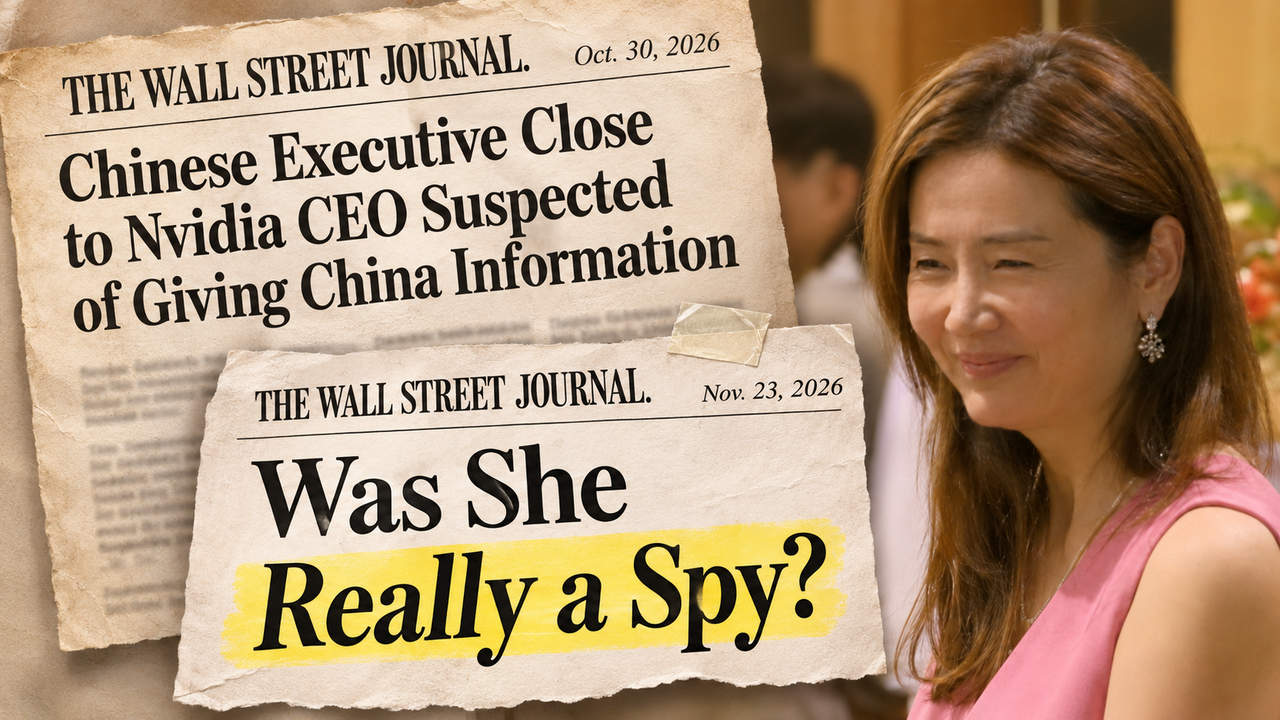
Wall Street Journal revises Nvidia spy report on Alice Huang three weeks after publication
The Wall Street Journal revised its reporting on Alice Huang, saying U.S. intelligence lacks definitive proof she was tasked by Chinese officials to spy on Nvidia. The walk-back came as Nvidia's board reinstated Jensen Huang after citing senior U.S. government input and no national-security risk. The episode matters because unverified national-security claims moved markets, governance and policy debate around a central AI company.
The Wall Street Journal reported late Monday that U.S. intelligence has no definitive proof that Alice Huang was tasked by Chinese officials to collect information on Nvidia chief executive Jensen Huang or pass national-security secrets, three weeks after the paper's Nov. 1 report that U.S., Singapore and Taiwan officials feared she was a Chinese intelligence source. The revised account said her contacts with Chinese state security may be circumstantial. Singapore's Ministry of Home Affairs said it had not conducted the physical surveillance described in the earlier reporting.
The new account, citing people with knowledge of U.S. intelligence, said Alice Huang was in contact with Chinese intelligence during her relationship with Jensen Huang but that intelligence does not show she was actively tasked by Beijing. Some officials told the Journal the links were circumstantial because Chinese business figures are routinely required to maintain contact with security authorities. The New York Times reported that U.S. intelligence had tracked her contact with an officer of China's Ministry of State Security from spring 2025 until fall.
The correction arrived as Nvidia's board said on Monday it had received input from senior levels of the U.S. government and was confident Jensen Huang's reinstatement poses no national security risk. The sequence shows how an unresolved intelligence question can move corporate governance and market valuations before evidence is tested publicly. It also shows the cost of treating national-security suspicion as settled fact: earlier headlines amplified a threat narrative that later reporting narrowed to contact without proof of collection.
The stakes reach beyond one company. Nvidia sits at the center of U.S.-China competition in artificial intelligence, semiconductors and data-center infrastructure, and its leadership decisions are read as signals about trust, security and regulatory pressure. The revised reporting also puts accountability on media and political actors who circulated allegations before the evidentiary record was clear. For investors, employees and policymakers, the episode illustrates how quickly reputational risk can become economic and institutional risk.
Investors, Nvidia employees and policymakers are affected because unverified China-threat reporting moved a central AI company's governance and market expectations before the evidentiary record was clarified.
Sources (1)
- [1]Original source(https://www.zerohedge.com/ai/no-smoking-gun-wsj-abruptly-walks-back-alice-huang-spy-story)