Iran's Fuel Crisis Deepens Amid US Sanctions and War Damage: A Case Study in Political-Economic Spiral
Corroborated reports detail Iran's gasoline shortages and queues driven by war damage, US blockade, and sanctions, amplifying hyperinflation and currency woes in a volatile political context with risks of social unrest.
Reports from multiple international outlets confirm that Iran is grappling with acute gasoline shortages, manifesting in long queues at Tehran petrol stations as of August 25, 2026. Drivers are rushing to fill tanks amid fears of price hikes and supply disruptions, with Iranian state media like Hamshahri noting panic buying that has pushed daily distribution in the capital to record levels.[1][2]
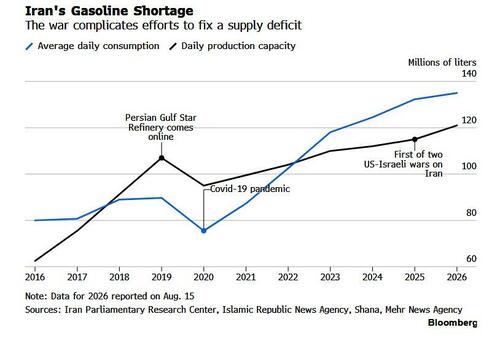
The shortages stem from a confluence of factors: damage to refining and storage facilities from prior US and Israeli strikes during the ongoing conflict that began in February, a US naval blockade imposed since July that has curtailed imports, and surging domestic demand exceeding production. Iranian energy official Esmaeil Saqab Esfahani (also spelled Saghab Esfahani) has publicly stated a daily gasoline deficit of 14-15 million liters against demand around 135 million liters, prompting government consideration of rationing, quotas, or higher prices for excess fuel.[3][4]
These developments occur against a backdrop of broader economic strain. The Iranian rial has hit record lows (around 2.02 million per USD on informal markets), with inflation soaring toward 90% year-on-year, exacerbating household pressures in an already subsidy-dependent system where gasoline has historically been among the world's cheapest. Past attempts to adjust prices, such as in 2019, triggered deadly protests, underscoring the social volatility of fuel policy.[5][6]
US Treasury Secretary Scott Bessent announced intensified sanctions on August 24, framing them as 'Operation Economic Outcast' or an 'economic D-Day' targeting sectors like shipping, aviation, gold, technology, and digital assets to isolate Iran's economy further. This builds on existing maximum pressure tactics and compounds war-related disruptions, with officials warning of impacts on ordinary citizens while regime figures downplay long-term effects due to prior adaptation.[7][8]
Deeper analysis reveals how geopolitical tensions—war stalemate, blockades, and sanctions—create feedback loops: energy infrastructure damage reduces output, import curbs widen deficits, panic buying strains distribution, and currency devaluation fuels inflation, all eroding public resilience and risking unrest. This dynamic affects millions through job losses in energy-dependent sectors, rising living costs, and eroded purchasing power, illustrating the direct socio-economic fallout from sustained political conflict.
Economic Analyst: Sustained sanctions and conflict will likely deepen Iran's domestic instability, with fuel and currency pressures potentially catalyzing broader protests or forcing policy concessions within months.
Sources (6)
- [1]Petrol queues deepen across Iran as fuel shortages hit Tehran(https://www.thenationalnews.com/news/mena/2026/08/25/petrol-queues-deepen-across-iran-as-fuel-shortages-hit-tehran/)
- [2]Iranians queue for petrol as US blockade bites(https://www.ft.com/content/e08d7f0e-f9fb-45a4-a1ef-025a75a5b776)
- [3]Iran fuel shortages spark lines at pumps as US pressure bites(https://www.bloomberg.com/news/articles/2026-08-24/iran-fuel-shortages-spark-lines-at-pumps-as-us-pressure-bites)
- [4]Remarks from Secretary of the Treasury Scott Bessent on Operation Economic Outcast against Iran(https://home.treasury.gov/news/press-releases/remarks-from-secretary-of-the-treasury-scott-bessent-on-operation-economic-outcast-against-iran)
- [5]Iran faces a new energy imbalance, but its options are limited(https://www.aljazeera.com/economy/2026/6/3/iran-faces-a-new-energy-imbalance-but-its-options-are-limited)
- [6]'Economic asphyxiation': US Treasury chief announces new sanctions campaign against Iran(https://www.timesofisrael.com/economic-asphyxiation-us-treasury-chief-announces-new-sanctions-campaign-against-iran/)