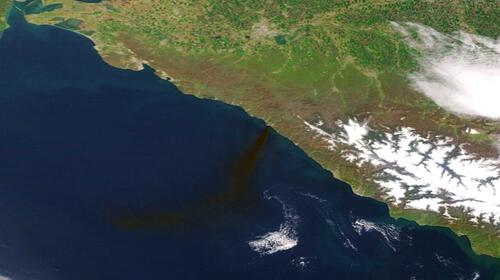
Tuapse Inferno Visible from Orbit: Intersecting Energy Warfare and Middle East Disruptions Heighten Global Supply Risks
Analysis of the Tuapse refinery strike reveals underestimated global energy supply risks when combined with Hormuz tensions, patterns of infrastructure warfare, and diverging Russian, Ukrainian, and Western perspectives on legitimacy of targets.
Satellite imagery released by NASA confirms an extensive smoke plume stretching approximately 200 kilometers over the Black Sea following a Ukrainian drone strike on the Rosneft-operated Tuapse oil refinery on April 16, 2026. Local authorities in Russia's Krasnodar region declared a state of emergency after the blaze damaged residential areas, with Governor Venyamin Kondratyev reporting the deaths of a woman and a teenage girl. Russia's Defense Ministry stated that air defenses downed 207 Ukrainian drones across multiple regions that night, while Ukrainian sources reported 14 civilian deaths from concurrent Russian missile and drone strikes on Kyiv, Odesa, and Dnipropetrovsk.
The ZeroHedge coverage frames the event as part of routine tit-for-tat infrastructure attacks that have largely faded from Western headlines after more than four years of war. However, this reporting understates the compounding global energy security implications, especially when viewed alongside the ongoing Iran conflict and reported blockade activities in the Strait of Hormuz. Primary Russian Ministry of Defense communiques describe the Tuapse strike as a deliberate attack on civilian energy infrastructure, while Ukrainian government statements to the UN characterize such operations as legitimate degradation of Russia's military sustainment capabilities, citing Rosneft's role in financing state operations.
This incident follows a documented pattern of Ukrainian long-range drone operations against Russian refining capacity, including the prior March 2025 strike on the same Tuapse facility and 2024 attacks on sites in Ryazan, Volgograd, and Syzran. Rosneft corporate filings indicate Tuapse processes around 240,000 barrels per day, with significant portions directed toward export markets serving Europe, Asia, and the Mediterranean. International Energy Agency primary market assessments from early 2026 had already warned of tight global spare capacity; simultaneous pressure from Hormuz disruptions - referenced in shipping industry reports and U.S. Energy Information Administration briefings - creates a multiplier effect not fully explored in day-to-day conflict coverage.
Russian perspectives, drawn from official Kremlin transcripts, emphasize humanitarian costs and label the campaign 'energy terrorism' intended to provoke broader escalation. Ukrainian officials counter that Russia's far larger volume of strikes on Ukrainian power grids and ports, documented in EU external action service reports, justifies reciprocal targeting. Western analytical bodies such as the Atlantic Council and European Council on Foreign Relations have noted both sides' increasing reliance on asymmetric infrastructure strikes while observing that mainstream coverage has normalized these exchanges, reducing public pressure for renewed diplomacy.
What much original reporting misses is the linkage between these 'routine' Black Sea strikes and fading prospects for political settlement in Ukraine. As global attention pivots to Iran, the Tuapse event functions as a visible signal - literally from space - that energy infrastructure is now a primary theater of economic warfare. Should similar attacks persist, IEA modeling scenarios suggest potential Brent crude price spikes of 15-25% within weeks, transmitting inflation to economies already strained by Red Sea and Hormuz volatility. OPEC+ production decisions, detailed in their March 2026 ministerial statements, may prove insufficient to offset combined Eurasian and Middle Eastern risks.
The convergence reveals a structural shift: modern conflicts increasingly weaponize chokepoints in global energy flows, with satellite-detectable fires serving as both tactical outcome and strategic messaging. European Commission energy directorate notes and Chinese Ministry of Commerce import data further illustrate how these events ripple beyond the belligerents, affecting third-party nations without direct stake in the territorial dispute. Absent de-escalatory mechanisms, the normalization of refinery targeting risks embedding energy price volatility into the global baseline.
MERIDIAN: Dual threats to Russian refining capacity and potential Hormuz closure are likely to tighten global oil markets through Q3 2026, elevating prices and reducing incentives for near-term Ukraine ceasefire agreements as economic pressure becomes a primary lever for both sides.
Sources (3)
- [1]Drone Attack On Russia's Tuapse Oil Refinery Unleashes Fire So Large It Can Be Seen From Space(https://www.zerohedge.com/geopolitical/drone-attack-russias-tuapse-oil-refinery-unleashes-fire-so-large-it-can-be-seen-space)
- [2]Russian Ministry of Defence Briefing on Overnight Drone Incidents - April 2026(https://eng.mil.ru/en/news_page/country/more.htm?id=12401234@egNews)
- [3]IEA Oil Market Report - April 2026(https://www.iea.org/reports/oil-market-report-april-2026)