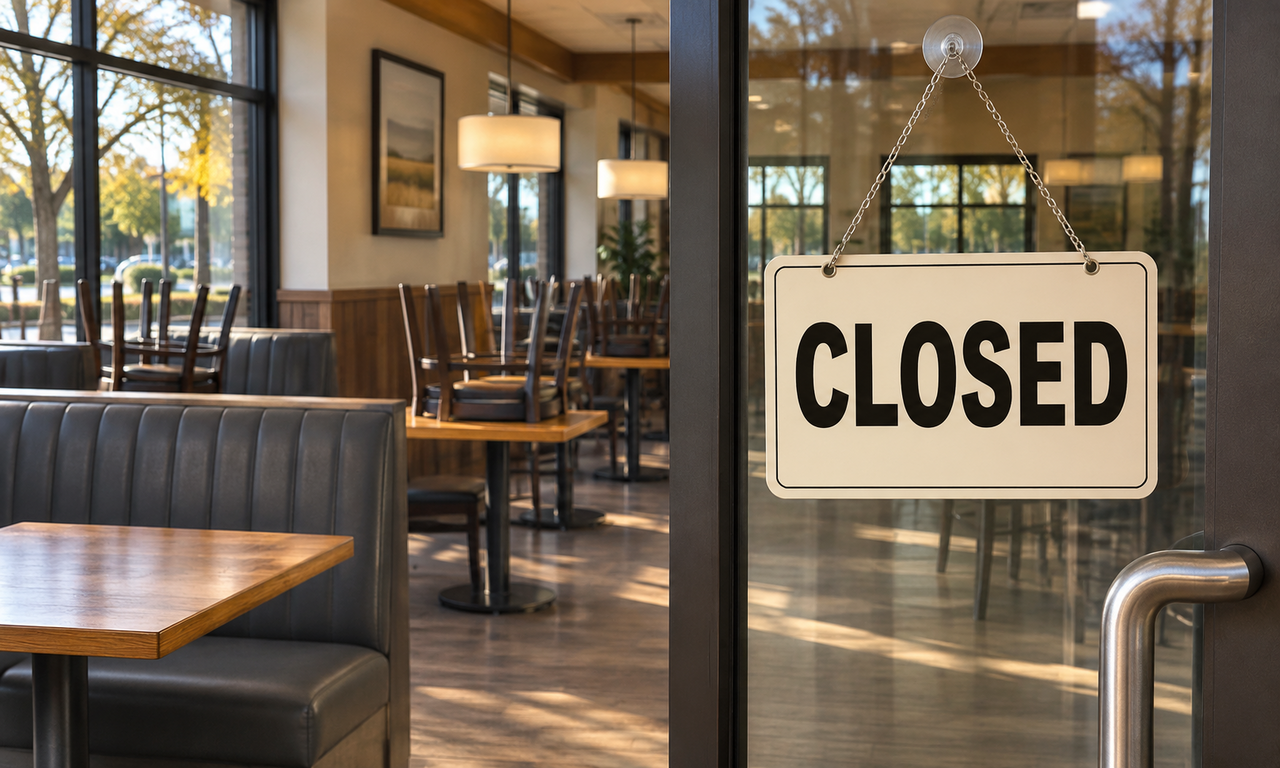
Two more restaurant franchise operators file Chapter 11, extending a 2026 wave of multi-unit insolvencies
Court filings and trade reporting confirm Chapter 11 cases for a 30-unit Denny’s operator and a small Schlotzsky’s franchisee in early November 2026, following a 314-unit Wendy’s franchisee bankruptcy in September and a 61-unit Outback franchisee filing on November 2. The brands themselves are not in bankruptcy; the documented pressure is on leveraged multi-unit operators facing weaker traffic, higher food and labor costs, and fixed royalties and debt.
Documented: Two additional multi-unit restaurant operators sought Chapter 11 protection in early November 2026, on top of larger franchisee restructurings already underway this year. EYM Diner of DFW, LLC, with affiliates EYM Diner of Florida, LLC and EYM Diner, LP, filed on November 4 in the U.S. Bankruptcy Court for the Northern District of Texas. Nation’s Restaurant News and Restaurant Dive, citing court records and a statement from Denny’s, report that the entities operated about 30 Denny’s restaurants in Texas and Florida, listed less than $50,000 in assets, and estimated liabilities between $10 million and $50 million. NRN reports the largest unsecured claim as nearly $3.5 million owed to the IRS for unpaid payroll taxes. Denny’s chief development officer Mark Burgess said the chain is working to move viable restaurants to other franchisees already in the system. The filing does not, by itself, close the restaurants. EYM’s founder, Eduardo Diaz, has already been through other brand-level failures: trade coverage documents prior Chapter 11 cases and closures across Pizza Hut, Panera, KFC, and Burger King holdings tied to the same operator group.
Documented, separately: JPrieto Hospitality LLC, a San Antonio-based Schlotzsky’s franchisee led by Jorge Prieto, filed Chapter 11 on November 5 in the Western District of Texas (case 26-53241). TheStreet and QSR Magazine, drawing on the petition and the chain’s franchise disclosure document, report roughly $532,000–$533,000 in assets against about $350,000–$351,000 in liabilities. Revenue was about $8.26 million in 2024 and about $8.19–$8.2 million in 2025, then $4.11–$4.12 million from the start of 2026 through the filing date. QSR reports 2025 ordinary business income of about $45,000, a margin near half a percent. The operator had run about eight to ten North Texas locations and listed five remaining leases; its largest unsecured creditor is franchisor GoTo Foods, owed about $149,000. Prieto told the court the strain came from weaker business activity in the Fort Worth market. This is a small-business Subchapter V case, not a system-wide failure of Schlotzsky’s.
Documented context, not the same filings: Meritage Hospitality Group, which operated 314 Wendy’s restaurants across 15 states and employed about 9,000 people, filed Chapter 11 on September 17 in the Western District of Michigan. USA Today, Bloomberg, and QSR Web report that Meritage had already closed about 60 underperforming stores, cited an 11.3 percent same-store sales drop in late 2025, beef costs up nearly 19 percent year over year in the quarter ending June, and a dispute with Wendy’s over unpaid royalties and fees that the franchisor has put near $147 million. Bloomberg reported about $651 million in liabilities and $725.9 million in assets. On November 2, Cerca Trova Restaurant Group Holdings, doing business as Out West Restaurant Group, filed in Delaware covering 61 Outback Steakhouse restaurants in five western states. Nation’s Restaurant News reports the operator had been in distress since 2018, closed 10 restaurants just before the filing, and had accumulated nearly $320 million in secured debt while operating under forbearance. Bloomin’ Brands agreed to a stalking-horse bid of about $26.3 million for substantially all remaining assets and up to $5.5 million in financing so stores can stay open during a sale. A widely circulated account that put Out West’s debt near $449 million and attributed a traffic-and-cost quote to CEO David Goronkin is not what NRN’s filing-based report shows; that figure and attribution should be treated as unconfirmed.
What is claimed versus what the filings show: The pattern is real—court dockets, franchisor statements, and trade reporting line up on the operators, dates, unit counts, and broad liability ranges. What is not documented is a single industry “collapse.” These are franchisee balance sheets, not brand bankruptcies. Denny’s, Wendy’s, Outback, and Schlotzsky’s continue as systems; in the Denny’s and Outback cases, the franchisors are actively trying to keep viable stores open under new or parent ownership. Restaurant Dive, citing restructuring attorneys, reported at least 10 significant multi-unit franchisee filings in 2026 through mid-September, spanning hundreds of locations, and said food and labor costs were up about 36 percent since 2019 while typical franchisee pre-tax margins run about 3 to 5 percent. BankruptcyData separately counted 683 restaurant-related filings from January 1 through November 5, 2026, versus 560 in all of 2025. Technomic data reported by Restaurant Business showed the 500 largest U.S. chains growing sales only 3 percent in 2025, below menu-price inflation, with median real sales down.
The connection that is easy to miss: the operators failing are not a random sample of weak independents. Several grew or borrowed into multi-state portfolios when traffic and cheap credit made unit growth look like a strategy—Meritage spent heavily to pass 300 Wendy’s; Out West has been trying to sell itself since 2018; EYM was a multi-brand roll-up whose other concepts had already failed. When same-store traffic softens, royalty and debt service do not. The IRS claim in the Denny’s case is a different signal from a landlord dispute: unpaid payroll taxes usually mean cash was already gone before the petition. For diners, the near-term effect is local and uneven—some addresses may change operators, some may close, most are still serving. For workers at the Wendy’s portfolio in particular, the documented exposure is larger: thousands of jobs sit inside a restructuring that already includes store sales and possible further closures.
People who work at or eat at these specific Denny’s, Schlotzsky’s, Wendy’s, and Outback locations can see stores change hands or close even though the national brands are still operating. The filings show how thin restaurant margins and heavy franchise debt turn a slowdown in guest traffic into local job and store risk.
Sources (6)
- [1]A 30-unit Denny’s operator files for bankruptcy(https://www.nrn.com/family-dining/a-30-unit-denny-s-operator-files-for-bankruptcy)
- [2]Denny’s operator files for Chapter 11(https://www.restaurantdive.com/news/eym-dennys-chapter-11-bankruptcy/873903/)
- [3]Schlotzsky’s Franchisee Files for Bankruptcy(https://www.qsrmagazine.com/uncategorized/schlotzskys-franchisee-files-for-bankruptcy/)
- [4]Large Wendy's franchisee files for bankruptcy, cites record beef prices(https://www.usatoday.com/story/money/food/2026/09/21/wendys-franchisee-bankruptcy/91873245007/)
- [5]A 61-unit Outback Steakhouse franchisee files for bankruptcy(https://www.nrn.com/casual-dining/a-61-unit-outback-steakhouse-franchisee-files-for-bankruptcy)
- [6]Why multi-unit restaurant franchisee bankruptcies are surging in 2026(https://www.restaurantdive.com/news/why-multi-unit-restaurant-franchisee-bankruptcies-are-surging-in-2026/829511/)