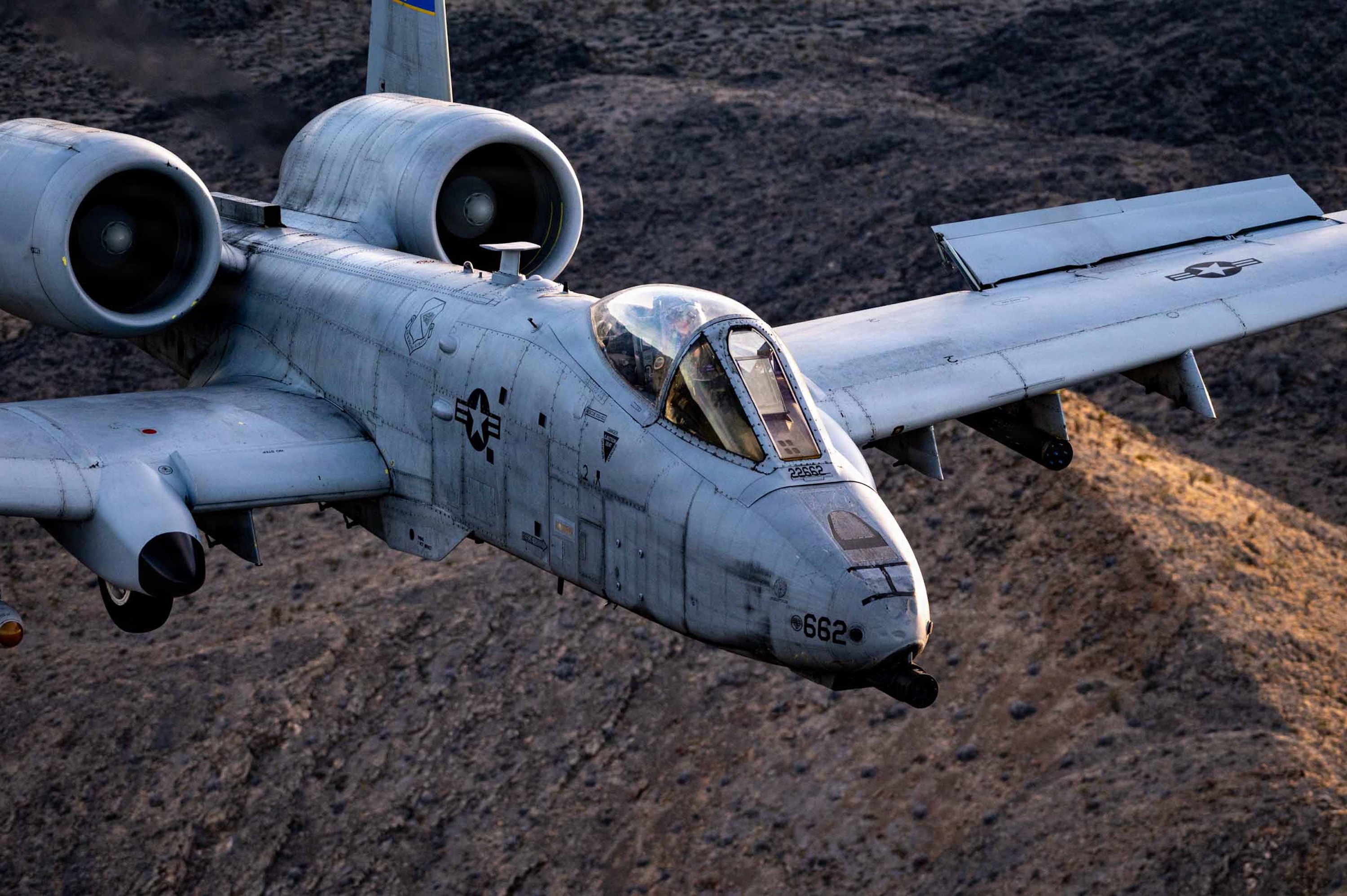
A-10 'Sandy' Retirement Exposes Critical CSAR Gaps, Jeopardizing Personnel Recovery in High-Intensity Conflicts
As A-10s retire by 2029 without a dedicated Sandy successor, critical gaps in loiter, survivability, and pilot expertise threaten US CSAR effectiveness in peer conflicts against China or Russia, beyond what legacy platforms or new fighters can fill.
The Defense News report on the A-10 Thunderbolt II's accelerated retirement by fiscal year 2029 correctly traces the 'Sandy' callsign from Vietnam-era A-1 Skyraiders through A-7 Corsairs to the Warthog's five-decade dominance of combat search and rescue. It highlights the specialized training at Davis-Monthan AFB, the four-ship formation roles, and Gen. Dan Caine's praise following the April 2026 Iran mission that recovered two F-15E crew members. However, the coverage stops short of confronting the deeper structural crisis: the U.S. Air Force is discarding its only platform optimized for the mission without a credible replacement, creating capability gaps that could prove catastrophic in peer-level warfare.
What the original piece misses is the mismatch between legacy CSAR doctrine and the realities of modern A2/AD environments. The A-10's armored survivability, extended loiter time, GAU-8 gun for suppressive fire, and low-speed visual search capabilities enabled it to act as on-scene commander while shielding HH-60 Pave Hawk helicopters. Neither the F-15E (used ad hoc in the Iran operation), F-35, nor proposed collaborative combat aircraft can replicate this. Fast jets lack persistence; stealth platforms are ill-suited for visual acquisition and close escort under contested skies. The article understates how the April 2026 mission occurred against a degraded Iranian adversary in relatively permissive airspace, an outlier rather than a template for operations against Chinese integrated air defense systems over the Taiwan Strait or Russian forces in the Baltic.
Synthesizing additional sources reveals a pattern of ignored warnings. A 2023 GAO report (GAO-23-105650) on DOD personnel recovery documented chronic readiness shortfalls across rescue aircraft fleets, training pipelines, and joint integration, rating CSAR force structure as 'high risk' with no mitigation plan for legacy platform divestment. Similarly, a 2024 War on the Rocks analysis by retired CSAR experts argued that institutional knowledge concentrated in the 357th Fighter Squadron and units at Moody AFB cannot be quickly transferred to new airframes or hastily trained pilots. They warned that replacing the A-10 with multi-role fighters would erode the 'Sandy community' trust essential for seamless coordination with pararescuemen and special operations forces.
These gaps connect to broader trends. Russia's experience in Ukraine shows personnel recovery becomes nearly impossible when air defenses and loitering munitions dominate; China's DF-21/26 'carrier killer' missiles and dense SAM networks would make traditional CSAR missions extraordinarily costly. The Air Force's focus on sixth-generation fighters and autonomous drones reflects a technology bias that undervalues the human factors of rescue command, authentication, and threat suppression under fire. Congressional language in the 2025 NDAA demanding a CSAR roadmap by 2027 indicates growing unease, yet service rhetoric remains vague on timelines for a purpose-built successor.
The retirement therefore represents more than airframe transition; it risks degrading a core U.S. military asymmetry—the credible promise of 'leave no one behind.' Without urgent development of a survivable, persistent Sandy platform (whether upgraded OA-1K armed overwatch derivatives, purpose-designed CCA variants, or hybrid manned-unmanned teams), personnel recovery in future high-intensity conflicts faces severe degradation. This could suppress aircrew willingness to accept risk, reduce operational tempo, and hand adversaries a psychological edge. The Iran success masks these vulnerabilities; the next peer conflict will not.
SENTINEL: Without a true A-10 Sandy replacement, US forces face growing risk of unrecoverable aircrews in high-end fights versus China. This gap in persistent, survivable CSAR could erode aircrew confidence and operational tempo faster than any kinetic threat.
Sources (3)
- [1]Combat search and rescue’s uncertain future: As A-10s phase out, US Air Force faces questions of what comes next(https://www.defensenews.com/news/your-military/2026/04/16/combat-search-and-rescues-uncertain-future-as-a-10s-phase-out-us-air-force-faces-questions-of-what-comes-next/)
- [2]Personnel Recovery: DOD Has Not Fully Implemented Its New Personnel Recovery Policy(https://www.gao.gov/products/gao-23-105650)
- [3]The Future of Combat Search and Rescue: Time for a Renaissance(https://warontherocks.com/2024/02/the-future-of-combat-search-and-rescue-time-for-a-renaissance/)