Emerging Economies Drive 60% Global Energy Demand Surge by 2060, Reshaping Transition Realities
S&P Global's September 2026 report confirms EMDE-driven 60% energy demand growth by 2060, necessitating diverse energy sources including fossils alongside renewables, complicating climate goals while enabling development; corroborated across PR Newswire, Marketplace, and OilPrice analyses with quotes from Yergin and Auth.
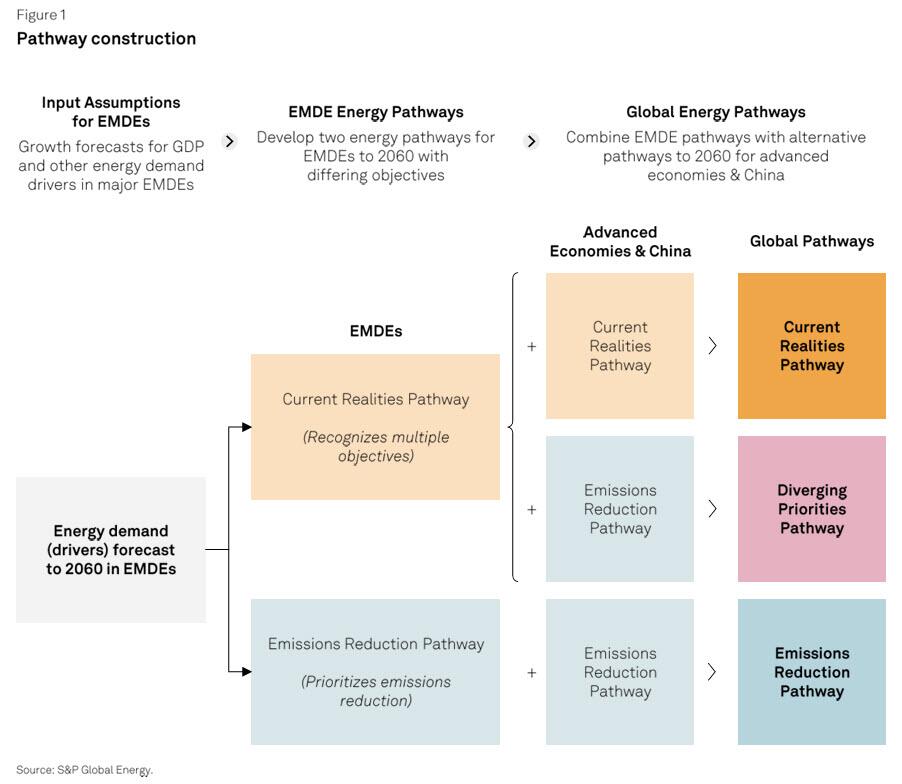
A new S&P Global study, 'Multidimensional Global Energy Pathways,' projects that energy demand from emerging markets and developing economies (EMDEs) could rise over 60% by 2060—equivalent to adding another China’s worth of consumption (155 EJ) to the global system. This growth, driven by industrialization, urbanization, and rising incomes in countries like India, Brazil, Indonesia, and Nigeria, contrasts with flat or slowly rising demand in advanced economies and China despite AI and data center loads. The report emphasizes an 'all-of-the-above' energy mix: renewables will expand significantly, aided by cheap Chinese solar tech, but coal use may persist or increase in some regions, while oil and gas remain integral longer than many transition models assume. Dan Yergin, S&P Global vice chairman, notes this demand 'is going to be met with a multiplicity of different energies,' rendering more ambitious climate timelines infeasible even with rapid renewables growth. Marketplace reporting highlights quotes from Katie Auth of the Energy for Growth Hub, underscoring that EMDEs cannot pause development for cheaper renewables; energy poverty remains stark, with examples like average Liberian consumption below a U.S. refrigerator's annual use. Broader context reveals tensions: while 63% of sampled EMDEs in Africa, Asia, and Latin America exceeded U.S. solar power shares by end-2025, climate finance shortfalls and the need for affordable baseload challenge 'leapfrogging' fossil fuels. Connections to AI-driven demand in the Global North amplify total pressure, potentially straining supply chains and geopolitics around hydrocarbons. The study finds limiting warming to 2°C possible only under aggressive pathways, with most EMDEs reaching carbon neutrality late-century at earliest. This multidimensional reality prioritizes energy prosperity—access plus reliability for economic growth—over uniform decarbonization narratives.
[S&P Global analysts]: Demand growth concentrated in EMDEs will sustain a diverse global energy mix through 2060, extending fossil fuel roles and testing net-zero feasibility while unlocking economic gains in the Global South.
Sources (5)
- [1]Energy Demand Growth Will Limit More-Ambitious Climate Goals, S&P Global Energy Study Finds(https://www.prnewswire.com/news-releases/energy-demand-growth-will-limit-more-ambitious-climate-goals-sp-global-energy-study-finds-302882018.html)
- [2]What's next for global energy demand growth(https://www.marketplace.org/story/2026/09/17/whats-next-for-global-energy-demand-growth)
- [3]Global Energy Demand Set to Jump 60% by 2060 as Developing Nations Power Up(https://oilprice.com/Energy/Energy-General/Global-Energy-Demand-Set-to-Jump-60-by-2060-as-Developing-Nations-Power-Up.html)
- [4]Multidimensional Global Energy Pathways Synthesis Report(https://www.spglobal.com/content/dam/spglobal/global-assets/en/special-reports/multidimensional-energy-pathways/Multidimensional%20Global%20Energy%20Pathways_Synthesis%20Report.pdf)
- [5]Can Global Energy Supply Keep Pace as Developing Economies Drive Demand 60% Higher?(https://www.kapitales.com.au/articles/trending/can-global-energy-supply-keep-pace-as-developing-economies-drive-demand-60-higher-240926)