Market Highs Amid Sentiment Lows Expose Policy-Geopolitical Fault Lines
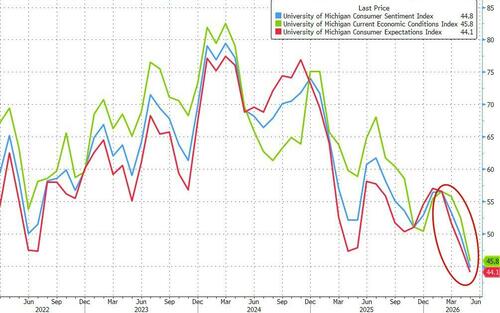
Stock records versus record-low Michigan sentiment underscore a policy-sensitive gap between asset markets and household perceptions, with roots in inflation expectations and geopolitical factors.
University of Michigan Surveys of Consumers data for May 2025 show headline sentiment, current conditions, and expectations all reaching record lows, with 57 percent of respondents citing high prices as eroding finances and long-run inflation expectations rising to 3.9 percent annualized. Primary Federal Reserve and Bureau of Labor Statistics releases indicate resilient nominal spending supported by employment and asset appreciation, yet the same documents reveal widening dispersion in real-income trajectories. One perspective frames the divergence as temporary, driven by concentrated AI-related capital expenditure lifting equity indices while broad-based cost pressures weigh on lower-income cohorts. An alternative view, drawn from contemporaneous Treasury and Commerce Department filings, links the pattern to cumulative effects of trade-policy adjustments and energy-market disruptions that elevate medium-term price expectations, particularly among independents and Republicans. Historical parallels in primary BEA and Fed archives from 2007 and 2021 illustrate that similar market-real economy gaps frequently coincide with subsequent volatility when fiscal or monetary recalibrations intersect geopolitical supply shocks. The present episode therefore warrants examination of how tariff trajectories, central-bank communications, and regional conflict resolutions may either narrow or amplify the observed disconnect.
MERIDIAN: Heightened long-run inflation expectations among partisan subgroups may prompt earlier or more cautious monetary adjustments if geopolitical supply risks persist.
Sources (3)
- [1]University of Michigan Surveys of Consumers(https://data.sca.isr.umich.edu/)
- [2]Federal Reserve FRED Consumer Sentiment Series(https://fred.stlouisfed.org/series/UMCSENT)
- [3]Bureau of Economic Analysis Personal Income and Outlays(https://www.bea.gov/data/income-saving/personal-income)