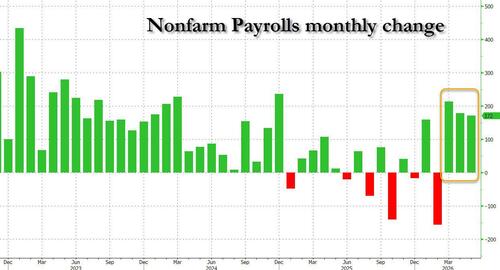
May Jobs Report's 4-Sigma Surprise Tests Fed Patience and Global Policy Transmission
May's outsized jobs beat complicates the Fed's rate path, strengthens the dollar, and creates uneven pressure on household finances and foreign borrowers.
The Bureau of Labor Statistics Employment Situation report for May recorded a 172,000 nonfarm payroll gain against a consensus of 88,000, with upward revisions lifting March and April by a combined 93,000. This outcome, the strongest macro print in several months, arrives as the FOMC maintains its data-dependent stance outlined in the June 2024 Statement on Longer-Run Goals and Monetary Policy Strategy. Household survey data showed a 149,000 rise in employment, breaking a prior pattern of divergence between establishment and household measures. Sector gains concentrated in leisure and hospitality (+70,000) and local government (+55,000), while financial activities contracted. Wage growth held at 3.4 percent year-over-year, aligning with the Fed's preferred PCE trajectory rather than signaling fresh wage-price spirals. From a policy lens, the print raises the implied probability of a September rate cut under CME FedWatch pricing while simultaneously compressing expectations for deeper easing later in the cycle. International spillovers appear through dollar strength and Treasury yield curves, affecting emerging-market debt service costs documented in the IMF's April 2024 World Economic Outlook. Household balance sheets face mixed effects: tighter financial conditions could slow consumption, yet sustained employment reduces layoff risk for lower-income cohorts tracked in Census Bureau pulse surveys. Critics of the establishment survey note potential seasonal adjustment distortions post-pandemic, while defenders point to consistent unemployment at 4.3 percent across demographic groups. The report therefore transmits conflicting signals to both domestic rate paths and global capital flows without resolving underlying questions of labor-market cooling speed.
MERIDIAN: Persistent strength in payrolls delays but does not eliminate 2024 easing, transmitting tighter financial conditions to both US households and dollar-linked economies.
Sources (2)
- [1]Primary Source(https://www.bls.gov/news.release/archives/empsit_06072024.htm)
- [2]Related Source(https://www.federalreserve.gov/monetarypolicy/files/monetary20240612a1.pdf)