UAE's OPEC Exit: A Catalyst for Global Oil Market Realignment Amid Middle East Tensions
The UAE’s exit from OPEC on May 1, 2026, driven by strategic and geopolitical factors, threatens the cartel’s cohesion and could trigger a broader realignment among oil producers. Amid Middle East tensions and global energy transitions, this move may reshape supply dynamics and price stability, with implications for smaller OPEC members and the multipolar oil market.
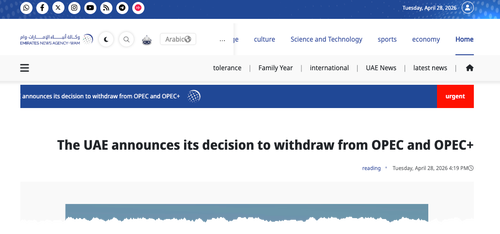
The United Arab Emirates' (UAE) unexpected decision to exit OPEC and OPEC+ as of May 1, 2026, marks a pivotal moment in global energy geopolitics, with far-reaching implications for oil supply agreements, price stability, and the broader alignment of oil-producing nations. Announced via the Emirates News Agency (WAM), the UAE framed the move as part of a long-term strategic and economic vision to enhance flexibility in responding to market dynamics while maintaining a commitment to responsible production. This exit, however, is not merely a unilateral policy shift; it reflects deeper structural and geopolitical currents that could reshape the global energy landscape.
The UAE, producing approximately 4.05 million barrels per day (bpd) and aiming for 5 million bpd by 2027, is a significant player within OPEC. Its departure weakens the cartel’s cohesion and ability to enforce production quotas, particularly during economic downturns when price floors are hardest to defend. This concern was echoed by UBS analyst Matthew Cowley, who noted the potential erosion of OPEC’s market control. Yet, the original coverage by ZeroHedge misses critical context: the UAE’s exit is not just a reaction to liquidity concerns or domestic economic pressures but a strategic pivot amid escalating tensions in the Middle East, particularly involving Iran and the Strait of Hormuz—a chokepoint for global oil supply. The WAM statement subtly references geopolitical fluctuations in the Arabian Gulf, signaling that security and supply chain risks are as much a driver as economic strategy.
Historically, OPEC has faced internal divisions, but the UAE’s exit is unique in its timing and potential to trigger a domino effect. Unlike previous disputes—such as the 2021 UAE-Saudi disagreement over production quotas, which was resolved through compromise—the current move coincides with heightened regional instability. Iran’s ongoing domestic chaos and its proxy conflicts across the region, as reported by the International Crisis Group in 2025, exacerbate risks to oil transit routes. The UAE, with its advanced infrastructure and proximity to these flashpoints, may be positioning itself as an independent actor to secure bilateral deals with major consumers like China and India, bypassing OPEC’s collective bargaining constraints. This aligns with a broader pattern of nationalistic realignment among producers, where countries prioritize sovereignty over cartel unity—a trend also visible in Saudi Arabia’s recent diversification efforts under Vision 2030.
What the original coverage overlooks is the potential impact on smaller OPEC members like Libya and Venezuela, which rely on cartel solidarity to stabilize their fragile economies. The UAE’s exit could embolden others to follow, fragmenting OPEC further and accelerating a shift toward a multipolar oil market. Additionally, the environmental angle is underexplored: the UAE’s emphasis on being a 'low-carbon-intensity' producer suggests a dual strategy of increasing oil output while branding itself as a sustainable energy leader ahead of global transitions—a narrative that could appeal to Western investors amid COP climate commitments.
Synthesizing multiple perspectives, the UAE’s decision also reflects a response to U.S. policy shifts. The 2025 U.S. Energy Information Administration (EIA) report highlights America’s growing shale output, reducing reliance on Middle Eastern oil and pressuring OPEC to adapt. Meanwhile, the UAE’s request for Federal Reserve swap lines, as noted in the original story, indicates financial strain that may have necessitated this bold move to unlock independent revenue streams. Together, these factors suggest the UAE is not merely exiting OPEC but redefining its role in a rapidly evolving energy order—one where regional security, economic autonomy, and global demand trends collide.
In conclusion, the UAE’s departure from OPEC is a microcosm of broader geopolitical and economic fault lines. It challenges the cartel’s relevance in an era of fragmented alliances and could catalyze a realignment among oil producers, with ripple effects on energy markets worldwide. As Middle East tensions escalate, the stability of global oil supply hangs in a delicate balance, with the UAE’s next moves likely to set a precedent for others.
MERIDIAN: The UAE’s exit may accelerate OPEC’s fragmentation, with smaller members facing heightened economic risks. Expect Saudi Arabia to counterbalance by tightening production controls, though regional instability could undermine these efforts.
Sources (3)
- [1]Emirates News Agency (WAM) - UAE Withdrawal Announcement(https://www.wam.ae/en/details/1395303234347)
- [2]U.S. Energy Information Administration (EIA) - 2025 Annual Energy Outlook(https://www.eia.gov/outlooks/aeo/)
- [3]International Crisis Group - Iran Conflict Dynamics 2025 Report(https://www.crisisgroup.org/middle-east-north-africa/gulf-and-arabian-peninsula/iran)