Pew and Gallup Data Document Sharp Ideological Gap in Young Women's Mental Health Reports
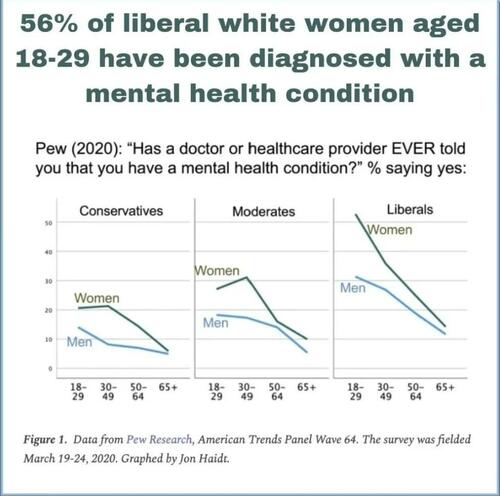
Multiple surveys record substantially higher mental health diagnosis rates and lower life satisfaction among young liberal women compared with conservative peers. The pattern holds after accounting for possible differences in help-seeking behavior. Countervailing male suicide statistics highlight selective cultural attention to reported distress.
The documented shift shows a steep decline in self-reported well-being. Gallup polling from 2020-2024 recorded only 15 percent of women ages 18-29 describing their mental health as excellent, down from 48 percent in 2010-2014. The 2024 American Family Survey reinforced the pattern, with 12 percent of liberal women ages 18-40 stating they were completely satisfied with life versus 37 percent of conservative women and nearly three times the loneliness frequency among liberals. Primary records indicate the divergence predates recent events and tracks ideological self-identification rather than external shocks alone. Competing interests appear in measurement: one 2025 study found that direct mood questions narrow the liberal-conservative gap, suggesting differences in labeling distress versus experiencing it. Male suicide rates remain nearly four times higher, exposing an asymmetry in which forms of suffering receive institutional recognition. State and institutional incentives favor expanded diagnostic categories and grievance frameworks that increase demand for services and policy interventions. The data do not establish causation between ideology and pathology but show persistent correlation across multiple surveys. Future tracking will test whether reported rates stabilize or continue diverging by political cohort.
Gallup: Share of US women 18-29 reporting excellent mental health will stay below 20 percent through 2027.
Sources (3)
- [1]Pew Research Center American Trends Panel(https://www.pewresearch.org)
- [2]Gallup Well-Being Tracking 2020-2024(https://news.gallup.com)
- [3]American Family Survey 2024(https://www.americanfamilysurvey.org)