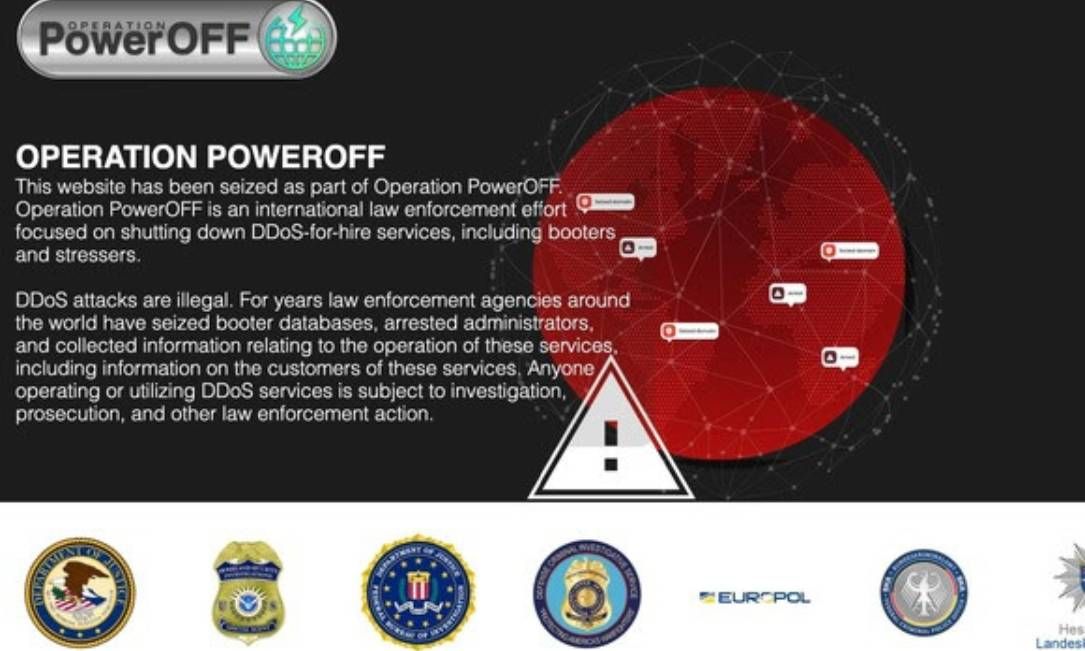
PowerOFF Takedown: Tactical Wins Mask Strategic Failure in Containing Commoditized Cyber Disruption
Multinational PowerOFF operation seizes 50+ DDoS-for-hire domains, arrests four operators, and exposes 75,000 users, yet analysis of prior operations and underground market data shows these services rapidly reconstitute, highlighting persistent infrastructure vulnerabilities and the limits of law enforcement-focused disruption.
International law enforcement executed a sweeping operation under the PowerOFF banner, coordinating across more than 20 countries to seize over 50 domains, execute 25 search warrants, and arrest four individuals tied to prominent DDoS-for-hire platforms including Vac Stresser, Mythical Stress, Quantum-Stress, and Dreams-Stresser. Europol reported the identification of roughly 75,000 user accounts, while U.S. authorities highlighted attacks against schools, gaming platforms, government systems, and critical infrastructure — including resources linked to the Department of Defense, awkwardly referenced in some materials as 'Department of War.' Court documents reveal one platform alone facilitated over 142 million attacks, with subscription tiers ranging from $45 for basic 40-minute strikes to $950 for sustained 500-hour campaigns capable of hitting 90 targets simultaneously.
This latest action builds on nearly a decade of Operation PowerOFF efforts that have produced 11 U.S. charges and roughly 100 domain seizures. However, the original coverage from The Record understates several critical dimensions. It treats the operation as a discrete victory rather than acknowledging the explicit admission by DOJ officials that, despite years of disruption, these services continue to proliferate precisely because they offer such a low barrier to entry. What the reporting missed is the intelligence multiplier effect: data harvested from prior takedowns enabled geolocation of over three million criminal accounts, demonstrating a maturing fusion model between Europol, FBI, DOJ, and allied agencies. This represents an evolution from simple server seizures to persistent targeting of backend infrastructure and user ecosystems.
Synthesizing the primary reporting with the official Europol IOCTA 2023 assessment and a 2024 Chainalysis report on underground cybercrime economies reveals deeper patterns. These 'stresser' services function as both gateway drugs into cybercrime and convenient cutouts for more sophisticated actors. Russian and Iranian-linked groups have historically used booter infrastructure for deniability during hybrid campaigns — the 2022 DDoS waves against Ukrainian financial and government targets frequently overlapped with commercial stresser traffic. Similarly, the Mirai botnet variants that power many of these services continue to exploit unpatched IoT devices at scale, creating an inexhaustible supply of attack nodes that law enforcement has been unable to address upstream.
The coverage also glosses over the geopolitical asymmetry. While Western agencies can arrest operators in EU countries and the United States — often young males running operations from bedrooms — the core hosting, payment processing, and botnet command infrastructure frequently resides in jurisdictions less responsive to mutual legal assistance requests. The operation's success in exposing 75,000 users offers significant follow-on potential for disruption of linked ransomware and fraud networks, yet history suggests new platforms will appear within weeks using updated code, cryptocurrency payments, and automated provisioning. Previous Polish arrests of four operators offering services for €10 and the 2022 LizardStresser takedown produced similar headlines but negligible long-term reduction in attack volume.
Genuine analysis indicates this is less a decisive blow than a necessary but insufficient calibration of effort. The commoditization of DDoS capability democratizes disruption, allowing script kiddies, hacktivists, and state proxies alike to generate strategic effects against soft targets like hospitals, municipalities, and transportation networks. As infrastructure becomes more interconnected, the societal cost of even short outages escalates. Law enforcement deserves credit for improved speed and coordination, yet without parallel pressure on cloud providers, ISP-level filtering mandates, and widespread deployment of advanced mitigation at the edge, these operations remain performative theater in an escalating cyber power shift toward offense. The real metric of success will not be domains seized but measurable decline in successful attacks against critical infrastructure — a threshold this campaign, like its predecessors, is unlikely to cross.
SENTINEL: While PowerOFF demonstrates maturing international intelligence fusion against commoditized cyber tools, the persistent low barrier to entry and resilient botnet supply chains mean new stresser services will emerge within weeks; genuine infrastructure protection requires shifting resources from periodic takedowns toward mandatory edge mitigation and IoT security standards.
Sources (3)
- [1]Four arrested in latest ‘PowerOFF’ DDoS-for-hire takedown(https://therecord.media/ddos-hire-europol-doj-crackdown)
- [2]Europol IOCTA 2023 - Internet Organised Crime Threat Assessment(https://www.europol.europa.eu/publications-events/main-reports/internet-organised-crime-threat-assessment-iocta-2023)
- [3]Chainalysis 2024 Crypto Crime Report: Cybercrime Markets(https://www.chainalysis.com/blog/2024-crypto-crime-report/)