Volkswagen CEO Plans Cuts of 100,000 Jobs and 11 Billion Euros in Costs by 2030
Volkswagen's proposed 100,000-job reduction and brand restructuring address chronic margin erosion from Chinese competition and EV transition costs. Governance constraints and union leverage will likely stretch timelines and raise the fiscal price of execution. The episode illustrates how legacy European automakers must reprice labor and capacity against new entrants operating with lower fixed costs.
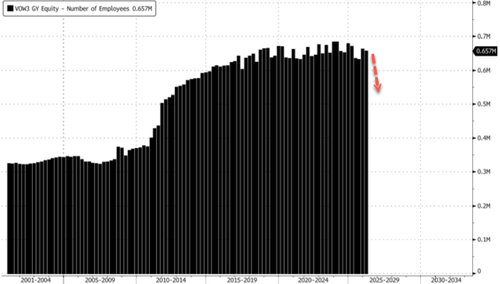
Manager Magazin reported that Blume will present the restructuring to the supervisory board next month. First-quarter results showed revenue down 2.5 percent to 75.7 billion euros, operating profit falling 14.3 percent to 2.46 billion euros, and vehicle sales declining 6.9 percent. The plan includes 11 billion euros in savings through automation, component divestitures, and brand separation. VW expanded headcount sharply from 2008 to 2020 before margins compressed under Chinese competition and weak European demand.
The cuts reflect a structural response to sustained low returns rather than cyclical weakness. Legacy scale in internal-combustion platforms now carries excess fixed costs while battery-electric volumes remain below break-even in Europe. Labor representation on the supervisory board and Lower Saxony's 20 percent stake create formal veto points that raise the price of any capacity reduction. Similar patterns appeared at Stellantis and Renault when Chinese imports accelerated after 2022.
Implementation hinges on negotiations that historically extend timelines. Union agreements at VW have previously required side payments in the form of investment guarantees or early-retirement packages. Without offsetting state subsidies or accelerated Chinese market recovery, full realization of the 100,000-headcount target by 2028 remains improbable. Supply-chain tier-one suppliers face parallel pressure as VW's component spin-offs shift volume risk downstream.
Next steps include board approval, works-council consultations under German co-determination law, and possible government mediation through the Federal Ministry for Economic Affairs. Parallel filings with the European Commission on state-aid compatibility will determine whether public funds can offset social costs.
Works council: Formal agreement on plant closures will not be reached before March 2025 absent federal subsidies above 1.5 billion euros.
Sources (2)
- [1]Volkswagen AG Q1 2024 Earnings Release(https://www.volkswagen-group.com/en/investors)
- [2]Manager Magazin VW Restructuring Report(https://www.manager-magazin.de)