South Korea's 'AI Tax' Threat: A New Frontier in Tech Regulation and Global Market Risks
South Korea's 'AI tax' threat, floated by a senior policymaker to fund citizen dividends, caused a $300 billion market drop before clarifications eased fears. This incident exposes novel regulatory risks for the global tech sector, reflecting broader patterns of government intervention in AI-driven inequality. Overlooked in initial coverage, the proposal's implications for investment, innovation, and global policy trends signal a potential shift toward wealth redistribution, raising unanswered questions about balancing equity and growth.
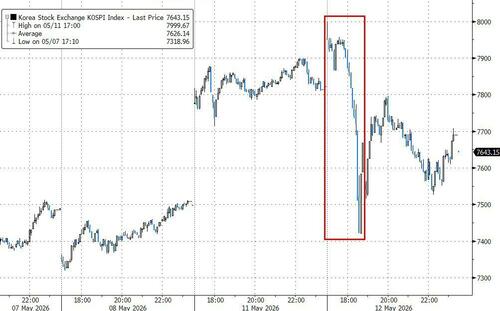
South Korea's recent market turbulence, triggered by a senior policymaker's suggestion of an 'AI tax' to fund citizen dividends, has unveiled a novel regulatory risk for the global tech sector. On a Facebook post, Kim Yong-beom, the presidential policy chief, argued that 'excess profits in the AI era are, by nature, concentrated,' pointing to the disproportionate benefits accrued by memory chip giants like Samsung and SK Hynix, while the middle class sees only indirect gains. This statement led to a sharp 5.1% drop in the KOSPI index, wiping out over $300 billion in market cap temporarily, before a clarification that Kim's remarks were personal and not policy-driven mitigated some damage. However, the episode underscores a growing tension between rapid AI-driven innovation and government efforts to address economic inequality, a theme with potential to ripple across borders.
Beyond the immediate market reaction, this incident reveals a critical oversight in initial coverage: the lack of context on South Korea's unique political and economic landscape. South Korea has a history of aggressive state intervention in tech industries, as seen in past policies targeting chaebols (family-run conglomerates) like Samsung with antitrust measures and corporate governance reforms. Kim's proposal, though speculative, aligns with a broader pattern of governments worldwide grappling with the societal impacts of AI, from job displacement to wealth concentration. For instance, the European Union's AI Act, finalized in 2023, imposes strict compliance costs on tech firms to mitigate risks, while the U.S. debates antitrust actions against Big Tech for market dominance. South Korea's 'AI tax' idea, even if not implemented, signals a potential shift toward direct wealth redistribution as a policy tool, a step beyond existing regulatory frameworks.
What original reports missed is the deeper implication for global AI investment. South Korea is a linchpin in the AI supply chain, with Samsung and SK Hynix controlling significant shares of the memory chip market essential for AI hardware. A tax on AI profits, even if framed as tapping 'excess tax revenue,' could deter investment in a sector already facing geopolitical risks, such as U.S.-China tech decoupling and export controls on semiconductor equipment. Investors, already jittery after an 80% rally in Korean tech stocks this year, may reassess risk premiums if similar policies gain traction elsewhere. This connects to a broader pattern of governments curbing Big Tech's unchecked growth—seen in China's 2021 crackdown on tech giants like Alibaba and India's data localization laws—reflecting a global push to reclaim economic sovereignty over digital innovation.
Moreover, the 'AI tax' debate highlights a gap in policy discourse: the absence of a clear framework for balancing innovation with equity. While Kim's idea of a citizen dividend echoes universal basic income experiments (like Finland's 2017-2018 pilot), it lacks specificity on funding mechanisms or economic impacts. Could such a tax stifle AI R&D at a time when global competition, particularly with China, demands accelerated investment? Or could it set a precedent for equitable wealth distribution in the digital age? These questions remain unanswered in both Kim's remarks and subsequent coverage, pointing to a need for deeper analysis of trade-offs.
Synthesizing multiple perspectives, the market reaction in South Korea may be a harbinger of volatility as governments experiment with tech taxation. The U.S., for instance, has seen proposals for digital services taxes targeting tech giants, as outlined in the 2021 OECD/G20 agreement on global minimum corporate tax rates, which indirectly pressures AI-heavy firms. Meanwhile, the EU's focus on AI ethics and safety could evolve into fiscal measures if wealth inequality worsens. South Korea's episode, though preliminary, may catalyze a global conversation on whether AI's economic benefits can—or should—be redistributed, and at what cost to innovation.
MERIDIAN: South Korea's 'AI tax' idea, even if not enacted, may inspire similar policies in other tech-heavy economies within 12-18 months, as governments seek to address AI-driven inequality, potentially slowing innovation if not carefully balanced.
Sources (3)
- [1]Bloomberg: South Korea's AI Tax Proposal Sparks Market Chaos(https://www.bloomberg.com/news/articles/2023-11-14/south-korea-ai-tax-proposal-triggers-market-selloff)
- [2]European Commission: EU AI Act Overview(https://digital-strategy.ec.europa.eu/en/policies/european-approach-artificial-intelligence)
- [3]OECD: Global Minimum Tax Agreement(https://www.oecd.org/tax/beps/statement-on-a-two-pillar-solution-to-address-the-tax-challenges-arising-from-the-digitalisation-of-the-economy-october-2021.htm)