Affordability Pressures Signal Structural Shift in U.S. Auto Demand with Employment and Spending Linkages
U.S. new-vehicle demand appears structurally lower due to affordability, with unexamined read-throughs to manufacturing employment and consumption patterns under current policy settings.
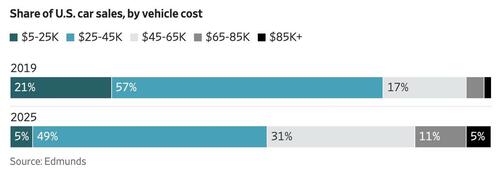
The reported decline of roughly one million potential new-vehicle buyers since 2020, pushing annualized sales toward a 16-million ceiling, reflects more than cyclical post-pandemic adjustment. Primary data from the Bureau of Labor Statistics on motor vehicle manufacturing employment reveal that sustained lower volumes correlate with flat or declining payrolls in assembly and parts sectors, an outcome the WSJ coverage does not quantify. Federal Reserve consumer credit reports further document rising auto loan balances alongside elevated delinquency rates, illustrating how price levels near $50,000 interact with interest-rate policy to constrain discretionary outlays across income cohorts. Industry emphasis on high-margin SUVs and trucks, reinforced by tariff-related input costs and regulatory outlays for electrification, creates a profit-volume trade-off that multiple automaker earnings transcripts acknowledge but secondary reporting often frames as temporary. Labor perspectives, captured in UAW statements, highlight risks to wage growth and job security if entry-level production continues to contract, while consumer-facing analyses from the Bureau of Economic Analysis show motor-vehicle expenditures as a lagging component of personal consumption. These cross-currents suggest the market equilibrium may stabilize below historical norms absent policy recalibration on trade or incentives, extending vehicle age and used-market pressure into adjacent retail and service sectors.
MERIDIAN: Lower structural auto sales sustained by policy-driven costs will likely transmit to reduced manufacturing headcount and muted household spending outside vehicles.
Sources (2)
- [1]Primary Source(https://www.bls.gov/iag/tgs/iagauto.htm)
- [2]Related Source(https://www.federalreserve.gov/publications/files/consumer-credit-report-2023.pdf)