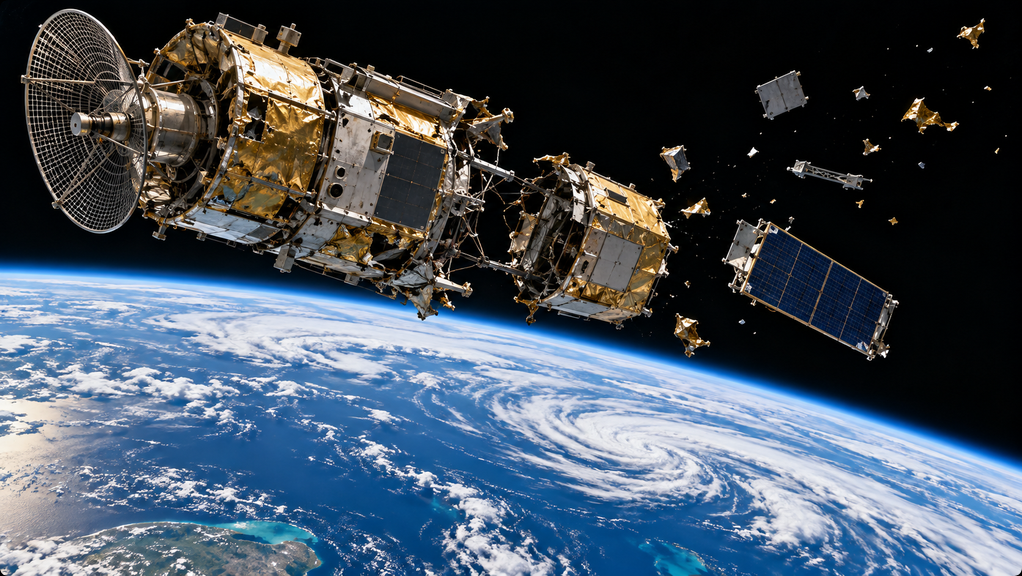
Cold War Spy Satellite USA-32 Fragments in Orbit, Cause Remains Unknown
Verified reports confirm the September 13, 2026, breakup of the 1988-launched USA-32/FARRAH III spy satellite, with official Space Force tracking of debris but undetermined cause; consistent with known risks from legacy spacecraft in congested orbits.
A nearly 40-year-old U.S. National Reconnaissance Office signals-intelligence satellite, designated USA-32 (also known as FARRAH III), unexpectedly broke apart in low Earth orbit on September 13, 2026, at approximately 21:13 UTC. The U.S. Space Forces-Space confirmed the fragmentation event via Space-Track, noting that all tracked debris are being incorporated into routine conjunction assessment screenings for spaceflight safety, with no immediate threats identified and further analysis ongoing.
Launched on September 5, 1988, aboard a Titan II rocket, the satellite operated in an orbit around 775 km (480 miles) altitude, designed to intercept Soviet-era radar and radio signals. Its codename FARRAH drew from actress Farrah Fawcett, part of a secretive NRO program. The spacecraft had long since completed its mission and was defunct when the breakup occurred.
Possible causes discussed across reports include aging hardware failure—such as a ruptured pressurized tank or battery cell after decades of thermal cycling—or an untracked collision. No evidence supports deliberate action. The event adds to recent orbital fragmentation incidents and highlights risks in a crowded LEO environment, where debris can threaten active satellites like those in the Iridium constellation.
Independent trackers, including s2a systems, observed fragments dispersing widely within days. Space analysts emphasize the importance of passivation standards for older satellites to mitigate future debris generation.
Space debris analyst: Legacy Cold War satellites without modern passivation increase collision cascade risks in LEO as orbital traffic grows; expect more such events prompting stricter end-of-life protocols.
Sources (6)
- [1]A Secret US Spy Satellite Launched In 1988 Has Unexpectedly Shattered Into Pieces(https://www.iflscience.com/a-secret-us-spy-satellite-launched-in-1988-has-unexpectedly-shattered-into-pieces-posing-danger-to-other-satellites-in-low-earth-orbit-84711)
- [2]A Cold War Spy Satellite Named After Farrah Fawcett Just Blew Apart in Orbit(https://gizmodo.com/a-cold-war-spy-satellite-named-after-farrah-fawcett-just-blew-apart-in-orbit-2000819282)
- [3]An American Cold War-era spy satellite just exploded above Earth — and nobody knows why(https://www.livescience.com/space/space-exploration/an-american-cold-war-era-spy-satellite-just-exploded-above-earth-and-nobody-knows-why)
- [4]USA 32 Spy Satellite Breaks Apart in Crowded LEO(https://fodnews.com/usa-32-spy-satellite-breakup-leo-debris/)
- [5]Mystery Surrounds Destruction of U.S. Spy Satellite in Orbit(https://thedebrief.org/mystery-surrounds-destruction-of-u-s-spy-satellite-in-orbit-as-officials-assess-possible-danger-to-spacecraft/)
- [6]KTOC Notice KT-20260913-19460-ANN(https://keeptrack.space/ktoc-notice/kt-20260913-19460-ann-usa-32-breakup-announced-by-space-track)