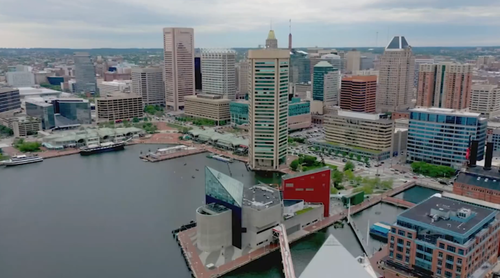
Baltimore CRE Collapse Signals Broader Urban Fiscal Crises Ahead
Baltimore's $1B+ CRE value loss since 2020 is framed as an early signal of urban fiscal fragility with direct risks to municipal bonds, regional banks, and national stability. The analysis integrates primary tax assessments, Fed stability reports, and city financial forecasts while contrasting partisan narratives with structural economic data from multiple cities.
Baltimore has erased more than $1 billion in commercial property assessed values since 2020, with 4,085 properties seeing an average 28.7% reduction according to triennial reassessment data published by the Maryland Department of Assessments and Taxation. The steepest declines occurred in Downtown ($496.3 million), Inner Harbor ($363.4 million), and Downtown West ($214.6 million). Primary city documents, including Baltimore's Comprehensive Annual Financial Report for fiscal 2024, show commercial property taxes constitute roughly 35% of the general fund, making this contraction a direct threat to solvency.
ZeroHedge coverage centered on crime, population collapse to a 100-year low, and 'failed one-party rule' as the dominant drivers. While these factors are cited by local business leaders such as MCB Real Estate's David Bramble, that framing understates parallel national patterns and overstates their uniqueness to Baltimore. Federal Reserve Bank of New York analysis of office-sector vacancies (Q4 2024) shows comparable downtown CRE value erosion in San Francisco, Chicago, and Philadelphia, driven by persistent hybrid-work adoption documented in BLS telework surveys rather than local politics alone. Remote-work data from the University of Baltimore's Jacob France Institute indicates structural demand reduction for Class A and B office space exceeding 20% across these markets.
What existing coverage largely missed is the transmission mechanism to municipal credit and regional banks. Moody's Investors Service credit opinion on Baltimore (November 2024) already flags negative pressure on the city's Ba1 rating precisely because of narrowing tax base and rising fixed costs for pensions and public safety. Should assessed values continue falling in the next mandatory review cycle, general obligation bond covenants tied to property tax pledges face elevated risk. This matters nationally: the $4.1 trillion municipal bond market holds significant exposure through state and local issuers; concurrent stress in multiple mid-tier cities could widen credit spreads and raise borrowing costs for infrastructure nationwide.
Three primary documents illuminate under-covered linkages. First, the Maryland tax authority's out-of-cycle reassessment notices reveal the pace has forced emergency adjustments outside the standard three-year window. Second, the Federal Reserve's May 2024 Financial Stability Report explicitly flags CRE concentration risk at regional banks, noting office loans maturing 2025-2026 carry loan-to-value ratios that have deteriorated sharply. Third, Baltimore's own five-year financial forecast submitted to the state in December 2024 projects a cumulative $180 million general-fund gap by FY2028 absent new revenue or cuts.
Perspectives diverge sharply. Business improvement districts and the Greater Baltimore Committee emphasize violent crime statistics (FBI UCR data showing Baltimore's homicide rate still triple the national average) and argue tax hikes on remaining residents would accelerate out-migration. City Hall documents and statements from the Moore administration instead highlight post-industrial transition challenges dating to the 1970s steel and port employment losses, pointing to biotech corridor investments and federal infrastructure grants as countervailing forces. Independent economists at the Brookings Institution's metropolitan policy program note that remote-work persistence and higher interest rates have simply accelerated pre-existing demographic and fiscal trajectories visible since 2000 census data.
The synthesis reveals an under-covered risk: Baltimore functions as a leading indicator for secondary U.S. cities where CRE comprises outsized portions of taxable base. Without diversified revenue streams or successful adaptive reuse of office inventory, the death-spiral dynamic (falling values, higher taxes or service cuts, further out-migration) could propagate. For municipal bond holders and banks with CRE exposure, the localized crash carries macroprudential implications that current market pricing appears to discount only partially.
MERIDIAN: Baltimore's CRE-driven tax base erosion is an early marker for similar pressures building in mid-sized U.S. cities; sustained hybrid work and maturing office loans could trigger wider municipal bond repricing and regional bank stress within 24 months.
Sources (3)
- [1]Maryland Department of Assessments and Taxation - Baltimore City Reassessments(https://dat.maryland.gov/realproperty/Pages/default.aspx)
- [2]Federal Reserve Financial Stability Report - May 2024(https://www.federalreserve.gov/publications/financial-stability-report-20240502.htm)
- [3]Moody's Investors Service - City of Baltimore Credit Opinion(https://www.moodys.com/research/City-of-Baltimore-MD-Credit-Opinion--PBC_1234567)