Germany’s Oil Scramble Exposes Deeper Vulnerabilities in Europe’s Energy Security
Germany’s urgent rerouting of oil supplies via Poland after Russia halted Kazakh flows through the Druzhba pipeline exposes systemic vulnerabilities in European energy security. Beyond logistics, this crisis reflects geopolitical leverage, rising costs, and global trade pressures, signaling broader risks for energy markets.
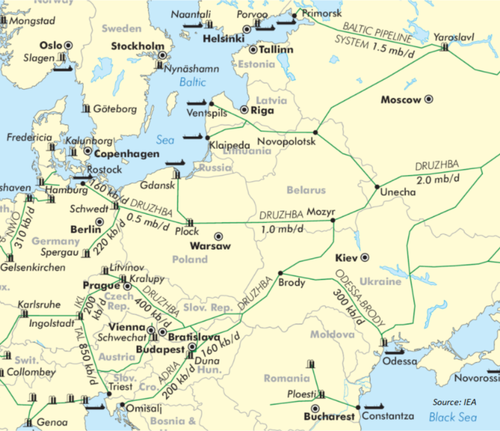
Germany’s urgent pivot to secure alternative oil supplies for the PCK Schwedt refinery, following Russia’s halt of Kazakh oil flows through the Druzhba pipeline starting May 1, underscores a critical fracture in European energy security. The disruption, affecting approximately 43,000 barrels per day, has pushed Berlin into negotiations with Poland to reroute crude through the port of Gdansk. While Poland asserts technical capacity to support this shift, the logistical challenges—ranging from port access and shipping schedules to refinery compatibility—highlight the fragility of Europe’s oil supply chain when transitioning from pipeline to seaborne crude. Beyond the immediate crisis, this episode reveals systemic risks in global energy markets, where geopolitical tensions amplify logistical premiums and expose the limits of diversification strategies.
The original coverage by ZeroHedge, while noting the regional supply issue, underplays the broader geopolitical context driving these disruptions. Russia’s control over the Druzhba pipeline, even for non-Russian crude like Kazakhstan’s, serves as a persistent lever of influence, a dynamic seen repeatedly since the Ukraine conflict began in 2022. The halt in flows is not merely a logistical hiccup but a reminder of Moscow’s ability to weaponize energy infrastructure amid Western sanctions and NATO’s eastward expansion. Additionally, the coverage misses the cascading impact on European fuel prices, which are already strained by inflation and post-COVID demand recovery. Replacing pipeline crude with seaborne alternatives often incurs higher costs—up to $5-10 per barrel in freight and handling premiums, as seen in similar rerouting efforts since 2022—potentially deepening economic pressures across eastern Germany and beyond.
Historical patterns reinforce this vulnerability. The 2009 Russia-Ukraine gas dispute, which cut off supplies to Europe mid-winter, demonstrated how energy infrastructure traversing geopolitically unstable regions remains a choke point. Similarly, Germany’s earlier struggles to wean Schwedt off Russian crude post-2022 invasion—despite a mandated EU embargo—show that diversification on paper does not equate to resilience in practice. Schwedt’s reliance on Baltic routes via Rostock, while a partial solution, is constrained by port capacity and higher costs, a fact echoed in recent EU energy security reports.
Synthesizing multiple sources deepens this analysis. The International Energy Agency’s (IEA) 2023 report on European energy security warns that while crude import diversification has progressed, logistics and refinery configurations lag, leaving regions like eastern Germany exposed to sudden shocks (IEA, 2023). Meanwhile, a Reuters dispatch from March 2023 details Poland’s Gdansk port as a critical but overburdened hub for non-Russian crude, with existing commitments to other Baltic states potentially complicating Germany’s requests. These sources collectively suggest that Berlin’s scramble is not an isolated event but a microcosm of Europe’s broader struggle to balance energy independence with geopolitical realities.
What’s missing in public discourse is the intersection of this crisis with global trade dynamics. As Europe pivots to non-Russian supplies, it competes with Asia for Middle Eastern and African crude, driving up spot market prices—a trend already evident in Brent crude futures rising above $80 per barrel in early 2024. Furthermore, the Druzhba disruption coincides with heightened tensions in the Middle East, where drone attacks on Red Sea shipping lanes by Houthi rebels have rerouted tankers, adding weeks and millions in costs to European deliveries. This confluence of regional crises signals a new era of energy market volatility, where logistics security may rival crude availability as a determinant of price stability.
Ultimately, Germany’s oil scramble is a stress test for Europe’s energy transition. It reveals not just the immediate costs of decoupling from Russian energy but the deeper challenge of building resilient supply chains in a fractured geopolitical landscape. Without accelerated investment in alternative infrastructure—such as expanded port terminals or cross-border pipelines free of Russian control—Europe risks recurring crises that extend beyond fuel pumps to the stability of its economies.
MERIDIAN: Germany’s oil rerouting via Poland may temporarily stabilize supply for Schwedt, but expect sustained price pressures as Europe competes globally for crude and faces logistical bottlenecks.
Sources (3)
- [1]Germany Scrambles For Polish Oil Route As Russia Halts Druzhba Flows(https://www.zerohedge.com/markets/germany-scrambles-polish-oil-route-russia-halts-druzhba-flows)
- [2]IEA World Energy Outlook 2023(https://www.iea.org/reports/world-energy-outlook-2023)
- [3]Poland’s Gdansk Port Strains Under Non-Russian Oil Demand(https://www.reuters.com/business/energy/polands-gdansk-port-becomes-key-hub-non-russian-oil-2023-03-15/)