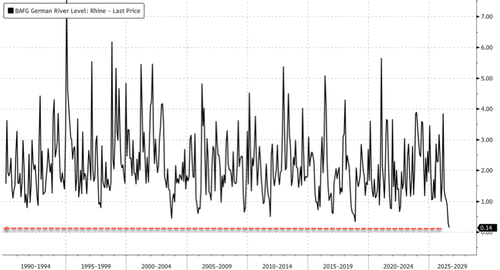
Record Rhine Drought Disrupts Europe's Industrial Heartland: Thyssenkrupp and Beyond Face Supply Chain Strain
Europe's Rhine River has hit record lows in August 2026 due to heat and drought, disrupting barge shipping and raw material flows to Thyssenkrupp's Duisburg steelworks and chemical producers like BASF. Multiple industries face higher costs and production tweaks, with modest near-term GDP risks but clear supply chain vulnerabilities exposed.
Persistent drought and extreme heat across Europe have driven the Rhine River to historic lows in August 2026, with navigable depths at the critical Kaub gauge falling to just 15 cm—surpassing the previous record of 25 cm set in 2018. This has halted most commercial barge traffic through the chokepoint, severely restricting raw material deliveries to major industrial facilities, most notably Thyssenkrupp's massive steel plant in Duisburg, Germany's industrial Ruhr region.
Thyssenkrupp has suspended its own push-barge operations and chartered shallower-draft vessels while slightly reducing blast furnace output due to constrained iron ore and other inputs. The port of Duisburg reports loading capacities down to roughly one-third of normal. Similar pressures affect chemical giants like BASF and Lanxess, which rely on the Rhine for feedstock and product transport.
Broader supply chain ripples extend to energy products, fuels, and industrial chemicals. Cargo vessels operate at ~20% capacity, triggering sharp freight surcharges and prompting German states to permit Sunday truck hauls. Analysts at UBS project only a modest, temporary GDP drag of 10-20 basis points in Q3—echoing 2018—but note the Rhine's outsized role in moving high-volume, low-value bulk goods despite representing just ~4% of total German freight.
The crisis underscores vulnerabilities in just-in-time European manufacturing amid climate-driven extremes. While companies have adapted with lighter vessels and multimodal shifts since 2018, prolonged low water (potentially into October without sustained rain) risks compounding existing pressures from energy costs and global competition. Daily consumer impacts could emerge via higher prices for steel-dependent goods (autos, appliances) and chemicals (plastics, fertilizers).
Historical parallels and current data from the Federal Institute of Hydrology confirm this as potentially a once-in-a-century event, linking meteorological anomalies directly to tangible economic bottlenecks.
Liminal: Persistent low Rhine levels illustrate how climate anomalies can cascade through bulk commodity logistics into everyday manufacturing costs and availability of steel- and chemical-derived products, amplifying vulnerabilities in concentrated industrial corridors.
Sources (5)
- [1]Low water on Germany's Rhine river threatens new blow to economy(https://www.euractiv.com/news/low-water-on-germanys-rhine-river-threatens-new-blow-to-economy/)
- [2]Rhine water levels fall to new lows, some ship sailings halted(https://www.reuters.com/business/environment/rhine-water-levels-fall-new-lows-some-ship-sailings-halted-2026-08-11/)
- [3]Rhine River Shipping Stalls as Water Level Hits Record Low(https://www.bloomberg.com/news/articles/2026-08-11/rhine-river-at-record-low-levels-is-forcing-industry-to-react)
- [4]Drought Threatens a Vital Economic Artery in the Heart of Europe(https://www.nytimes.com/2026/08/06/business/rhine-drought-germany-economy.html)
- [5]Low Rhine water levels raise logistics costs, force Thyssenkrupp Steel to cut blast furnace output(https://eurometal.net/low-rhine-water-levels-raise-logistics-costs-force-thyssenkrupp-steel-to-cut-blast-furnace-output/)