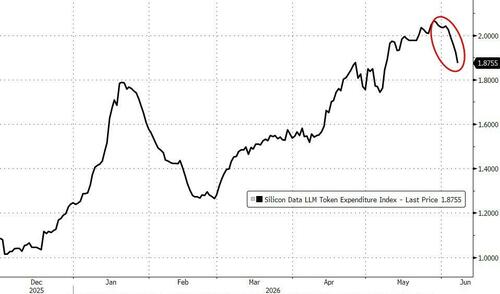
Token Panic: Corporate Backlash Signals the End of the AI Goldilocks Narrative
Corporate AI spending has pivoted sharply from hype-driven token-maxxing to cost panic, with major firms burning through 2026 budgets in Q1-Q2 amid usage-based pricing and agentic consumption surges. This exposes the fragility of the Goldilocks narrative, with implications for semiconductor demand, hyperscaler capex, and a likely shift toward efficient open models—connections largely missed by capability-focused tech reporting.
While mainstream tech outlets continue celebrating record ARR growth at AI labs like Anthropic and OpenAI, an overlooked economic reckoning is underway. Enterprises that enthusiastically adopted generative tools and agents in early 2026 are now confronting runaway token costs that have shattered budgets, marking a decisive shift from 'token-maxxing' exuberance to 'token-panic' austerity. This transition challenges the prevailing Goldilocks story—that AI capabilities could scale exponentially while costs remained manageable and returns obvious.
The warning signs are corroborated across multiple outlets. OpenAI CEO Sam Altman acknowledged at a recent enterprise event that cost has suddenly become 'a huge issue,' with clients repeating the meme: 'My company spent my entire 2026 budget in Q1. Can you make this more efficient?' What began the year as a non-issue has flipped as usage-based pricing replaces subsidized all-you-can-eat models. Altman noted the change was abrupt: customers were 'totally happy' with spending levels before the surge in agentic workloads that consume orders of magnitude more tokens than simple chat interfaces. Similar concerns appear in reporting from The Times of India and Business Insider.
Concrete examples illustrate the scale. Uber exhausted its full-year AI coding budget by April after promoting aggressive internal usage with leaderboards, prompting spending caps of $1,500 per tool per month and real-time dashboards. Microsoft's AI leadership cancelled Claude Code licenses, citing extreme expense and a search for alternatives. CNBC reports CFOs now face a brutal trade-off: 'tokens or humans,' as each new frontier model release roughly doubles per-token costs despite efficiency claims. TechCrunch's deep dive into the 'token bill comes due' describes an industry-wide scramble for guardrails after early 2025's consumption frenzy gave way to 3x budget overruns by spring 2026.
Citrini Research, which has tracked these dynamics since its earlier skeptical takes, frames the moment as the Goldilocks narrative hitting a wall. Explosive token growth that doubled semiconductor market values in months has a direct corollary: exploding opex lines on corporate P&Ls precisely as labs raise prices ahead of potential public debuts. OpenAI, Anthropic, Google, and Microsoft have all shifted toward usage-based token billing between April and June 2026. New tokenizers and agentic patterns can increase effective consumption 30%+ even at stable list prices, leaving finance teams without visibility into true burn rates.
The deeper, underreported connection lies in market consequences. Hyperscalers and infrastructure plays benefited from the subsidy-fueled land grab; corporate pushback risks tempering capex enthusiasm and exposing overbuilt expectations. This favors efficiency-focused innovators—open-source models reportedly 87% cheaper in some inference benchmarks—and on-device or tiered routing strategies that avoid defaulting to frontier models for every task. Mainstream coverage fixated on capabilities and valuation upside has ignored this maturing phase where ROI scrutiny returns, potentially pressuring pure token-volume plays while rewarding those solving the economics. The AI hype cycle is not ending, but its unchecked growth phase is encountering the hard constraints of unit economics and corporate governance that many chose to extrapolate past.
Efficiency Sentinel: Corporate token-panic and budget resets will accelerate adoption of cost-optimized open-source and routed inference solutions, slowing hyperscaler capex growth and introducing downward pressure on frontier AI infrastructure valuations through 2026-2027.
Sources (5)
- [1]The token bill comes due: Inside the industry scramble to manage AI's runaway costs(https://techcrunch.com/2026/06/05/the-token-bill-comes-due-inside-the-industry-scramble-to-manage-ais-runaway-costs/)
- [2]Bubble Heads Seize on Sam Altman's AI Costs Are 'Huge Issue'(https://www.businessinsider.com/ai-bubble-heads-doomers-sam-altman-ai-costs-huge-issue-2026-6)
- [3]Tokens or humans? The new corporate trade-off(https://www.cnbc.com/2026/05/29/-tokens-or-humans-the-new-corporate-trade-off.html)
- [4]State of the Themes: June 2026(https://www.citriniresearch.com/p/state-of-the-themes-june-2026)
- [5]OpenAI CEO Sam Altman 'accepts' clients telling him that 'My company spent my entire 2026 budget in Q1'(https://timesofindia.indiatimes.com/technology/tech-news/openai-ceo-sam-altman-accepts-clients-telling-him-that-my-company-spent-my-entire-2026-budget-in-q1-says-all-of-a-sudden-there-is-/articleshow/131508553.cms)