The Permanent Exit of a Million New-Car Buyers: Signs of a Deeper Affordability Reckoning
WSJ, Cox Automotive, and S&P Global data confirm ~1M buyers have permanently exited the new-car market, locking annual U.S. sales below 16M with record vehicle age at 12.8 years. This points to structural affordability collapse tied to debt, inflation, and margin-focused OEM strategies rather than temporary factors.
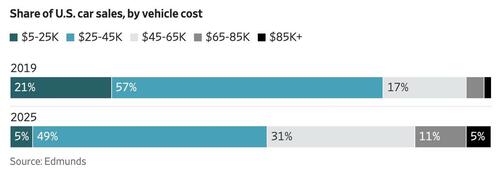
A recent Wall Street Journal investigation reveals that roughly one million prospective new-car buyers have left the U.S. market since 2020 and are not expected to return soon. Pre-pandemic annual sales routinely approached 17 million units; current industry forecasts from Cox Automotive and S&P Global Mobility project 2026 sales at approximately 15.8 million, a level that appears locked in below earlier norms even as supply constraints have eased. The average transaction price hovering near $50,000 has rendered entry-level models nearly extinct, pushing the new-vehicle market out of reach for many middle-income households. Automakers, having grown accustomed to high margins during pandemic-era shortages, show little appetite for aggressive price cuts or volume-chasing incentives, instead doubling down on profitable SUVs, trucks, and premium trims while pouring capital into costly EV mandates and navigating tariffs.
This is more than a cyclical dip. It reflects a structural shift in consumer behavior driven by persistent inflation, elevated interest rates, record levels of household debt, and the reality of being "underwater" on existing auto loans. A companion WSJ report highlights rising negative equity in trade-ins, with growing numbers of borrowers owing tens of thousands more than their vehicles are worth. Rather than buy new or even used (where prices also surged), millions are simply keeping older vehicles longer. The average age of light vehicles on U.S. roads reached a record 12.8 years in 2025 according to S&P Global Mobility, up two months for the second straight year.
Surface-level economic commentary often frames soft auto sales as transitory or tied to interest-rate sensitivity. The deeper pattern suggests otherwise: prolonged affordability pressure is reshaping expectations. Delayed big-ticket purchases ripple outward, sustaining demand for aftermarket repairs, depressing new-car manufacturing employment relative to pre-2020 trends, and signaling broader erosion in discretionary spending power. Some manufacturers including Stellantis have pledged future affordable models, yet analysts see no near-term path back to 17 million annual sales absent a significant increase in sub-$40,000 offerings. Until real wages, debt burdens, and price levels adjust, the American love affair with new cars is being quietly postponed, perhaps indefinitely, for a sizable segment of the population.
LIMINAL: This isn't a pause but a durable downgrade in middle-class consumption capacity; expect sustained weak new-vehicle demand, booming repair/aftermarket sectors, and hidden economic drag as households stretch aging assets amid unacknowledged inflation and debt realities.
Sources (4)
- [1]One Million New-Car Buyers Are Gone and They’re Not Coming Back Soon(https://www.wsj.com/business/autos/one-million-new-car-buyers-are-gone-and-theyre-not-coming-back-soon-c8984fae)
- [2]Cox Automotive Forecasts New-Vehicle Sales at 15.8 Million, Down From 2025(https://www.coxautoinc.com/insights/cox-automotive-2026-outlook/)
- [3]U.S. Vehicle Age Rises Again to 12.8 Years in 2025, According to S&P Global Mobility(https://www.spglobal.com/automotive-insights/en/blogs/2025/05/average-age-of-vehicle-in-us)
- [4]Car Buyers Sinking Into Record Levels of ‘Underwater’ Debt(https://www.wsj.com/business/autos/car-owners-debt-negative-equity-3cfcd031)