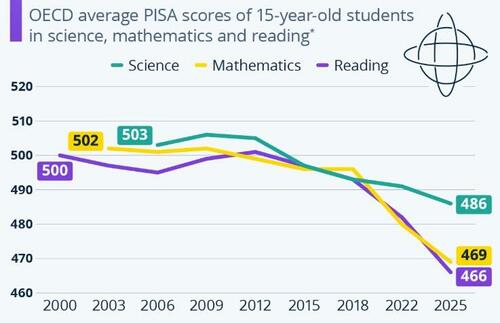
U.S. 15-Year-Olds Post Math Scores Below OECD Average on 2025 PISA With Reading Down From 2022 Levels
2025 PISA data confirm U.S. math and reading remain below 2019 levels and trail multiple developed peers. Secretary McMahon links results to federal structure and advocates school choice. OECD notes global rise in low performers and urges focused investment over technology substitution.
The OECD released initial 2025 PISA findings on 8 September covering 760,000 students across 91 systems. U.S. math stayed slightly below the OECD mean while reading fell further from 2015; science held steady from 2022. Only 8 percent of U.S. students reached top math proficiency levels versus 37 percent in Singapore. Four participating Chinese provinces again outperformed the United States across all domains. The digital computational problem-solving module placed the U.S. above the global mean yet behind several Asian and Anglosphere peers.
Education Secretary McMahon attributed the stagnation to federal bureaucracy and called for universal school choice. OECD Secretary-General Cormann stressed that top systems concentrate depth, support teachers and target low performers rather than rely on technology as a substitute. One in five global students now falls into the low-performance category in all three subjects, up from 16 percent in 2022.
Human-capital shortfalls compound long-term fiscal pressures. Lower average skills reduce productivity growth, narrowing the tax base that funds entitlements and infrastructure. Persistent gaps in the bottom quartile widen future transfer costs while limiting domestic capacity to absorb supply-chain or energy-price shocks that transmit directly into household budgets such as groceries.
State-level experiments with expanded choice and targeted remediation will determine whether scores recover by the 2028 cycle. Primary records show no reversal of the post-2015 reading decline absent sustained policy shifts.
Secretary McMahon: At least five additional states enact universal ESA-style choice programs by end-2027, with measurable enrollment shift exceeding 8 percent in those states.
Sources (2)
- [1]Primary Source(https://www.oecd.org/pisa)
- [2]Supporting Source(https://www.oecd.org/en/publications/pisa-2025-results-volume-i_1e1f7e37-en.html)