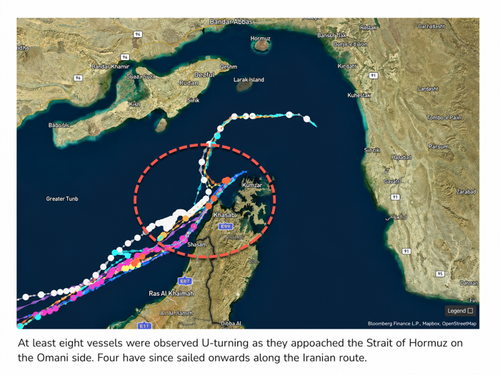
Vessels Reverse Near Hormuz as Iran Directs Traffic and UK-France Announce Navigation Support
Ships reversed course near Hormuz before complying with Iranian routes, coinciding with Tehran's warning against extra-regional naval activity and UK-French readiness statements. Data show traffic recovering but still below prior levels, with floating storage declining as operators test the new constraints. The episode demonstrates Iran's ability to shape passage rules through administrative measures rather than force.
Ship-tracking data recorded the abrupt reversals along the Omani coast on the same day Deputy Foreign Minister Kazem Gharibabadi stated Iran would treat the strait as its security responsibility and monitor extra-regional military movements. UK and French naval statements on freedom-of-navigation operations preceded the Iranian warning by hours. Daily transits remain at 34 vessels, well below pre-disruption averages, while floating storage has already declined to 20 million barrels according to JPMorgan tracking.
Iran's designated lanes shift traffic northward, reducing exposure to Omani-side monitoring while asserting de facto control over passage rules. This follows repeated VHF advisories and aligns with Tehran's long-standing position that coastal states alone guarantee security. Western naval readiness declarations create a direct test of that claim without immediate kinetic contact.
The reversal pattern and subsequent compliance reveal the narrow margin between resumed flows and renewed disruption. JPMorgan data show inbound VLCC queues lengthening and onshore inventories awaiting export, indicating operators are prioritizing clearance over confrontation. Any sustained naval presence by non-littoral powers raises the probability that Tehran will tighten lane enforcement or extend VHF restrictions.
Further escalation hinges on whether UK-French operations remain below the threshold that triggers Iranian interdiction or additional route mandates. Current volumes at 19 million barrels per day suggest operators are absorbing the friction rather than halting trade outright.
JPMorgan: Average daily crude exports through Hormuz will exceed 20 mbd within 14 days if no additional naval transits occur.
Sources (3)
- [1]Iranian Deputy Foreign Minister Statement(https://x.com/KazemGharibabadi)
- [2]Bloomberg Ship-Tracking Data via Marketdesk(https://www.bloomberg.com)
- [3]JPMorgan Commodities Note on Gulf Exports(https://www.jpmorgan.com)