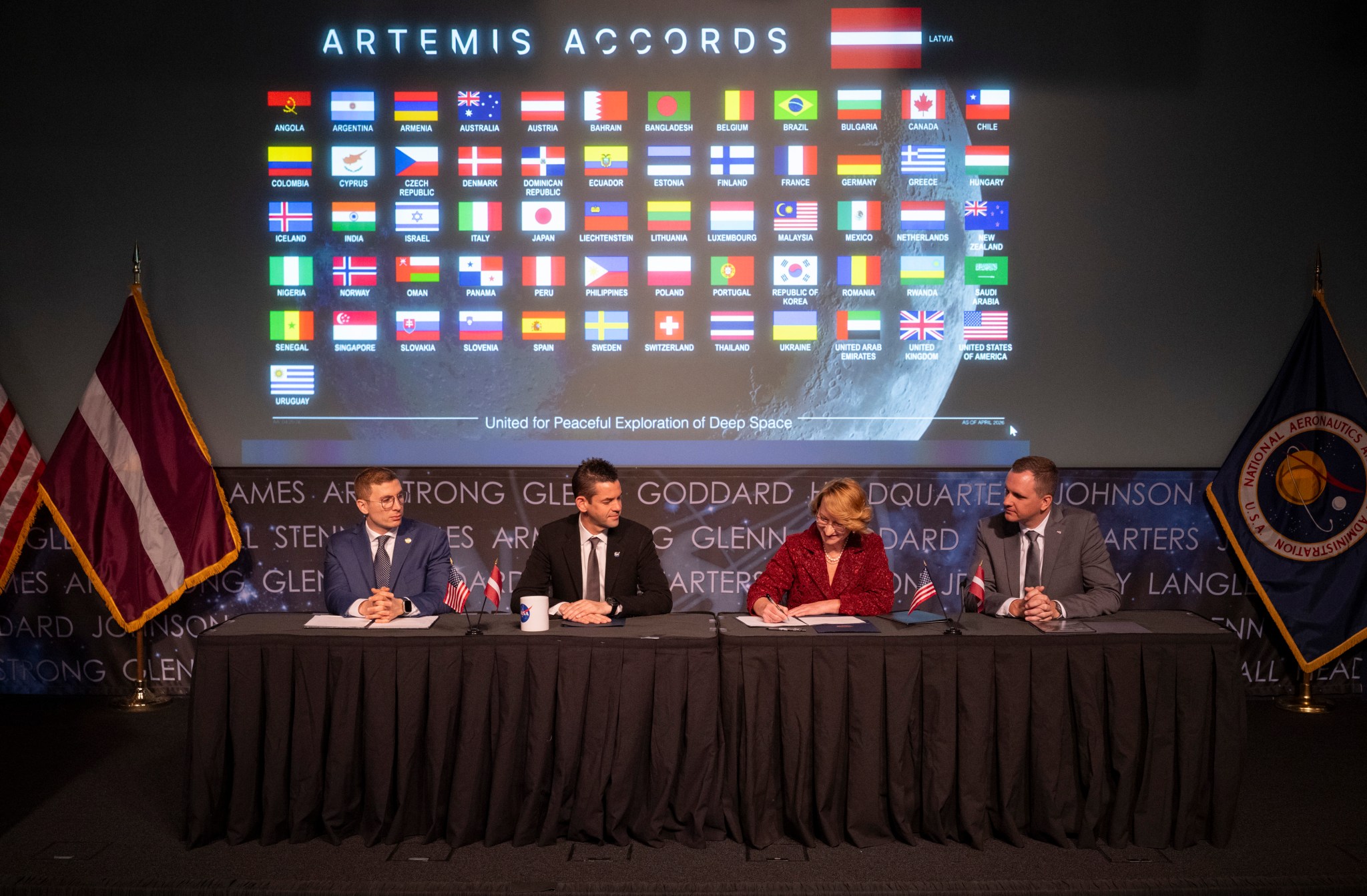
Latvia's Artemis Signing: How a Baltic Nation's Move Reveals Deeper Geopolitical Fault Lines in Space Governance
Latvia's entry as the 62nd Artemis Accords signatory extends U.S.-led space norms into the Baltics, reflecting NATO-like alliance patterns in lunar governance and highlighting an underreported divide with China-Russia space initiatives.
NASA's warm welcome of Latvia as the 62nd Artemis Accords signatory, marked by a Washington ceremony featuring Administrator Jared Isaacman and Latvian Education and Science Minister Dace Melbārde, presents the event as a straightforward win for peaceful exploration. The press release highlights principles like transparency, interoperability, and preservation of heritage sites while noting Latvia's existing contributions to research and education. Yet this official narrative stays surface-level, missing the sharper geopolitical currents that make such expansions strategically vital in 2025.
What the NASA coverage underplays is the Accords' role as a normative counterweight in an emerging space order split by great-power rivalry. Launched in 2020 by the United States and seven partners during the first Trump administration, the Accords now function as de-facto Western standards for lunar resource use, safety zones, and scientific data sharing. They stand in contrast to the China-Russia International Lunar Research Station (ILRS) initiative, which has attracted fewer partners and operates under different interpretations of the 1967 Outer Space Treaty. A 2024 CSIS report on space governance frameworks notes that Artemis signatories now represent more than two-thirds of global GDP, creating a self-reinforcing coalition that sets practical rules Beijing has so far declined to join.
Latvia's accession fits a recognizable post-Cold War pattern. Having regained independence from Soviet rule in 1991 and joined NATO and the EU in 2004, the Baltic state is extending its security alignment into the space domain. This mirrors earlier moves by Estonia and Lithuania, which have used similar commitments to build domestic space sectors in small-satellite technology and data analytics. The original release mentions benefits for Latvian students and innovators but fails to connect this to broader capacity-building strategies smaller nations employ to avoid being sidelined in the new space economy.
Synthesizing the NASA announcement with a 2023 Secure World Foundation policy paper and a recent European Space Policy Institute brief on newer EU member states reveals what is often overlooked: the Accords are accelerating a form of 'normative bloc-building.' Rather than purely scientific, these commitments help codify U.S.-preferred interpretations of issues like space resource utilization that remain contested under existing treaties. Critics have correctly noted the Accords are non-binding political statements, not treaty law, yet their rapid growth from eight to 62 members demonstrates soft-power success in shaping behavior ahead of actual lunar missions.
Geopolitically, Latvia's move signals that space governance is increasingly reflecting terrestrial divisions. With NASA planning sustained lunar presence and commercial partnerships, the coalition's expansion into Eastern Europe adds political legitimacy and distributes technical participation. However, limitations persist: the framework still excludes major space actors, risks fragmenting future multilateral cooperation, and depends on actual mission success that remains years away. As more nations join, the real test will be whether these accords evolve into genuinely inclusive rules or solidify parallel space orders divided along geopolitical lines.
HELIX: Latvia's signing shows smaller Eastern European nations actively choosing U.S.-led space norms to boost tech capacity and align against rival China-Russia frameworks, accelerating a values-based split in how humanity will govern the Moon and beyond.
Sources (3)
- [1]NASA Welcomes Latvia as Newest Artemis Accords Signatory(https://www.nasa.gov/news-release/nasa-welcomes-latvia-as-newest-artemis-accords-signatory/)
- [2]The Artemis Accords and Future Space Governance(https://www.csis.org/analysis/artemis-accords-and-future-space-governance)
- [3]Smaller States and European Space Policy(https://www.espi.or.at/publications/espi-report-85/)