U.S. Hormuz Blockade and China Sanctions: Unpacking Risks to Global Oil Supply Chains and Trade Dynamics
The U.S. is intensifying pressure on Iran via a potential Hormuz blockade and sanctions warnings tied to China’s teapot refineries. Beyond the immediate focus on Tehran, this strategy risks spiking global oil prices, stoking inflation, and straining U.S.-China trade ties. Historical patterns suggest short-term gains but long-term costs to energy stability and diplomacy.
The United States is ramping up its 'maximum pressure' campaign against Iran with a dual strategy: preparing for an extended naval blockade of the Strait of Hormuz and issuing warnings to financial institutions about sanctions risks tied to China's independent 'teapot' refineries. While the original coverage by ZeroHedge highlights the military and economic dimensions of this approach, it overlooks critical broader implications for global oil supply chains, inflationary pressures, and U.S.-China energy relations. This article delves into these underreported risks and contextualizes them within historical patterns of geopolitical energy conflicts.
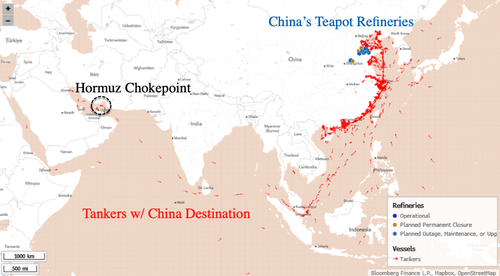
First, the proposed blockade of the Strait of Hormuz, through which roughly 21 million barrels of oil pass daily (about 21% of global oil trade according to the U.S. Energy Information Administration), poses a direct threat to global energy stability. The ZeroHedge report frames this as a targeted move to cripple Iran’s oil revenue, but it misses the potential for cascading effects. A prolonged blockade could spike oil prices, as seen during the 1979 Iranian Revolution when prices doubled amid supply fears. Today, with global markets already strained by post-COVID recovery and OPEC+ production cuts, Brent crude could surge past $100 per barrel, fueling inflation in energy-dependent economies like the EU and India. Moreover, alternative routes such as Saudi Arabia’s East-West Pipeline have limited capacity, and any escalation involving Iran’s proxies (e.g., Houthi attacks in the Red Sea) could further disrupt shipping lanes.
Second, the Treasury Department’s focus on China’s teapot refineries in Shandong Province, which process approximately 90% of Iran’s oil exports, signals a new front in U.S.-China energy tensions. The ZeroHedge piece notes the sanctions warnings but underplays their strategic intent. Beyond pressuring Iran, this move challenges China’s energy security, as teapot refineries account for a significant share of its crude imports. Historical parallels are instructive: during the 2018-2019 U.S.-China trade war, energy commodities like LNG became bargaining chips, with China retaliating via tariffs. Today, with Trump set to meet Xi Jinping, sanctions on refineries could provoke Beijing to diversify away from U.S. financial systems or accelerate de-dollarization efforts through platforms like the Cross-Border Interbank Payment System (CIPS). This risks fracturing global trade mechanisms further.
Third, the original coverage errs in framing this solely as an Iran-focused policy. It misses the domestic U.S. angle: escalating energy prices from a Hormuz blockade could undermine the Trump administration’s economic agenda, particularly if inflation erodes voter confidence ahead of future elections. Additionally, targeting Chinese refineries indirectly pressures U.S. allies like South Korea and Japan, who rely on stable Asian refining capacity for their own energy needs. This could strain diplomatic ties if secondary sanctions disrupt their supply chains.
Synthesizing multiple sources, including the U.S. Treasury’s official press release on sanctions and the Energy Information Administration’s data on Hormuz transit volumes, alongside historical analyses from the International Energy Agency, it’s clear that the U.S. strategy is a high-stakes gamble. While it may economically isolate Iran, it risks alienating China at a time when bilateral cooperation on issues like climate goals (e.g., COP agreements) is already fragile. The pattern of weaponizing energy chokepoints, evident in past U.S. actions like the 1980s tanker war with Iran, suggests that such moves often yield short-term tactical wins but long-term strategic costs, including regional instability and global economic fallout.
Ultimately, the U.S. must weigh whether squeezing Iran justifies the collateral damage to oil markets and trade relations. The ZeroHedge report captures the immediacy of the policy but misses these deeper fault lines. As tensions simmer, the ripple effects of a Hormuz blockade and refinery sanctions could redefine energy geopolitics for years to come.
MERIDIAN: A prolonged Hormuz blockade could push oil prices above $100 per barrel within months, intensifying global inflation. U.S.-China energy tensions may also accelerate Beijing’s push for financial independence from the dollar.
Sources (3)
- [1]U.S. Treasury Press Release on Sanctions Targeting Iranian Shadow Banking and Chinese Refineries(https://home.treasury.gov/news/press-releases)
- [2]U.S. Energy Information Administration: World Oil Transit Chokepoints(https://www.eia.gov/international/analysis/special-topics/World_Oil_Transit_Chokepoints)
- [3]International Energy Agency: Historical Analysis of Oil Market Disruptions(https://www.iea.org/reports)