Fuel Price Shock Ignites EV Demand: A Deeper Look at Market Shifts and Geopolitical Catalysts
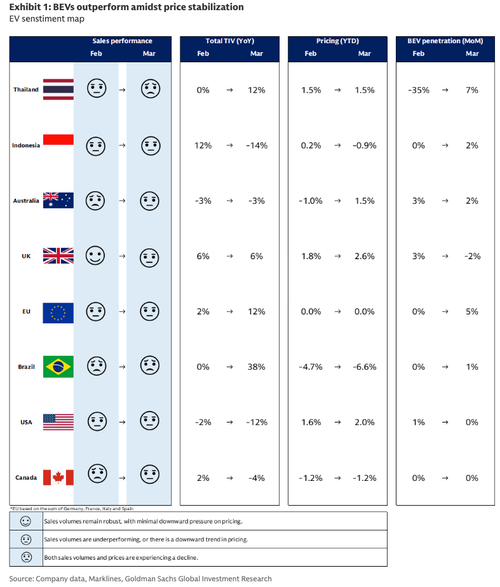
Goldman Sachs reports a surge in global EV demand driven by fuel price shocks, with sales mix rising from 30% to 80% in key markets from January to March. This analysis delves deeper, examining overlooked policy catalysts, supply chain risks, and geopolitical patterns, revealing a more complex electrification landscape.
Goldman Sachs' recent report highlights a resurgence in global electric vehicle (EV) demand, driven by fuel price shocks amid geopolitical tensions, particularly the U.S.-Iran conflict impacting oil supply through the Strait of Hormuz. Analysts led by Kota Yuzawa note that EV sales mix in the top 30 markets rose sharply from 30% in January to 80% in March, signaling a consumer pivot toward electrification as pump prices soar. However, this analysis extends beyond Goldman's observations to explore overlooked dimensions: the interplay of regional policy responses, supply chain constraints, and the broader geopolitical context shaping this trend.
First, while Goldman attributes the EV demand spike primarily to fuel price shocks, it underplays the role of government policies accelerating this shift. In China, for instance, the extension of EV subsidies through 2023 and aggressive targets for new energy vehicle (NEV) adoption—aiming for 50% of new car sales by 2035—have bolstered domestic giants like BYD. Meanwhile, in the European Union, stringent CO2 emission regulations and the planned 2035 ban on internal combustion engine vehicles are pushing consumers toward EVs, even absent immediate fuel price pressures. These policy frameworks, combined with energy shocks, create a dual catalyst that Goldman’s report does not fully address.
Second, the report misses critical supply chain bottlenecks that could temper this EV demand surge. The global semiconductor shortage, compounded by lithium and cobalt price volatility, poses risks to scaling production. For example, Tesla and BYD, while benefiting from rising demand for automotive batteries and energy storage systems (ESS), face upstream constraints that could delay deliveries and inflate costs. A 2022 International Energy Agency (IEA) report warned that battery metal supply chains are vulnerable to geopolitical disruptions, particularly in regions like the Democratic Republic of Congo, which supplies 70% of global cobalt. This fragility, ignored in Goldman’s optimism, could hinder the electrification boom if not addressed by diversified sourcing or recycling innovations.
Geopolitically, the fuel price shock tied to the Hormuz chokepoint underscores a broader pattern of energy insecurity driving sustainable transitions. Historical parallels, such as the 1973 OPEC oil embargo, show how energy crises often catalyze long-term shifts in consumer behavior and policy—yet Goldman’s analysis stops at short-term demand spikes without connecting to this trend. The current crisis, with Brent and WTI forecasts revised upward to $83 for Q4 by Goldman’s commodity team, mirrors past shocks that spurred renewable energy investments. However, the likelihood of a U.S.-Iran peace deal or Hormuz reopening remains speculative, and prolonged tensions could entrench higher oil prices, further accelerating EV adoption but also risking economic slowdowns that curb consumer spending on big-ticket items like vehicles.
Regionally, Goldman’s focus on markets like Thailand, India, and China reveals varied drivers of electrification. In Thailand, hybrid electric vehicles (HEVs) gain traction alongside battery EVs (BEVs), reflecting a pragmatic consumer base prioritizing fuel efficiency over full electrification—a nuance suggesting that pure EV dominance is not guaranteed. In India, rising natural gas prices threaten compressed natural gas (CNG) vehicle sales for companies like Maruti Suzuki, yet the government’s push for EV infrastructure remains nascent, potentially slowing the transition. These disparities highlight a fragmented global EV landscape that Goldman’s bullish outlook oversimplifies.
Synthesizing these insights, the EV demand resurgence is not merely a reaction to fuel prices but a complex outcome of policy, geopolitics, and supply dynamics. While Goldman’s data on sales mix growth is compelling, it risks over-optimism by neglecting structural challenges and regional variations. The fuel shock may indeed be a ‘jolt’ to electrification, as the report quips, but sustaining this momentum requires navigating a minefield of supply chain risks and geopolitical uncertainties—factors that will shape whether this trend is a fleeting spike or a transformative shift.
MERIDIAN: The EV demand surge may persist into 2024 if fuel prices remain elevated, but supply chain constraints, especially in battery metals, could cap growth unless addressed by policy or innovation.
Sources (3)
- [1]Resurgence Of Electrification: Goldman Says EV Demand Gaining Momentum Amid Fuel Price Shock(https://www.zerohedge.com/markets/resurgence-electrification-goldman-says-ev-demand-gaining-momo-amid-fuel-price-shock)
- [2]IEA Report: The Role of Critical Minerals in Clean Energy Transitions(https://www.iea.org/reports/the-role-of-critical-minerals-in-clean-energy-transitions)
- [3]European Commission: Fit for 55 - Delivering the EU's 2030 Climate Target(https://ec.europa.eu/info/strategy/priorities-2019-2024/european-green-deal/delivering-european-green-deal_en)