The $2,000 Mortgage Threshold: Unmasking America's Structural Housing Affordability Crisis
Average U.S. mortgage payments surpassed $2,000 in late 2025 amid a 44% rise since 2021, reflecting not just high rates but a chronic, systemic housing supply shortage that is blocking generational wealth building for younger Americans and deepening inequality.
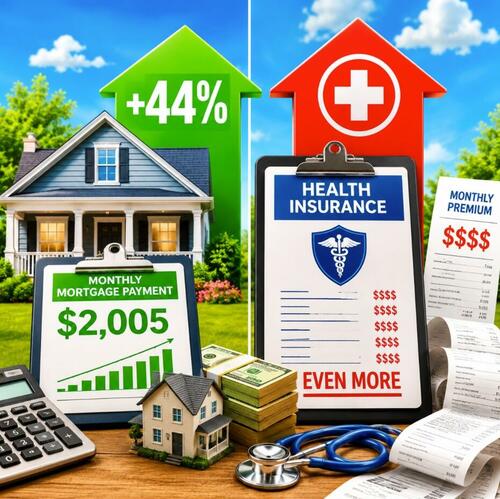
For the first time in history, the average monthly mortgage payment on existing U.S. home loans has exceeded $2,000, hitting $2,005 in Q4 2025 according to Realtor.com's quarterly outstanding mortgage data. This represents a 44% surge since 2021 and an increase of more than $600 in just three years, driven by the toxic combination of elevated home prices and mortgage rates that have refused to normalize. While mainstream coverage often portrays high borrowing costs as a transient effect of post-pandemic monetary policy, the underlying drivers are deeply structural: decades of chronic underbuilding, restrictive zoning, NIMBY local governance, and regulatory barriers that have rendered housing supply dangerously inelastic.
Realtor.com's research reveals a national housing supply gap now exceeding 4 million units as of 2025, with 1.8 million 'missing' millennial and Gen Z households who have been priced out of independent household formation. Harvard's Joint Center for Housing Studies 2025 report underscores the severity, noting that affording a median-priced home now requires an annual income of at least $126,700 in many markets—up dramatically in recent years—with home prices sitting at five times median household income. This is not a blip; it is the culmination of supply-side failures that Brookings Institution scholars trace to local control over permitting, which prevents new construction from responding to price signals.
The implications for generational wealth are profound and underappreciated. Homeownership has historically been the primary mechanism for middle-class wealth accumulation through equity building and appreciation. As payments cross this symbolic $2,000 threshold, younger cohorts face delayed or permanently deferred entry into the market, with the median first-time buyer age reaching 40. NAHB data shows nearly 60% of U.S. households cannot afford even a $300,000 home, while CBRE analysis highlights how price-to-income ratios have reached all-time highs. IMF reporting confirms this as among the worst affordability crises in over a decade. Rather than a temporary squeeze, these trends signal a bifurcated economy: existing homeowners (often older, wealthier) enjoy locked-in low rates from prior eras, while new entrants and renters subsidize an increasingly extractive system. Without aggressive supply-side reforms—upzoning, streamlined permitting, and reduced regulatory overhead—this crisis will compound inequality, erode social mobility, and redefine the American Dream as inaccessible for all but high earners. The data from multiple independent analyses paint a consistent picture: what is framed as a rates problem is fundamentally a supply and governance failure with multi-generational consequences.
LIMINAL: Crossing $2k monthly payments cements a two-tier economy where homeownership shifts from a broad wealth ladder to an exclusive asset class for the already propertied, permanently tilting generational wealth transfer toward older cohorts and accelerating inequality unless supply constraints are dismantled.
Sources (5)
- [1]Average Mortgage Payment Hits Historic New High, Topping $2K(https://www.realtor.com/news/trends/homeowners-monthly-mortgage-payments-april-2026-report/)
- [2]The State of the Nation's Housing 2025(https://www.jchs.harvard.edu/sites/default/files/reports/files/Harvard_JCHS_The_State_of_the_Nations_Housing_2025.pdf)
- [3]Thinking about the growing housing affordability problem(https://www.brookings.edu/articles/thinking-about-the-growing-housing-affordability-problem/)
- [4]Digging Out of the U.S. Housing Affordability Crisis(https://www.cbreim.com/insights/articles/digging-out-of-the-us-housing-affordability-crisis)
- [5]Housing Supply Gap Exceeds 4 Million Homes in 2025(https://www.realtor.com/research/us-housing-supply-gap-2026/)