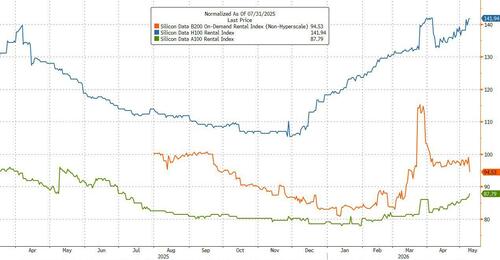
CME's AI Compute Futures: Financializing the Backbone of the Digital Economy
CME Group's launch of AI compute futures, in partnership with Silicon Data, introduces a novel financial instrument to hedge against volatility in computing power, a critical resource for AI. Beyond market efficiency, this move raises geopolitical concerns, risks speculative bubbles, and could widen access inequalities—issues initial reports missed. Analysis draws on U.S. export controls and energy consumption data to highlight broader implications.
The launch of futures contracts for AI compute by CME Group, in partnership with Silicon Data, marks a pivotal moment in the financialization of emerging technologies. As reported by ZeroHedge, these futures aim to address the volatility and price swings in computing power—a critical resource for AI development—by providing a hedging mechanism for traders, AI builders, and cloud providers. CME CEO Terry Duffy's assertion that 'compute is the new oil of the 21st century' underscores the growing recognition of computing power as a tradable asset class akin to traditional commodities like oil or gold. However, this development raises deeper questions about the implications of treating compute as a commodity, the potential impact on AI infrastructure investment, and the broader geopolitical and economic patterns it reflects.
Beyond the initial coverage, this move by CME signals a profound shift in how technological resources are integrated into global financial markets. Computing power, driven by the explosive demand for AI training through GPUs (graphics processing units), has become a scarce and strategic asset. The Silicon Data H100 Rental Index, which tracks hourly GPU rental costs, provides a benchmark for pricing—a transparency measure that ZeroHedge notes as a step toward market efficiency. Yet, what the original coverage misses is the potential for this financial instrument to exacerbate existing inequalities in access to compute resources. Smaller AI startups or research institutions, already struggling with the high costs of GPU access, may find themselves priced out as institutional investors and large tech firms dominate futures trading to secure capacity.
This development also intersects with broader geopolitical trends. The global race for AI supremacy, particularly between the United States and China, has made compute a national security concern. The U.S. government's export controls on advanced semiconductors to China, as detailed in the U.S. Department of Commerce's October 2022 restrictions, highlight how access to compute is not merely a market issue but a strategic one. By financializing compute, CME's futures could inadvertently amplify these tensions, as countries or corporations with capital to invest in futures contracts may secure disproportionate control over global AI infrastructure. ZeroHedge did not address this geopolitical dimension, focusing instead on the market mechanics of the futures launch.
Moreover, the historical parallel to the commoditization of other critical resources offers a cautionary lens. Just as oil futures reshaped energy markets in the 20th century—often leading to speculative bubbles and geopolitical conflicts, as seen in the 1973 OPEC crisis—compute futures could introduce similar volatility into the tech sector. The CME's initiative may drive investment in data centers and GPU production, but it also risks creating a speculative market detached from the actual needs of AI developers. This pattern is reminiscent of the early days of cryptocurrency futures, where price speculation often outpaced practical utility, as evidenced by the 2017 Bitcoin futures launch on CME itself.
Synthesizing multiple perspectives, the futures market for compute could be a double-edged sword. On one hand, as BlackRock CEO Larry Fink noted in recent statements, the scarcity of compute justifies its emergence as a new asset class, potentially unlocking capital for infrastructure growth. On the other, the financialization of a resource so central to innovation raises ethical questions about access and control, which neither ZeroHedge nor other initial reports have fully unpacked. The U.S. Energy Information Administration's 2023 report on data center energy consumption further contextualizes the stakes, revealing that data centers powering AI workloads already account for nearly 2% of U.S. electricity usage—a figure set to rise with increased compute demand. Financial instruments like futures could either stabilize or destabilize this critical sector, depending on how they are regulated and adopted.
In conclusion, while CME's launch of AI compute futures is a groundbreaking step toward integrating technology into commodity markets, it is not without risks. The interplay of market dynamics, geopolitical strategy, and technological access will shape whether this innovation fosters equitable growth or entrenches power imbalances. Future analysis must monitor how these contracts influence AI development and whether regulatory frameworks can mitigate speculative excesses—a dimension overlooked in the initial coverage.
MERIDIAN: The introduction of AI compute futures by CME could accelerate investment in data centers over the next 3-5 years, but speculative trading may drive price volatility, mirroring patterns seen in early cryptocurrency markets.
Sources (3)
- [1]CME Launching Futures Market For AI Compute(https://www.zerohedge.com/markets/cme-launching-futures-market-ai-compute)
- [2]U.S. Department of Commerce Export Controls on Advanced Semiconductors(https://www.bis.doc.gov/index.php/documents/about-bis/newsroom/press-releases/3158-2022-10-07-bis-press-release-advanced-computing-and-semiconductor-manufacturing-controls-final/file)
- [3]U.S. Energy Information Administration: Data Center Energy Consumption(https://www.eia.gov/todayinenergy/detail.php?id=54299)